Decoding The Rolex Crown: What Its Markings Mean
Rolex's coronet is the world's most recognised logo, but the tiny crown beneath it, dots, dashes and all, tells a far more interesting technical story
There exists, tucked into the vast and occasionally impenetrable lexicon of horology, a small object that manages to be simultaneously the most photographed and least understood component on the world’s most recognisable watch. The Rolex crown. It is easy, when confronted with a Submariner or a Datejust, to let one’s gaze drift admiringly to the dial and the bezel, and grant the crown little more than a cursory nod, as one might a doorman while sweeping into a rather grand hotel. This would be a mistake of some consequence, for the crown is, in fact, the watch’s principal gatekeeper, the device by which one winds the mainspring, sets the time and date, and, on every modern Rolex Oyster, seals the case against the intrusions of water, dust and the general indignities of daily life. It is, to borrow a phrase, small in stature but positively Churchillian in importance, and Rolex, being Rolex, has contrived to hide within its tiny surface an entire coded language.
The Coronet: A Logo With Five Points and a Purpose
Before we descend to the crown’s more technical markings, a word on the coronet itself, that five-pointed emblem first registered as a trademark in 1925, a mere two decades after Hans Wilsdorf and Alfred Davis founded the company in London. Tradition holds that each of its five points corresponds to a pillar of watchmaking excellence: precision, quality, waterproofness, self-winding capability and aesthetic perfection. It is, in other words, not mere heraldic flourish but a rather tidy summary of everything the brand claims to stand for, worn quite literally on the sleeve.
Also Read: Rolex Unites Four One-of-One Cosmograph Daytonas For A Landmark Charity Auction
Twinlock and Triplock: Rolex’s Sealing Systems

Beneath that coronet sits the winding crown proper, and it is here that Rolex‘s engineering ambitions become genuinely interesting. In 1926, the brand introduced the Oyster case, patenting a screw-down crown that sealed against the case much as a submarine hatch seals against the sea, a genuinely revolutionary idea for its time. This concept was refined in 1953 into what Rolex calls the Twinlock system, employing two independent sealing points, one within the crown and another within the case tube, sufficient for water resistance up to 100 metres and entirely adequate for a rain shower, a swim, or an unexpectedly enthusiastic handshake.

For those requiring rather more serious protection, Rolex unveiled the Triplock system in 1970 alongside the Sea-Dweller, adding a third sealed zone, two O-ring gaskets positioned within the tube and a third beneath the crown itself, and pushing water resistance to depths ranging from 300 to a frankly absurd 3,900 metres. Today, Triplock crowns are found on the brand’s professional and diving references, the Submariner, Daytona, GMT-Master II and Yacht-Master among them, while Twinlock crowns continue to serve the Datejust, Day-Date, Oyster Perpetual, Explorer, Sky-Dweller and Land-Dweller collections.
Also Read: Rolex Models That Almost Disappeared: Rare Watches You Should Know
Reading the Dots: A Code Hiding in Plain Sight
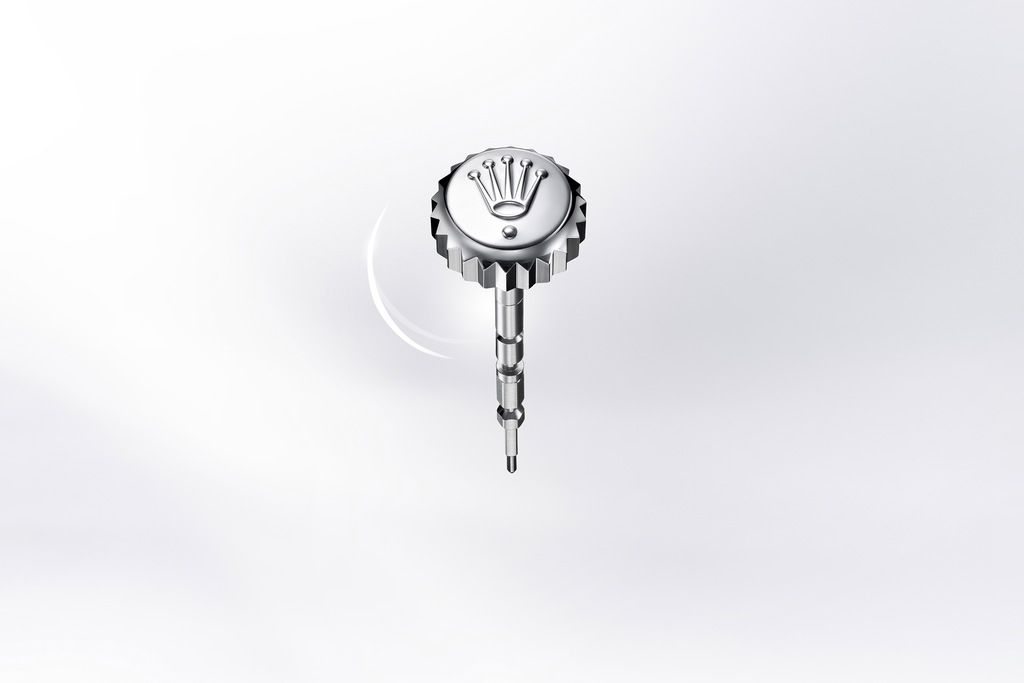
Here is where matters turn genuinely delightful. Examine the crown of a modern Rolex under a loupe, and just beneath the coronet you will find a tiny dash, one dot, two dots or three, an unassuming little code that discloses both the crown system fitted and, in many cases, the metal from which the crown itself is made. A dash typically denotes steel. Two dots indicate gold of any hue, yellow, Everose or white. A single dot signals platinum. On some references, this scheme is expressed slightly differently, with three evenly sized dots for steel, a larger central dot for gold, and larger dots flanking a smaller centre for platinum. It bears mentioning that crown sizes and production eras can render these markings somewhat inconsistent, and service crowns, swapped during routine maintenance, do not always perfectly match the original specification, so treat the dots as a helpful clue rather than an infallible oracle.
A Small Object Carrying Considerable Weight
What emerges from all this, I think, is a rather charming illustration of Rolex’s broader philosophy: that even the most modest component deserves the same obsessive attention as the dial or the movement. The crown is neither decorative afterthought nor mere winding mechanism; it is a coded, engineered statement of intent, disguised as something one might absentmindedly twist shut on the way out the door. The next time you find yourself examining a Rolex, do resist the temptation to look only at the face. The real conversation, appropriately enough, is happening at the side.