Patek Philippe Ref. 3970 Sells For CHF 2Million At Sotheby’s Auction
The first numbered example of the Ref. 3970, dating to 1986, achieved CHF 2,048,000 at Sotheby’s Geneva, setting a new auction benchmark for the yellow gold perpetual calendar chronograph
The theatre of a great watch auction is rarely confined to the moment the hammer falls. There is the anticipation before the sale, the careful examination of an object that has survived decades, the quiet calculations of collectors and, finally, the bidding that determines how history will remember it. At Sotheby’s Geneva, one such moment unfolded around a Patek Philippe Ref. 3970. Presented as the first numbered example of the celebrated reference, this 1986 yellow gold timepiece achieved CHF 2,048,000, establishing a new auction benchmark for a yellow gold example of the model. Yet the significance of the result extends beyond the figure itself. It is a story about rarity, provenance, mechanical ambition and the enduring fascination with watches that occupy an important place in the history of modern horology. Known among collectors as ‘The First 3970’, the watch carries an unusual distinction. Manufactured in 1986, it is the earliest numbered yellow gold example of a reference that would become one of Patek Philippe’s most recognisable perpetual calendar chronographs. Its place at the beginning of the 3970 story gives it a historical importance that is difficult to replicate. While later examples belong to an established production lineage, this particular watch represents the opening chapter of a new generation of complicated wristwatches from the Geneva manufacture.
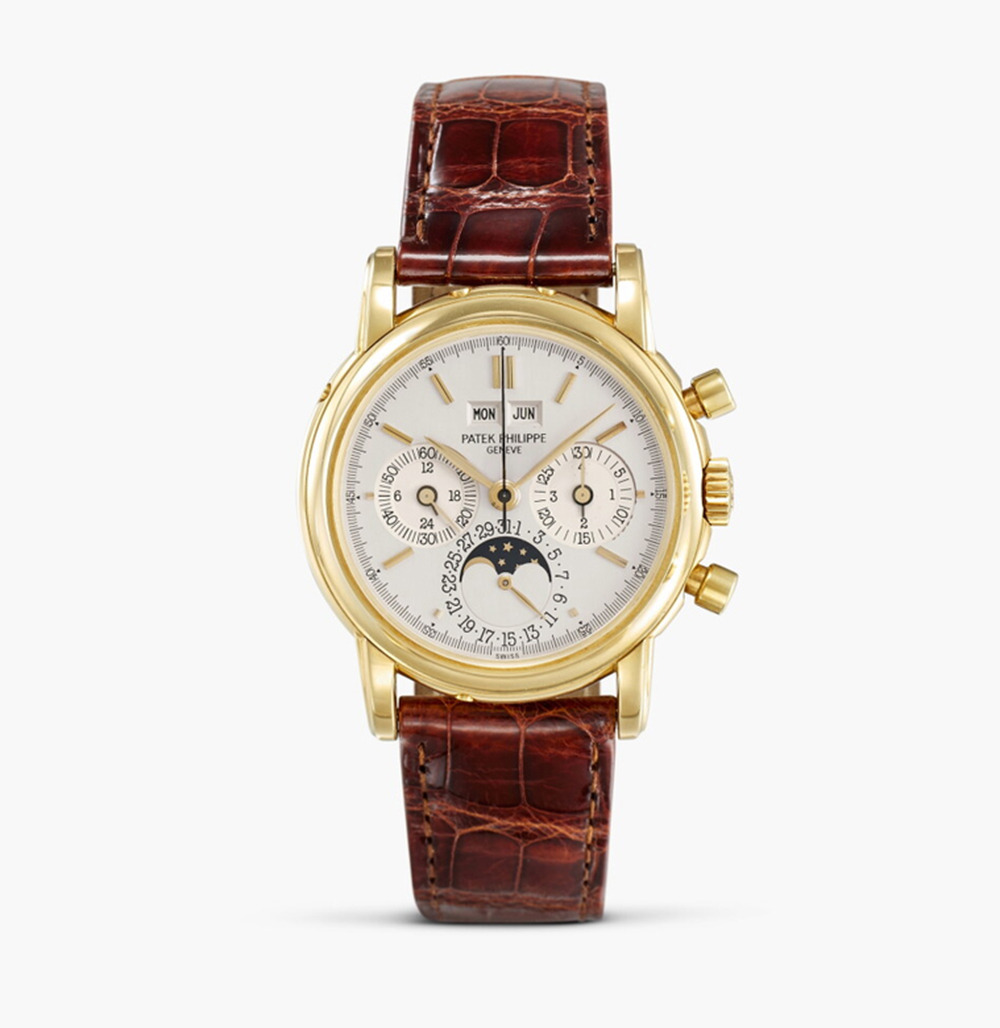
The Ref. 3970 was introduced in 1986 as the successor to the celebrated Ref. 2499. That was no small responsibility. The 2499 had already secured its position among the most important perpetual calendar chronographs ever produced, and its successor needed to preserve that heritage while moving the complication forward. Patek Philippe approached the challenge with a watch that brought together a perpetual calendar, chronograph, moon phases and leap year indication in a remarkably balanced 36.2mm case. The earliest production examples are especially interesting to collectors. The first series, believed to have been produced for approximately two years, is thought to comprise around 100 watches. These early pieces can be distinguished by their snap-on casebacks, a construction that preceded the screw-down caseback introduced with the second series. The later watches also carried the ‘3970E’ designation, with the additional letter referring to the French term étanche, meaning water-resistant. Such distinctions may appear modest to an untrained eye, but in the world of vintage Patek Philippe collecting, the smallest production details can carry considerable historical and financial significance.
Also Read: Five Racing Chronographs That Bring Motorsport Heritage To Your Wrist
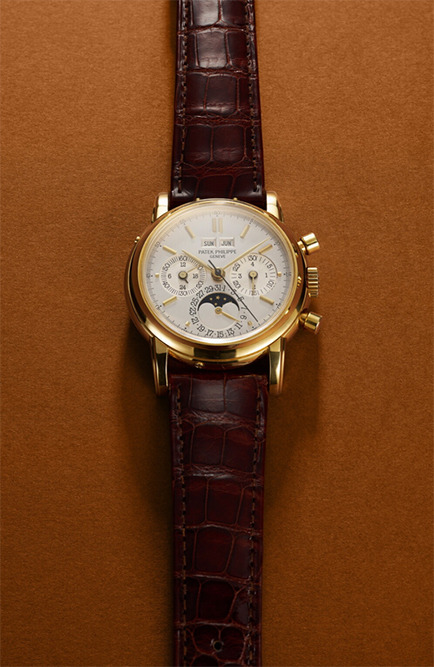
The example sold at Sotheby’s offers an opportunity to examine these early characteristics in detail. Its 18k yellow gold case measures 36.2mm across and retains the proportions that made the Ref. 3970 such an elegant interpretation of a highly complicated watch. The case is complemented by a silvered dial, where the information is arranged with an almost architectural sense of order. Applied rectangular yellow gold hour markers sit around the perimeter, accompanied by delicate feuille-shaped hands. The result is a dial that communicates considerable mechanical complexity without appearing crowded. At 12 o’clock, two apertures display the day and month, while the lower half of the dial houses the date and moon phase indication. The subsidiary displays provide constant seconds, a 30-minute chronograph counter, leap year indication and a 24-hour display. Each element has a defined purpose, yet the composition remains remarkably composed. This balance between utility and restraint is central to the appeal of the Ref. 3970. It is a watch designed to perform several demanding functions without allowing its complications to overwhelm its appearance.
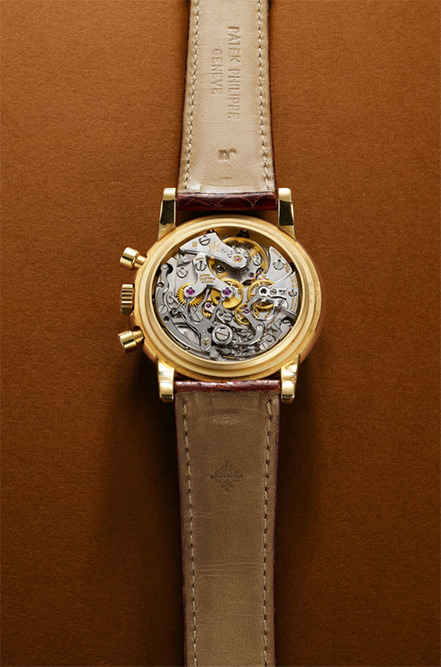
Powering the timepiece is the manually wound calibre 27-70 Q, a movement based on the Lemania 2310 architecture and extensively modified and finished by Patek Philippe. The calibre contains 24 jewels and reflects the manufacture’s approach to transforming an established movement platform into a high-grade complicated mechanism. Its perpetual calendar accounts for the varying lengths of the months and leap years, while the chronograph adds another layer of mechanical sophistication. The combination also continues a distinguished lineage established by the Ref. 1518 and Ref. 2499, two models that helped define the perpetual calendar chronograph as one of the most desirable expressions of traditional Swiss watchmaking. The watch’s documentation further strengthens its appeal. It was offered with its Certificate of Origin, an Extract from the Archives to be received, a presentation case, a reference dossier and a Tortella & Sons passport. Its movement number, 875’000, and case number, 2’824’130, provide additional identifying details. The final three digits of the case number are repeated inside the case, matching the number on the caseback. Sotheby’s also highlighted the condition of the case, noting the strength of its hallmarks, the crispness of its definition and the preservation of its lug fluting.
Also Read: Grand Prix d’Horlogerie de Genève 2026: The Complete List Of Winners
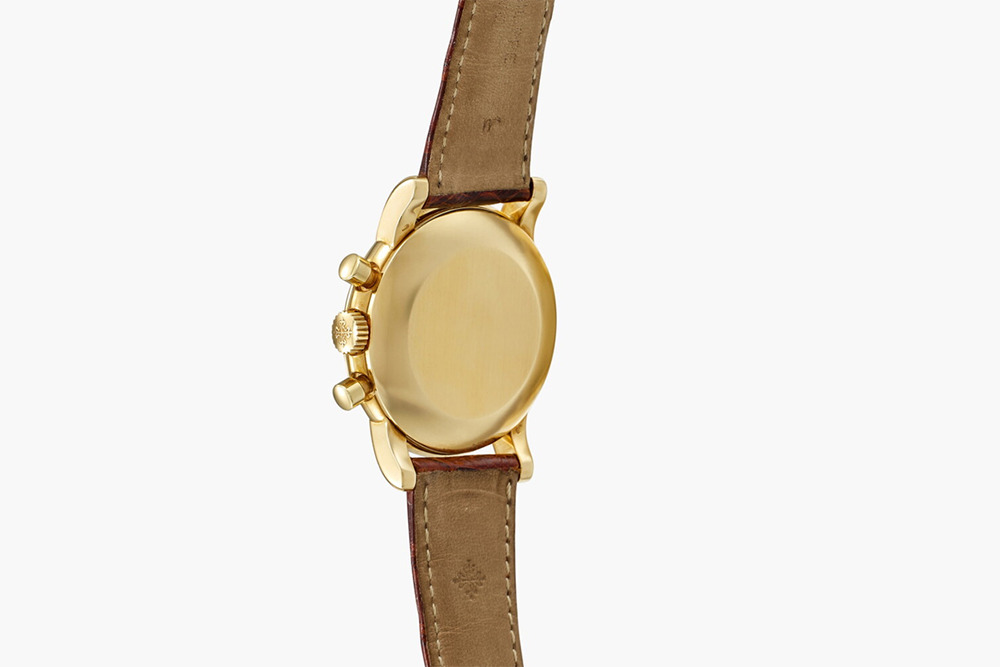
For collectors, condition and originality are only part of the equation. The identity of a watch, its position within a reference’s production history and the completeness of its accompanying material can all influence its desirability. In this instance, the combination of an exceptionally early production date, the snap-on caseback, its documented numbers and its place as the first numbered example creates a particularly compelling proposition. The CHF 2,048,000 result at Sotheby’s Geneva therefore represents more than a successful auction. It is a recognition of the Ref. 3970’s place in Patek Philippe’s complicated watchmaking history, and of the extraordinary appeal that an important first example can hold for the collecting community. Nearly four decades after its manufacture, the watch remains an elegant demonstration of how technical ambition and visual restraint can coexist. Its auction appearance has given collectors another reason to revisit the reference, while reminding the wider watch world that, sometimes, the most consequential detail is not a complication or a precious metal case. It is the number that tells you where a watch belongs in history.