IWC x Mercedes-Benz: A Limited-Edition Big Pilot’s Watch Marks 140 Years of Mercedes-Benz
As Mercedes-Benz celebrates 140 years of innovation, IWC proves the relationship between cars and watches has never really been about sponsorship but about the same old obsession with making complicated things work beautifully
Legacy is a funny thing. Everyone wants it, preferably embossed on something expensive and accompanied by a photograph of a founder looking stern. But genuine legacy is rather harder to manufacture. It comes from doing the same thing for a very long time, getting better at it and occasionally changing the world along the way. That is precisely what makes the relationship between the automobile and the mechanical watch so fascinating. Both industries were born from the same Victorian obsession with engineering things that move, both transformed the way humans travelled through the world and both have spent the past century turning mechanical necessity into an object of desire. So when Mercedes-Benz celebrates 140 years of innovation and IWC Schaffhausen marks the occasion with a new limited edition, this is not simply a watch company putting a famous car badge on a dial. It is two engineering cultures recognising that they have been speaking essentially the same language for generations.
Two Industries, One Obsession
The modern automobile began with Carl Benz filing the patent for his motorwagen in 1886, followed shortly afterwards by Gottlieb Daimler’s motorised carriage. The wristwatch, meanwhile, was evolving from a practical instrument into something that could be carried everywhere, and mechanical watchmaking was becoming an increasingly sophisticated exercise in miniaturisation. Both industries were attempting essentially the same trick: take an extraordinary number of tiny components, persuade them to work together with almost absurd precision and then make the whole thing reliable enough that an ordinary human being can use it without needing an engineering degree. The car gave us mobility; the watch gave us control over time. Eventually, both became something more. They became expressions of performance, craftsmanship and design. A beautifully engineered engine and a beautifully engineered movement may operate on entirely different scales, but the mentality behind them is remarkably similar. The fascination lies not merely in what they do, but in how they do it.
Also Read: Why IWC Is One Of The Most Respected Swiss Watchmakers
Where Mercedes-Benz And IWC Found Common Ground
That shared obsession is at the heart of the relationship between IWC and Mercedes-AMG, which began in 2004. The partnership developed from a common interest in engineering, performance and design, and in 2013 IWC became the Official Engineering Partner of the Mercedes-AMG PETRONAS Formula One Team. Since then, the relationship has produced special edition watches, motorsport experiences and collaborations inspired by some of Mercedes-Benz’s most recognisable machines, including the legendary G-Class. Customers have also been taken beyond the showroom and into the world of motorsport, from Formula One races to the gruelling 24 Hours of Nürburgring, as well as behind the wheel of Mercedes-AMG’s most powerful sports cars. And this is where the relationship makes sense. A watch and a sports car may sit on opposite ends of the engineering spectrum, but both are ultimately machines designed to make performance feel tangible.
A Big Pilot For A Big Anniversary
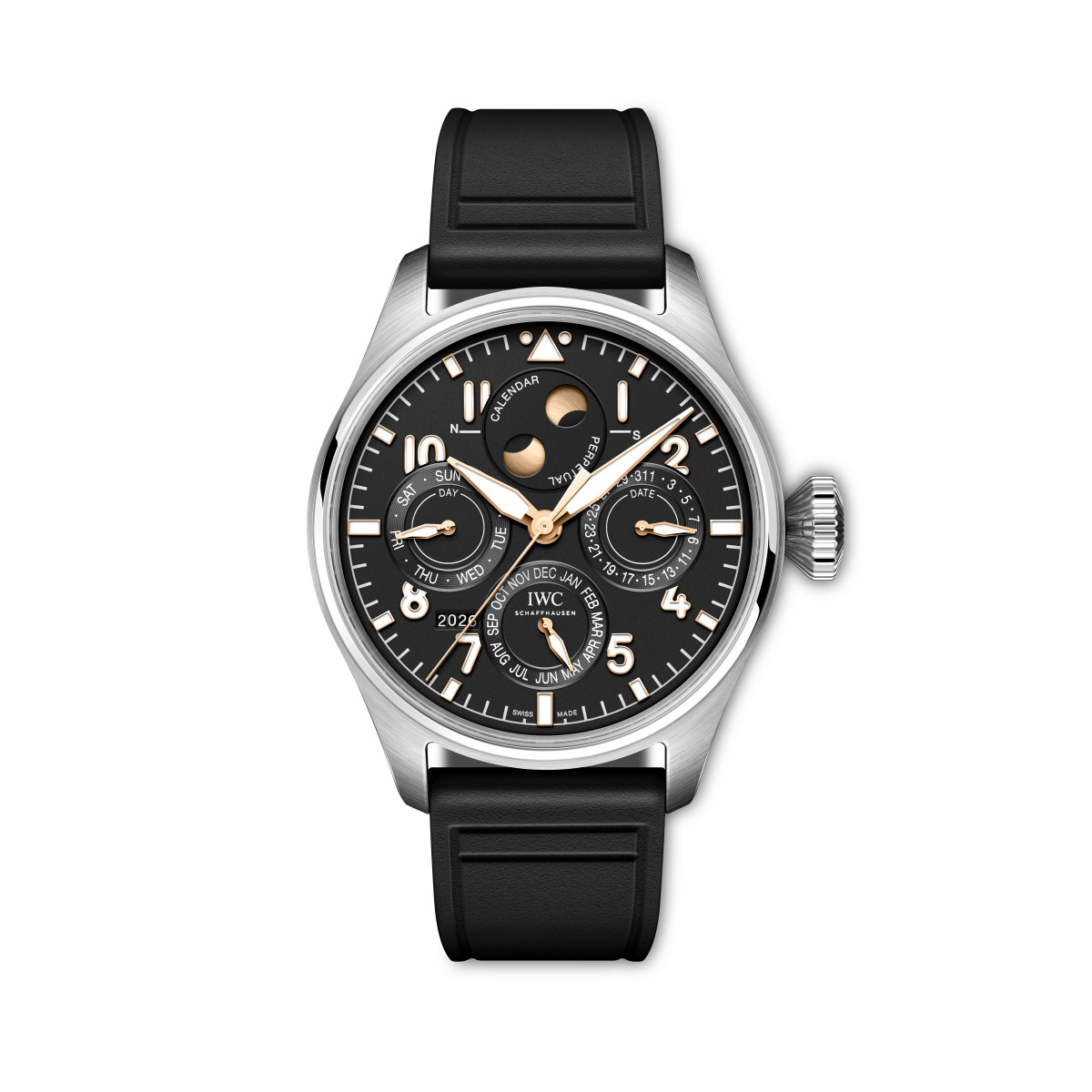
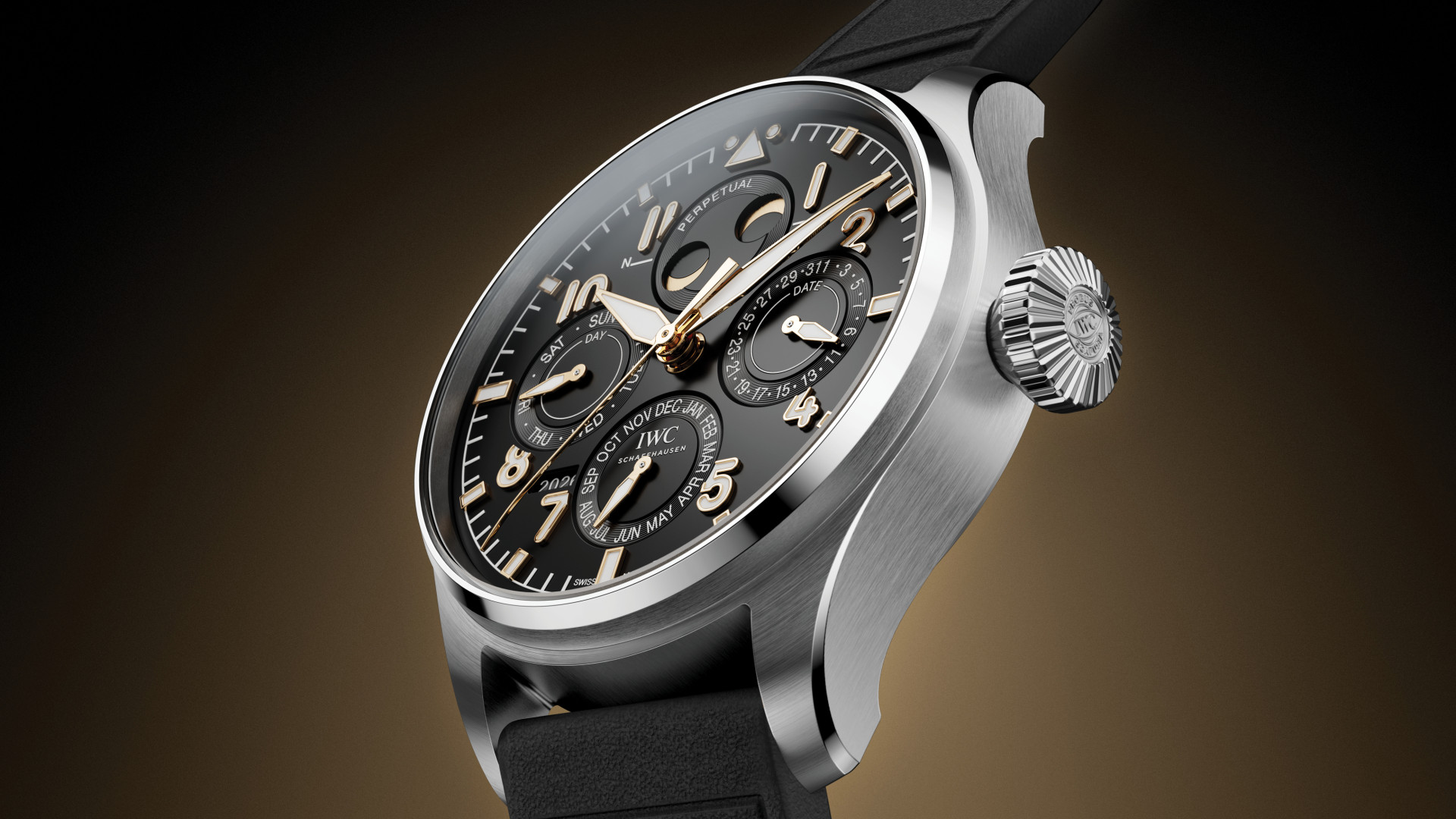
To celebrate Mercedes-Benz’s 140th anniversary, IWC has created the Big Pilot’s Watch Perpetual Calendar ProSet 140 Years Mercedes-Benz, Ref. (IW329603). Limited to just 140 pieces, the watch is essentially a miniature celebration of the two companies’ shared engineering DNA. Its 42mm stainless steel case combines brushed and polished surfaces with a polished bezel with an oversized onion crown at 3 o’clock. The black dial is paired with solid gold hour markers and gold-plated hands. The minute track is printed in white for clarity, maintaining the highly legible character expected of a Big Pilot. The real reason this watch exists, however, is not the logo. It is the mechanism. IWC’s new Perpetual Calendar ProSet is one of the company’s most significant developments in mechanical calendar technology in decades, and it addresses one of watchmaking’s more irritating problems.
Traditionally, adjusting a perpetual calendar can involve pushers, different crown positions and enough patience to make you question whether you really needed to know the date in the first place. The ProSet takes a considerably more civilised approach. Using a new gear-based mechanism protected by four patents, the calendar can be adjusted forwards and, for the first time in an IWC perpetual calendar, backwards using a single crown position. In other words, setting the calendar becomes almost as intuitive as setting the time. This is exactly the sort of engineering innovation that both Mercedes-Benz and IWC understand: hide the complexity and make the user experience beautifully simple.
Making The Complicated Look Easy
Of course, making something complicated look easy is one of the oldest tricks in engineering. The ProSet mechanism is based entirely on gears and uses components with intricate geometries manufactured through LIGA, an advanced microstructuring process involving lithography and electroforming. What appears on the wrist to be a straightforward adjustment is therefore the result of some decidedly complicated manufacturing. The perpetual calendar displays the date subdial at 3 o’clock, the month subdial at 6 o’clock, the day of the week subdial at 9 o’clock, and the moonphase at 12 o’clock, while the four-digit year display sits at 7:30. IWC’s Double Moon display also shows the lunar cycle for observers in both hemispheres, while the 82665 calibre provides a 60-hour power reserve through its bidirectional Pellaton automatic winding system, reinforced with ceramic components.
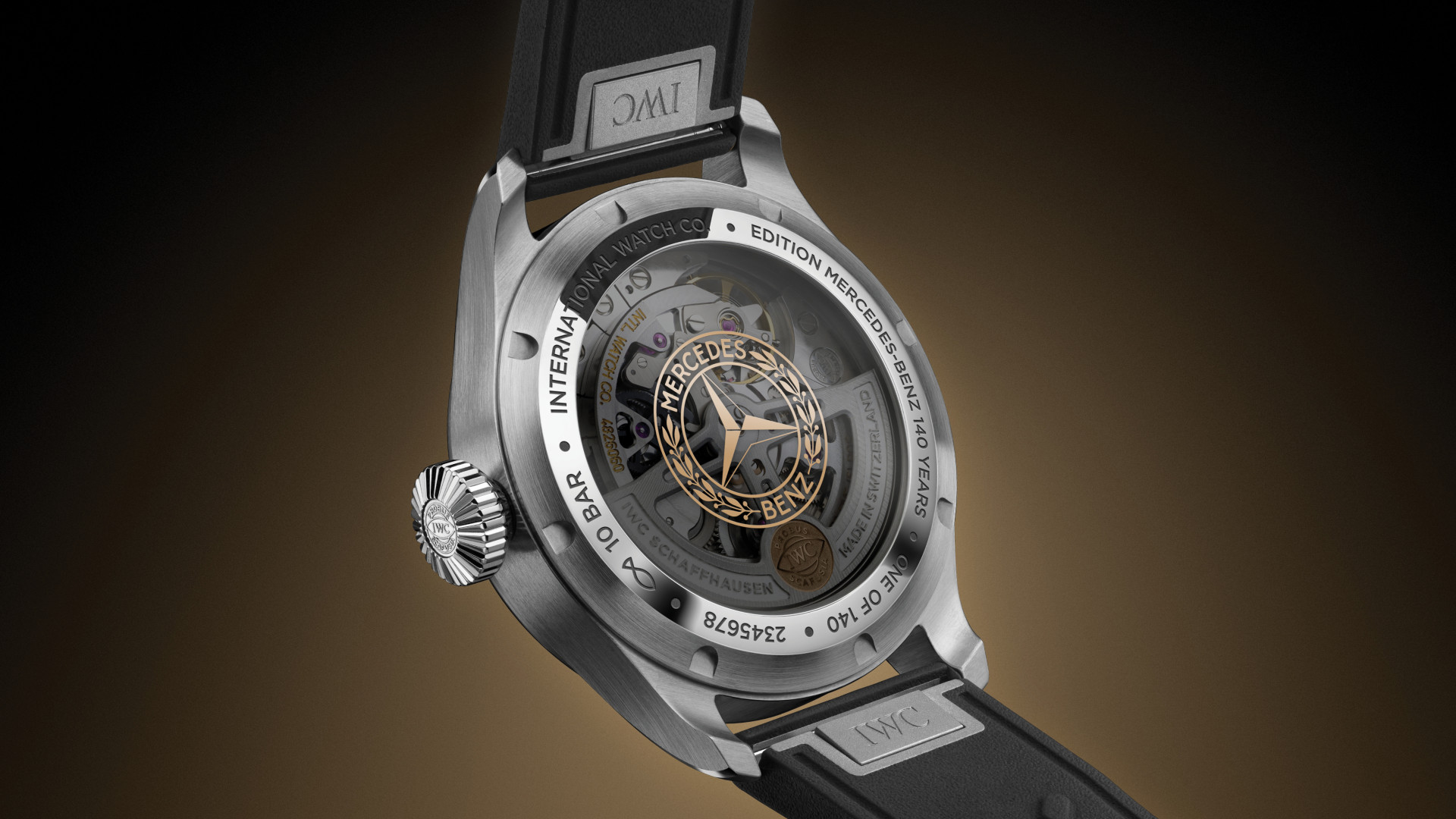
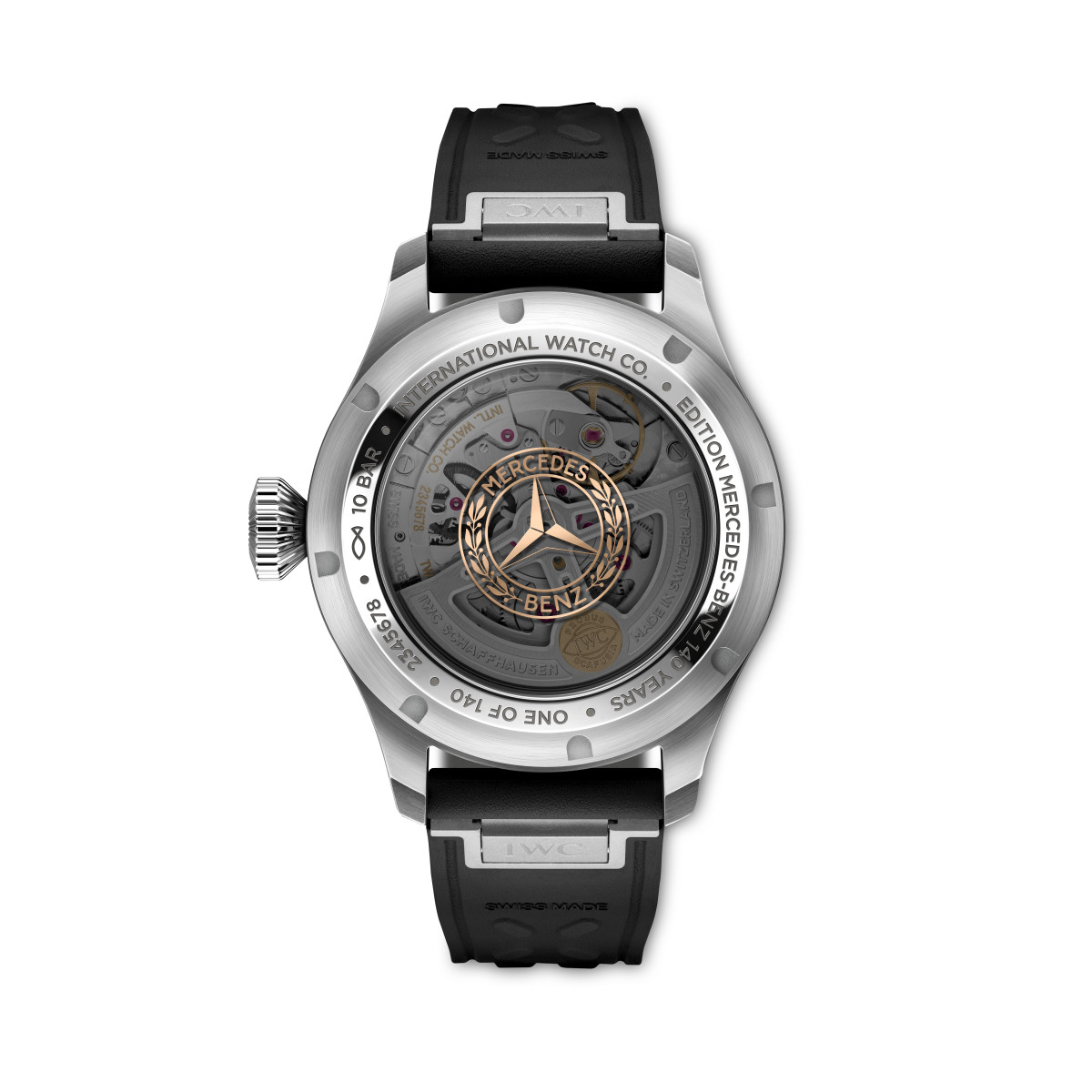
But the real piece of history is hidden on the reverse. The sapphire crystal caseback carries the first joint logo of Daimler Motoren-Gesellschaft and Benz & Cie., introduced after the two companies merged in 1926. The emblem combines the laurel wreath from Benz with Daimler’s famous three-pointed star, creating the first visual identity for what would become Mercedes-Benz. It is a small detail, but it neatly connects the watch to the company’s century-long evolution. Thanks to the integrated EasX-CHANGE system, the strap can be swapped for another option without any tools.
The Automotive Connection Runs Deeper
The partnership between IWC and Mercedes-Benz has never stopped at putting a logo on a dial. Over the years, the two have explored the visual and mechanical vocabulary they share. The Pilot’s Watch Performance Chronograph 41 AMG, for instance, reflects the partnership’s focus on performance and design, while IWC’s Formula One watches have translated the technical world of Mercedes-AMG PETRONAS into wristwatch form. There have also been special editions inspired by the G-Class, including the Big Pilot’s Watch AMG G 63 in 18-carat Armor Gold and the Big Pilot’s Watch AMG G 63 featuring a ceramic matrix composite case, a material developed in collaboration with the German Aerospace Center. That is the sort of crossover that makes sense because it is based on technology rather than simply aesthetics. Both companies are interested in materials that are light, strong and capable of surviving things that would make ordinary objects rather nervous. This Big Pilot’s Watch is fitted on a black rubber strap.
When Engineering Becomes Luxury
This is ultimately why the relationship between cars and watches works so well. Neither industry really needs to exist in its current form. A modern car could be designed simply to transport people, and a smartphone can tell the time with an accuracy that would make a mechanical watchmaker weep. Yet we continue to buy both because rationality stopped being the point a long time ago. We want to understand the machine. We want to feel the engine, hear the exhaust, watch the gears move and admire the craftsmanship involved in making something work when it does not strictly have to. The IWC Big Pilot’s Watch Perpetual Calendar ProSet 140 Years Mercedes-Benz is therefore more than an anniversary watch. It is a meeting of two industries that have spent more than a century turning engineering into emotion. Mercedes-Benz made the automobile a symbol of movement. IWC made mechanical timekeeping an exercise in precision. Put the two together and you get something wonderfully unnecessary, beautifully complicated and completely logical. Which, when you think about it, is exactly what great engineering has always been about.