Tourbillon Vs Carrousel: What Sets Blancpain’s New Carrousel Incliné Apart?
Two cousins in anti-gravity watchmaking meet a sapphire case and a 30-degree tilt, in a CHF 380,000 Blancpain that turns the regulator into the star of the show
If you have ever stared at a watch and wondered why a tiny spinning cage is such a big deal, you are in good company. The tourbillon is probably the most famous complication in watchmaking, a showpiece that collectors love to talk about. But it has a lesser-known cousin that does a similar job in a slightly different way: the carrousel. Blancpain, a house with a long history of carrousels, has just taken the idea somewhere new with the Carrousel Incliné, a watch with a regulator tilted at 30 degrees and a case made entirely of sapphire. Let’s look at what each complication does, and why this one is turning heads.
The Problem Both Try to Solve
A mechanical watch has a beating heart, a regulating organ that keeps time. The trouble is gravity. When a watch sits in different positions, the regulator beats slightly differently, which throws off accuracy. Both the tourbillon and the carrousel fight this by rotating the regulating organ constantly, so its position keeps changing and the errors average out. The tourbillon, patented by Abraham-Louis Breguet, is the more familiar solution. The carrousel is the alternative, and it is a speciality of Blancpain.
Tourbillon vs Carrousel: What’s the Difference?
The distinction comes down to the gearing. In a tourbillon, a fixed wheel drives the cage’s rotation and also interacts with the escapement, so a single powertrain does both jobs. In a carrousel, two separate gear trains work independently: one powers the escapement, the other turns the cage. The absence of that fixed wheel is the key difference between the two.
The carrousel was developed by Bahne Bonniksen, a British watchmaker of Danish origin who patented his system in 1892. It was mostly used in precision pocket watches made in Britain around the turn of the 20th century. Interestingly, the Bonniksen name is back in focus, since an independent project called Naissance d’une Montre 4 aims to reconstruct his work and launch a brand.
Blancpain’s Carrousel History
Blancpain has been exploring this territory for years. It brought the flying one-minute carrousel to the wrist in 2008 with the Carrousel Volant Une Minute, and followed it with models such as the Villeret Carrousel Phases de Lune. In 2013, the Villeret Tourbillon Carrousel combined a flying tourbillon and a flying carrousel in the same watch, using calibre 2322. The new Carrousel Incliné is different: it focuses on the geometry and performance of the carrousel alone.
Why Tilt It?
Here is where the story gets clever. Blancpain’s new calibre 222ISQ, developed over four years, has a flying carrousel inclined at 30 degrees. The idea is to reduce differences in rate between positions by changing the regulator’s orientation as the cage rotates. To find the ideal angle, Blancpain tested inclinations from 0 to 35 degrees in five-degree steps, studying rate and amplitude across four vertical and two horizontal positions. The result: 30 degrees worked best. The company notes that inclined regulators are not entirely new, and Greubel Forsey has long used the idea. But in a carrousel, and in this form, it is a first.
The carrousel rotates once a minute and beats at 28,800 vibrations per hour (4 Hz), with an 8 mm balance and a silicon hairspring. Blancpain also reduced mass: the cage is 8.5% lighter than before, and its rotational inertia is down by 30%. Transitioning from the movement’s flat plane to the tilted regulator required a two-stage geometry, 22 degrees followed by a further eight. The 9 mm cage rides on a double ball-bearing system, with a patent application filed. The movement measures 35.2 mm in diameter and 5.3 mm thick, rising to 6.98 mm at the cage, with 224 components and 37 jewels. Two barrels in series provide a 100-hour power reserve.
A Case You Can See Through
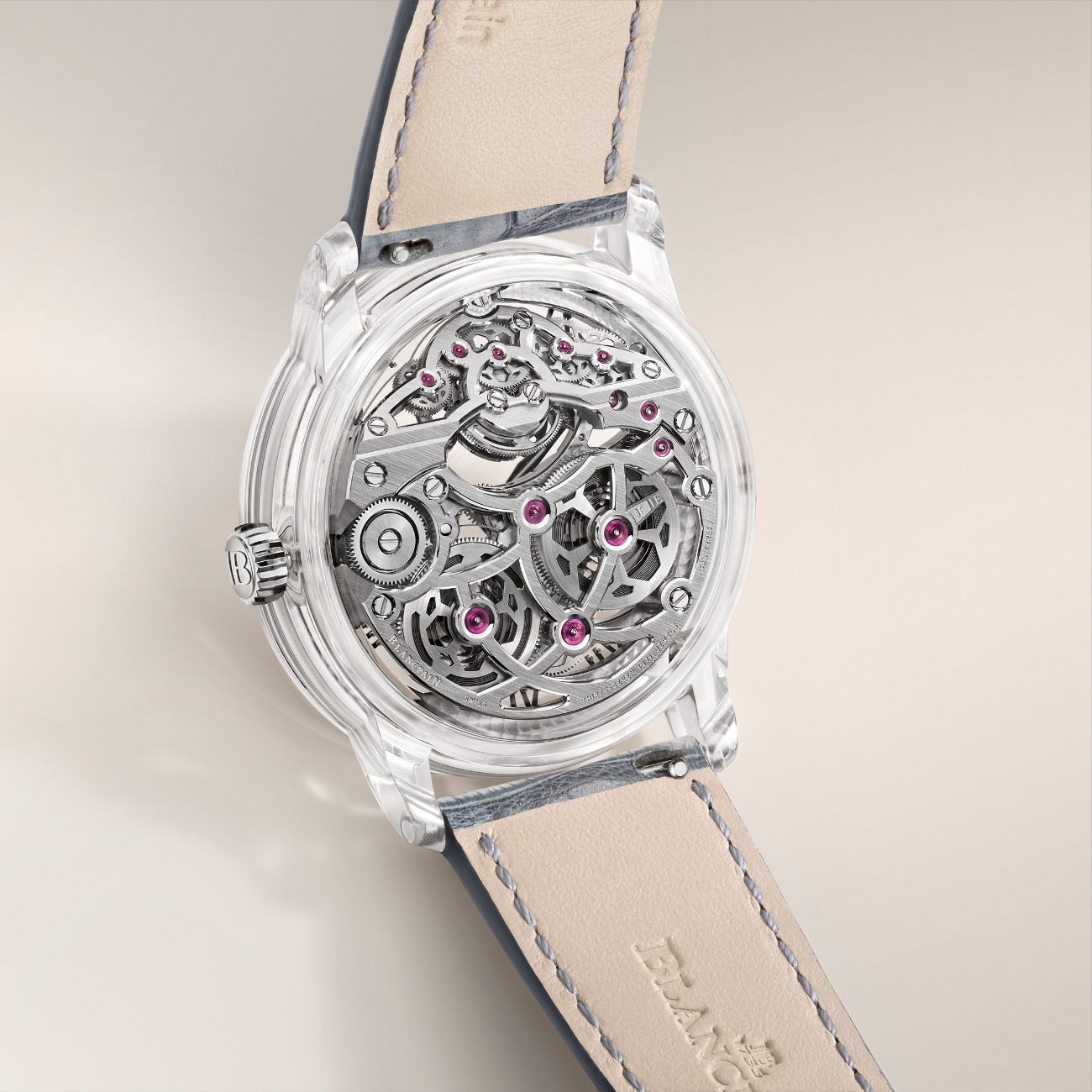
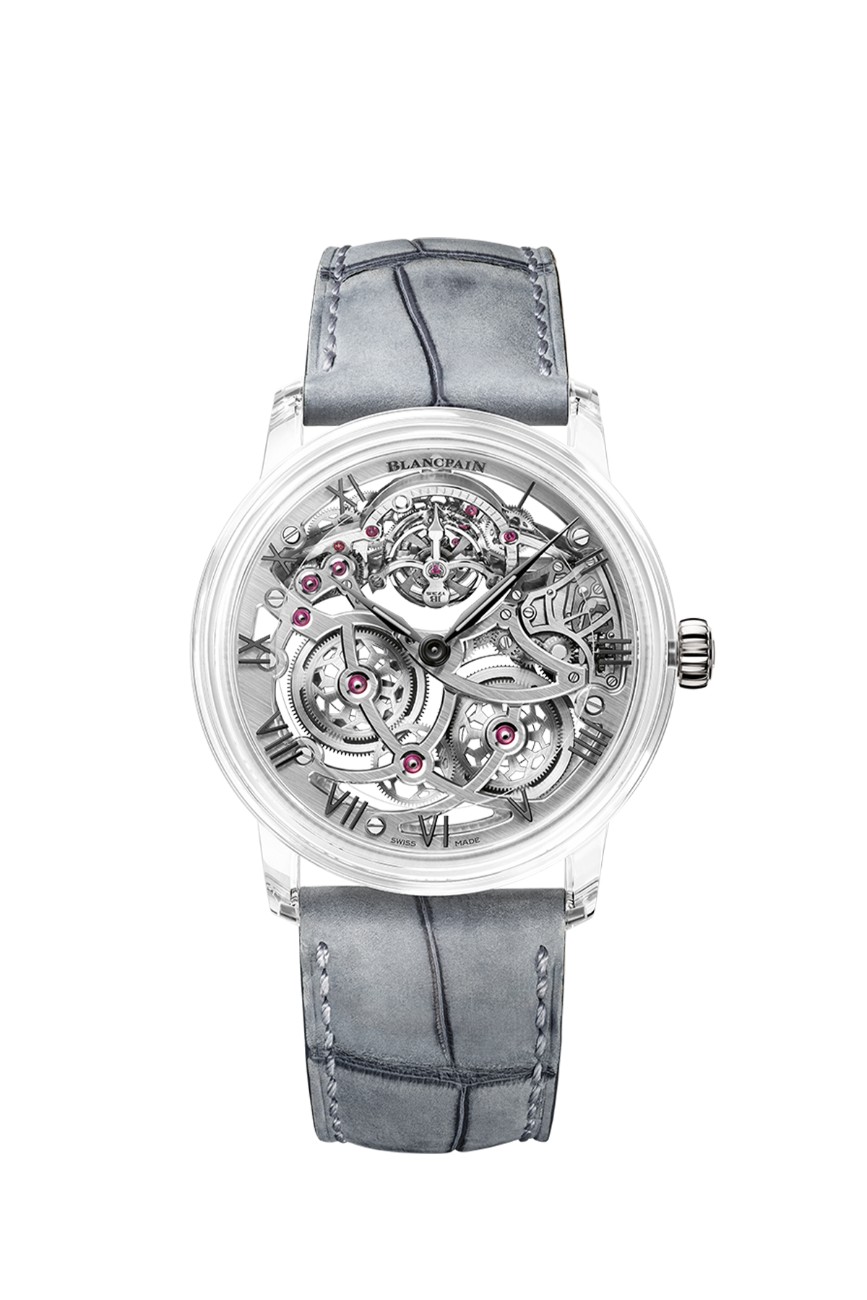
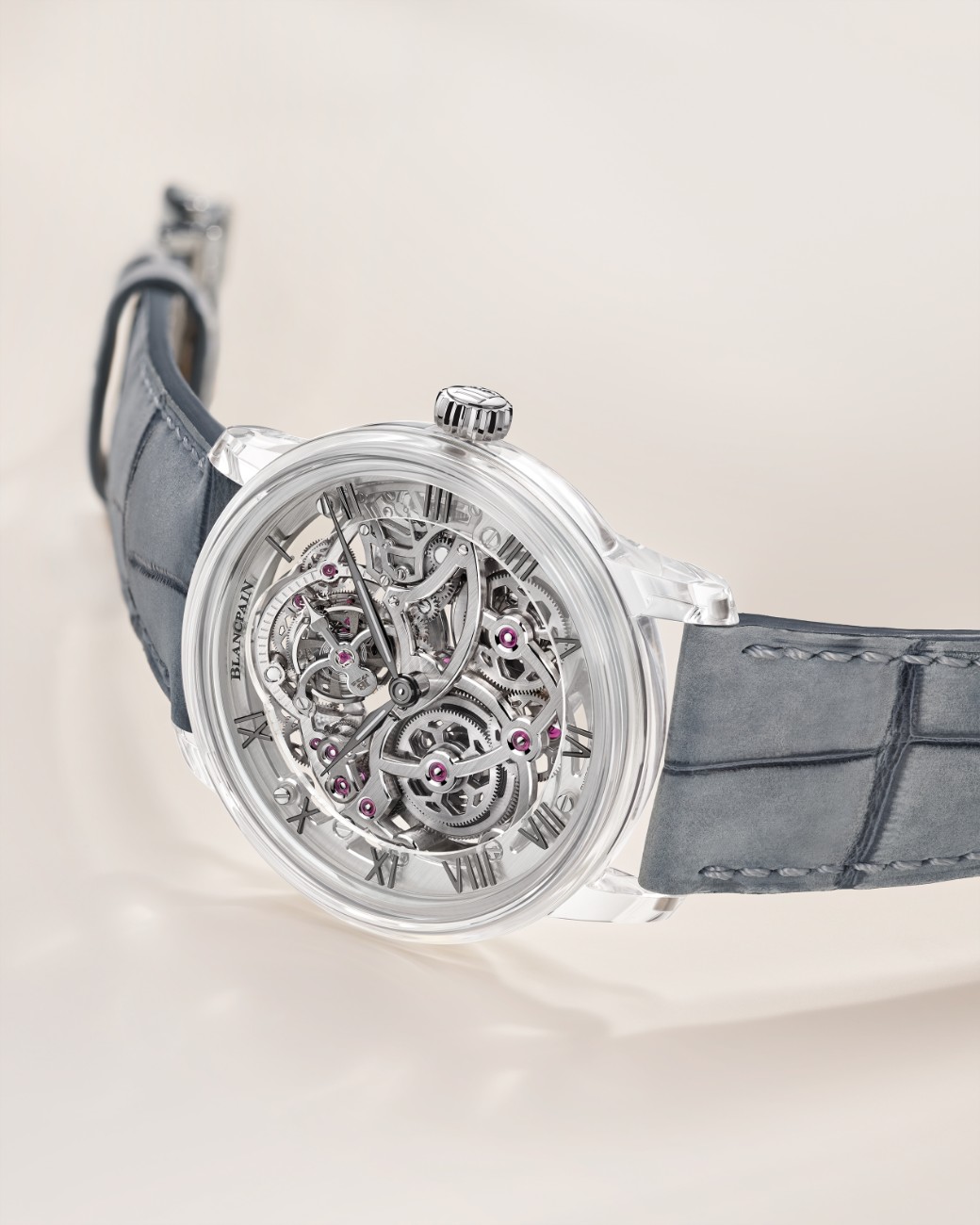
The other headline feature is the case. It is the first time Blancpain has used sapphire for a complete case, measuring 40.3 mm across and 11.3 mm thick, with the middle and back formed as one component and water resistance of 30 metres. The dial is sapphire too, with gold Roman numerals and luminescent hands, so the movement is visible from almost every angle. The carrousel carries a beak-shaped indicator for running seconds, making the regulator both the star and a working part of the display. Skeletonised barrels act as a visual power reserve, and an E/F indicator on the back shows the state of wind.
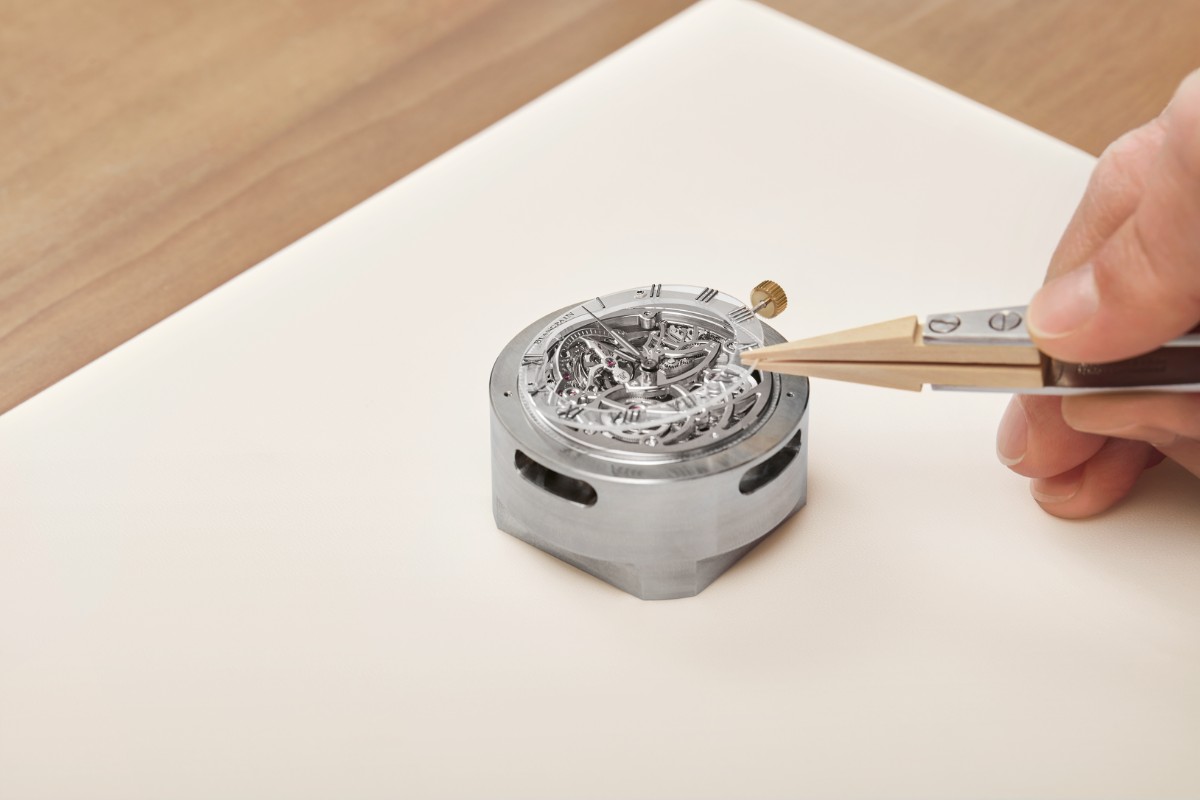
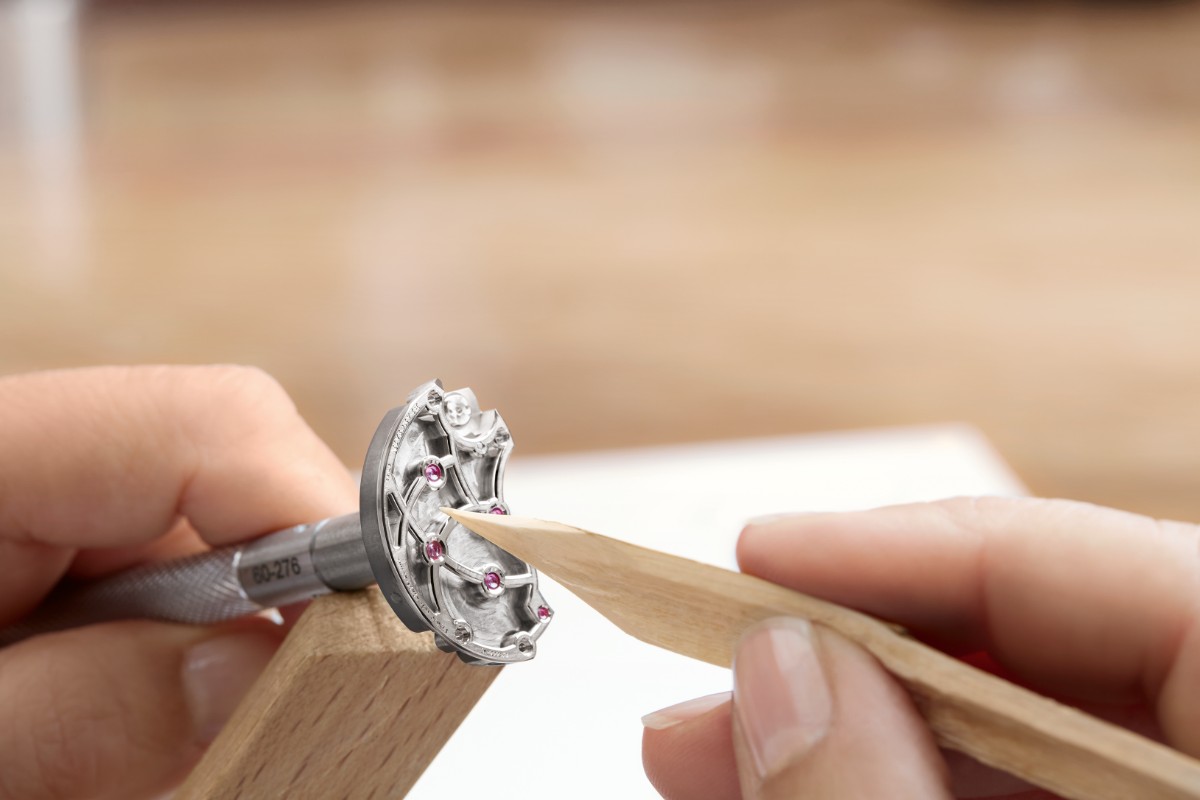
Since you can see everything, the finishing matters. The movement comes in rhodium-plated 5N gold or 5N red gold, and each one takes around 210 hours of hand finishing, using more than 60 dedicated tools. The calibre has 253 sharp inward angles, and the anglage is done on both sides of the bridges, with 30-degree bevels on top and 45-degree bevels below. The mainplate and barrel bridge alone need 55 to 60 hours.