

For more than a century, braking was one of the simplest ideas in the automobile world; press the pedal, create friction and bring the vehicle to a stop. But electric vehicles have rewritten this basic principle. Instead of allowing the energy created during braking to disappear as heat through traditional brake discs and pads, EV’s use a smarter system that captures a portion of that energy and sends it back into the battery.
This technology, known as regenerative braking, has become one of the defining innovations of modern electric mobility. It is a perfect example of how electric vehicles rethink the fundamentals of driving, turning something that was once considered waste into a source of additional efficiency. From city traffic to winding highways, every moment when an EV slows down becomes an opportunity to recover energy. While it does not create unlimited power or eliminate the need for charging, regenerative braking plays a crucial role in extending driving range, reducing wear on components and making electric cars more efficient.

The Science Behind Regenerative Braking
The concept behind regenerative braking begins with a simple principle of physics: energy cannot be destroyed; it can only change form. In a traditional petrol or diesel car, the kinetic energy created while moving is converted into heat when the brake pads clamp against the brake discs. That heat escapes into the environment, meaning the energy used to accelerate the vehicle is largely lost. An electric vehicle approaches the process differently. When the driver lifts off the accelerator or presses the brake pedal, the electric motor changes its role. Instead of consuming electricity to move the car, it begins working as a generator. As the wheels continue turning, they rotate the motor, which creates electrical energy. This recovered energy is then sent back into the battery pack, where it can be stored and used later to power the vehicle.
Also Read: Morgan Unveils Exclusive Midsummer Coupé: Everything You Need to Know
The Electric Motor That Becomes A Generator
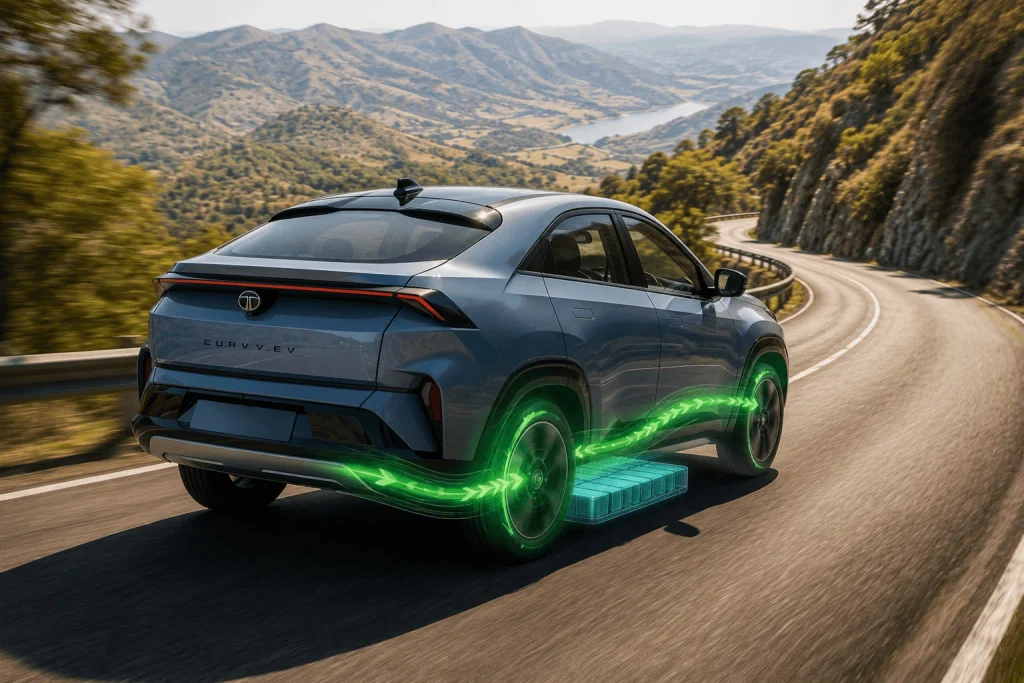
At the centre of regenerative braking is the EV’s electric motor. Most electric vehicles use motors that can operate in two directions. During acceleration, electricity from the battery powers the motor, creating magnetic forces that rotate the wheels and move the vehicle forward. During deceleration, the process reverses. The spinning wheels drive the motor, and the motor produces electricity instead. This ability to switch between propulsion and energy recovery is one of the biggest advantages of electric powertrains. A single component can perform multiple functions, improving both performance and efficiency.
Also Read: Is Ferrari Bringing Back The Manual Transmission? What We Know So Far
One Pedal Driving And The New EV Experience
One of the biggest changes regenerative braking has brought to driving is the rise of one pedal driving. Many EVs allow drivers to control acceleration and deceleration primarily through the accelerator pedal. When the driver releases the pedal, the vehicle automatically begins slowing down as the motor recovers energy. This creates a different driving style, especially in urban environments where constant stopping and starting is common. Instead of moving between accelerator and brake repeatedly, drivers can often manage traffic flow with smoother pedal control. For many EV owners, this becomes one of the most enjoyable and intuitive features of electric driving.