Why Spanish Architect Alberto Campo Baeza Is The Modern Master Of Light, Space, And Silence
A visionary Spanish architect who distilled architecture to its purest essence, Alberto Campo Baeza shaped modern minimalism through light, geometry, and profound spatial clarity, leaving behind a body of work that redefined how we inhabit space
Alberto Campo Baeza is the sort of architect who looks at a building site, squints into the sun, and says something like, “This place doesn’t need walls. It needs an enlightenment.” While most architects are busy fussing over materials, colours, and whether to add yet another decorative flourish, Baeza simply steps back and lets the universe do most of the work. Where others see a room, he sees a vessel for light; where others see empty space, he sees the possibility of silence so serene you could hear a thought drop. If architecture is noise, Baeza’s work is the moment when someone finally turns the volume down. And somehow, with nothing but clean planes, precise geometry, and a devotion to proportion so strict it might frighten a mathematician, he creates buildings that feel more powerful than the most elaborate palaces.
Born in Valladolid in 1946 and raised in Cádiz, Baeza grew up surrounded by open horizons, luminous skies, and a Mediterranean culture that valued simplicity. These early encounters with natural light and expansive landscapes etched themselves into his architectural soul. When he eventually trained at the Polytechnic University of Madrid, he approached architecture not as construction, but as a form of distilled thinking. For Baeza, the world was already filled with noise; what architecture needed was calm. This belief would later define his œuvre, setting him apart from the clamour of contemporary spectacle-driven design.
Design Philosophy Revolving Around Essentiality
At the heart of Campo Baeza’s work lies the radical belief that architecture should be stripped of everything unnecessary until only essence remains. He often speaks of light as his primary building material and gravity as his greatest teacher. To him, architecture is not about decorating space—it’s about shaping the intangible. Light reveals form. Proportion gives meaning. Silence cultivates emotional resonance. His buildings often resemble meditative landscapes: white surfaces, precise planes, and volumes arranged with almost surgical clarity. In an era obsessed with visual excess, Baeza introduced a profound counterpoint—architecture as contemplation.
His buildings are defined by rigorous geometry, meticulously calibrated proportions, and an unwavering fidelity to light. Walls are treated as canvases, roofs as instruments for directing illumination, and courtyards as voids that heighten spatial awareness. Materials tend toward stone, concrete, and glass—honest, tactile, and quietly monumental. He often uses pure white planes not as aesthetic choices but as tools for amplifying natural light. Silence is not metaphorical in his work; it is physical, achieved through spatial stillness, restrained detailing, and volumes that evoke a sense of sacred calm. The result is architecture that feels simultaneously weightless and monolithic.
Most Iconic Buildings
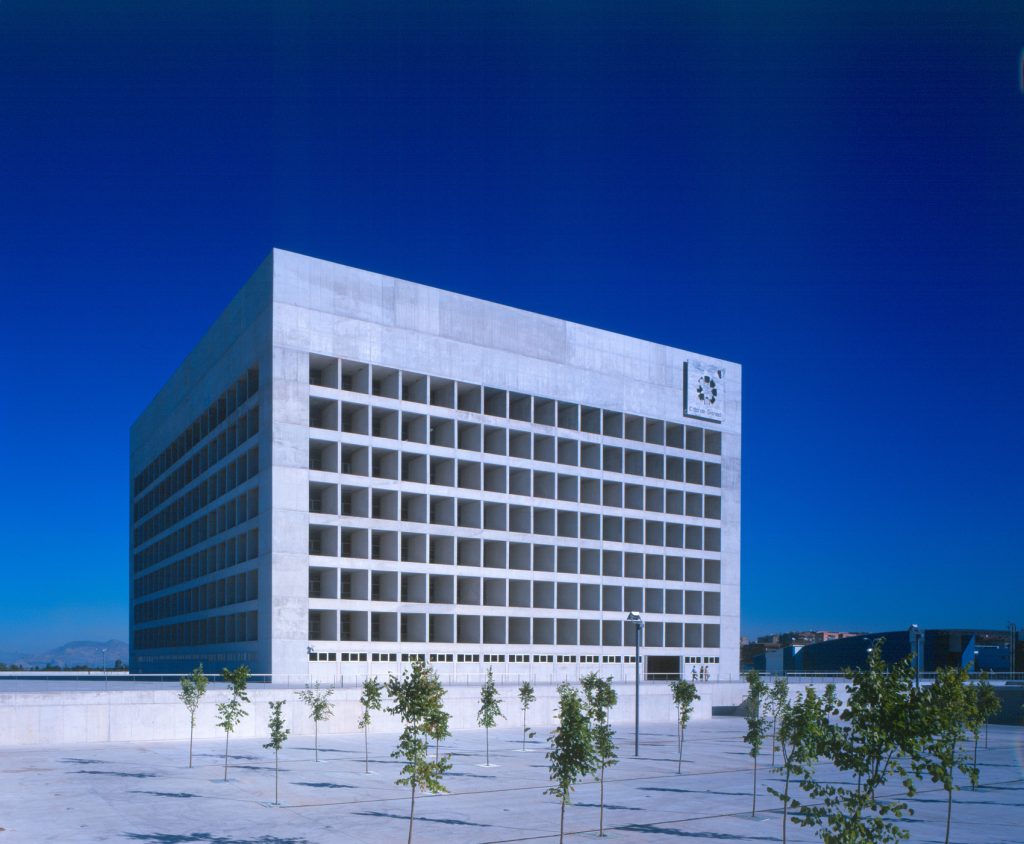
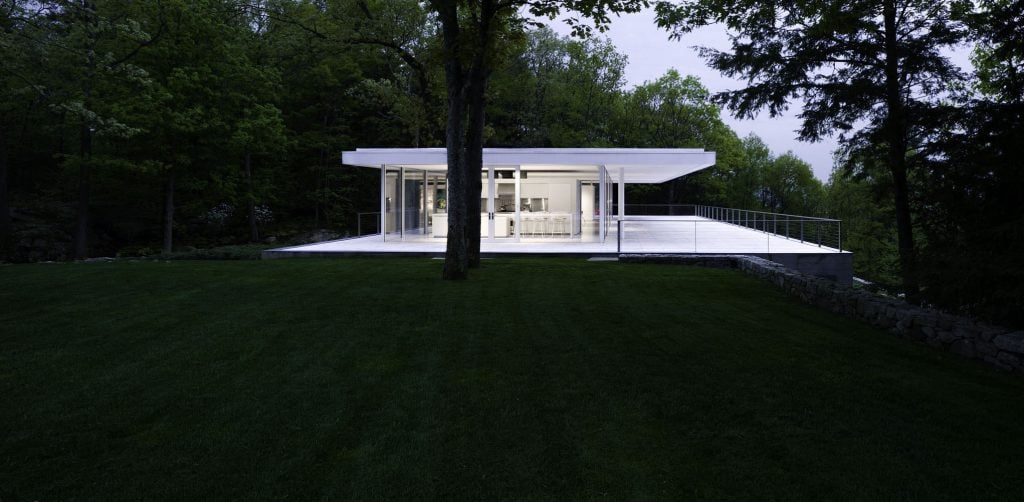
Many of Baeza’s most celebrated works have become global case studies in minimalism. The Casa Gaspar in Cádiz is a masterclass in horizontal planes and desert-like openness, where the light performs as the true protagonist. The Caja Granada Savings Bank stands as a monumental civic gesture, its colossal glass plane inviting daylight across vast interior depths. His Olnick Spanu House in New York showcases how pure geometry and California-style luminosity can coexist across continents. The Guardería Benetton childcare centre and Between Cathedrals project further highlight his ability to create profound serenity even in public and urban settings. Each building feels like a thoughtful pause carved into the fabric of the world.
Alberto Campo Baeza is widely regarded not simply as an architect, but as an intellectual force in contemporary design. His writings, lectures, and teaching at the Polytechnic University of Madrid have shaped multiple generations of architects. He received the Arnold W. Brunner Memorial Prize, the RIBA International Fellowship, and numerous global honours that acknowledge his pursuit of architectural purity. Though deeply rooted in Spanish tradition, his influence stretches from Italy and Germany to Japan and the United States. His work reminds designers that technical excellence and poetic restraint are not mutually exclusive.