

In the rarefied world of Swiss horology, where tradition often moves with deliberate restraint and innovation is measured against centuries of legacy, the announcement by the COSC of a new certification represents more than a regulatory update; it signals a philosophical evolution. Marking the fiftieth anniversary of the ISO 3159 standard, the Swiss Official Chronometer Testing Institute has introduced the “Excellence Chronometer” certification, a distinction designed to respond to the technical realities of contemporary watchmaking while honouring the rigorous ethos that has long defined Swiss precision. Far from replacing the existing chronometer certification, this new benchmark emerges as a complementary extension, one that seeks to unite manufacturers around ever higher standards without disturbing the delicate equilibrium between innovation and heritage.
A Certification Born Of Evolution, Not Revolution
The decision to introduce the Excellence Chronometer certification reflects a nuanced understanding of how mechanical watchmaking has evolved over the past five decades. Since the adoption of ISO 3159, the traditional chronometer standard has served as a trusted measure of accuracy, yet advances in materials science, movement engineering and consumer expectations have gradually expanded the definition of what constitutes exemplary performance. Today’s enthusiasts demand not only precision but also resilience and transparency, expecting their timepieces to perform consistently in environments shaped by magnetic fields, dynamic lifestyles and prolonged power reserves.
Recognising this shift, the COSC has chosen to strengthen its certification framework while remaining faithful to its unifying mission in service of Swiss watchmaking. The Excellence Chronometer is therefore less a departure from tradition than a sophisticated progression, reaffirming the institute’s role as both guardian and innovator within the industry.
Testing on the Finished Watch
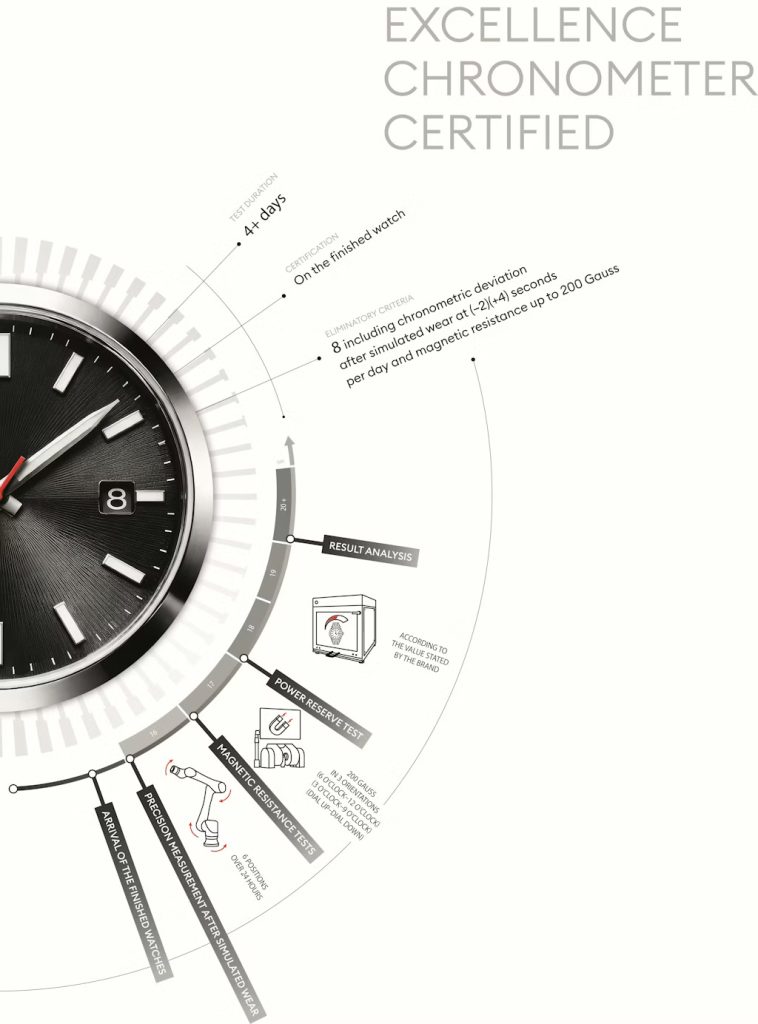
Perhaps the most significant enhancement lies in the methodology itself. Unlike earlier practices that primarily evaluated uncased movements, the Excellence Chronometer certification introduces tests conducted on the finished watch. This shift reflects a modern understanding that real world performance depends on the interaction between movement, case construction and overall assembly. By evaluating the complete timepiece, COSC ensures that the final product worn by the consumer truly embodies the promised standards of precision.
This holistic approach acknowledges that a watch’s performance cannot be isolated from its physical context. The integration of case materials, dial architecture and protective systems all influence chronometric behaviour, and the new certification embraces this complexity with scientific rigor.

Tighter Accuracy for a New Era
Central to the Excellence Chronometer distinction is a reduced rate tolerance of six seconds per day, measured at minus two to plus four seconds daily. This narrower window represents a significant tightening of expectations and speaks directly to the heightened capabilities of modern movements. In practical terms, it places greater emphasis on consistency and stability, requiring manufacturers to refine regulation techniques and elevate overall production quality.
For collectors and enthusiasts, the stricter tolerance offers reassurance that certified watches are not merely accurate in controlled conditions but exhibit sustained performance worthy of contemporary standards. Precision, once a celebrated luxury, has become an expectation, and COSC’s new metric reflects that cultural transition.
Magnetic Resistance in the Modern World

In an age saturated with smartphones, laptops and wireless technology, magnetic interference has emerged as one of the most persistent threats to mechanical accuracy. The Excellence Chronometer certification addresses this reality by incorporating magnetic resistance testing at 200 gauss, ensuring that certified watches maintain performance despite everyday exposure to magnetic fields.
This requirement underscores the pragmatic turn in modern watchmaking, where technical elegance must coexist with practical durability. It also reflects the industry’s broader movement toward anti magnetic materials and improved movement architecture, demonstrating COSC’s willingness to evolve alongside technological progress.
Verification of the Stated Power Reserve
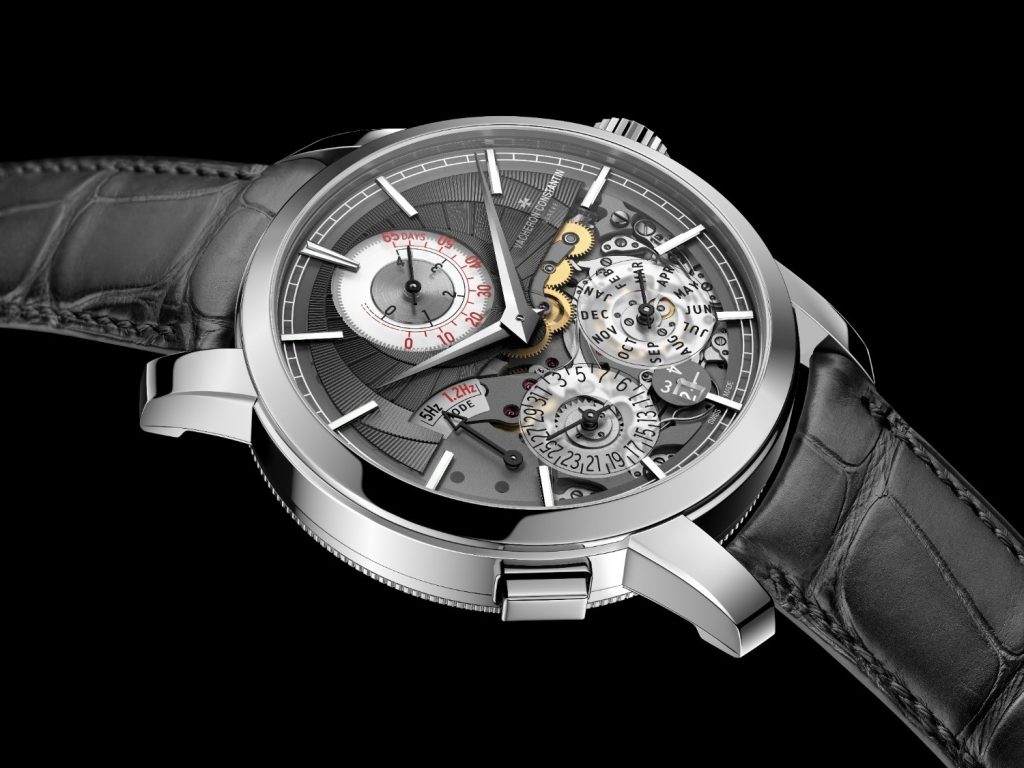
Another notable addition is the verification of the stated power reserve, a feature increasingly important as manufacturers compete to offer extended autonomy. By independently confirming that a watch delivers the duration of operation claimed by its maker, COSC reinforces trust between brand and consumer, ensuring that marketing declarations align with measurable reality. This emphasis on transparency speaks to a wider cultural shift within luxury watchmaking, where informed collectors demand empirical validation as much as aesthetic refinement.
The Meaning of “Excellence Chronometer Certified”
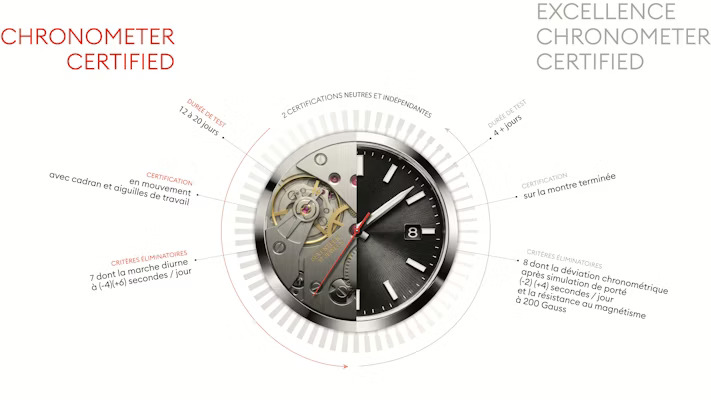
Watches that satisfy all of these enhanced criteria earn the title “Excellence Chronometer Certified,” a designation intended to stand as a symbol of elevated performance rather than exclusivity for its own sake. It supports manufacturers in addressing contemporary challenges while preserving the independence and impartiality that have long defined COSC’s reputation. The institute’s commitment to rigorous testing remains unwavering, yet its embrace of modern requirements demonstrates a willingness to adapt without compromise.
A Shared Future for Swiss Watchmaking
Ultimately, the introduction of the Excellence Chronometer certification reflects a broader aspiration: to unite Swiss watchmaking around a shared standard of excellence that balances innovation with tradition. On the milestone anniversary of ISO 3159, COSC’s announcement serves as both a tribute to the past and a declaration of intent for the future, reminding us that horology’s enduring strength lies not in resisting change but in refining it.
In elevating accuracy, resilience and transparency, the Excellence Chronometer initiative signals that the next chapter of Swiss watchmaking will be defined not merely by mechanical ingenuity but by a renewed commitment to meaningful, measurable excellence, ensuring that the timeless art of precision remains as relevant tomorrow as it has been for generations.