What Is Neoclassical Architecture? Key Characteristics, Influential Figures And Iconic Buildings
A powerful architectural movement inspired by ancient Greece and Rome, Neoclassical architecture champions order, balance, and rational beauty
Neoclassical architecture is what happens when designers look at the frilly chaos of earlier styles and collectively decide, “Lets bring back the columns. And make them enormous.” It’s architecture with a stiff upper lip—disciplined, chiselled, and striding confidently into the streets as if its marble sandals never go out of fashion. While Baroque and Rococo twirled around in decorative excess, Neoclassicism marched in like a general, demanding symmetry, clarity, and monumental drama. These buildings don’t try to seduce you; they stare at you like a marble philosopher who has no patience for your emotional whims. And somehow, in their seriousness, they become breathtaking. It’s architecture that doesn’t shout; it pronounces.

Also Read: Who Is Maya Lin? The Visionary Architect Behind Vietnam Veterans Memorial
The Origins
Neoclassical architecture developed in the mid-18th century as Europe grew weary of the decorative indulgence of Rococo and the theatricality of Baroque. Enlightenment thinkers were championing reason, science, and the revival of classical ideals, which naturally influenced architecture. Archaeological discoveries in Pompeii and Herculaneum further ignited fascination with antiquity, inspiring architects to emulate the symmetry, discipline, and mathematical precision of ancient Greece and Rome. Neoclassicism quickly positioned itself as the architectural embodiment of rational thought, civic virtue, and timeless beauty. At the heart of Neoclassical design is a commitment to clarity. The style rejects excessive ornamentation, instead embracing clean lines, proportional systems, and balanced compositions. Buildings are designed with a sense of calm authority, using geometry as their guiding principle. Unlike the emotional exuberance of earlier movements, Neoclassicism communicates through structure, not decoration. It creates visual serenity through repetition, symmetry, and monumental scale—reminding viewers that beauty can be both intellectual and emotional.

Key Features And Iconic Structures Of Neoclassical Architecture
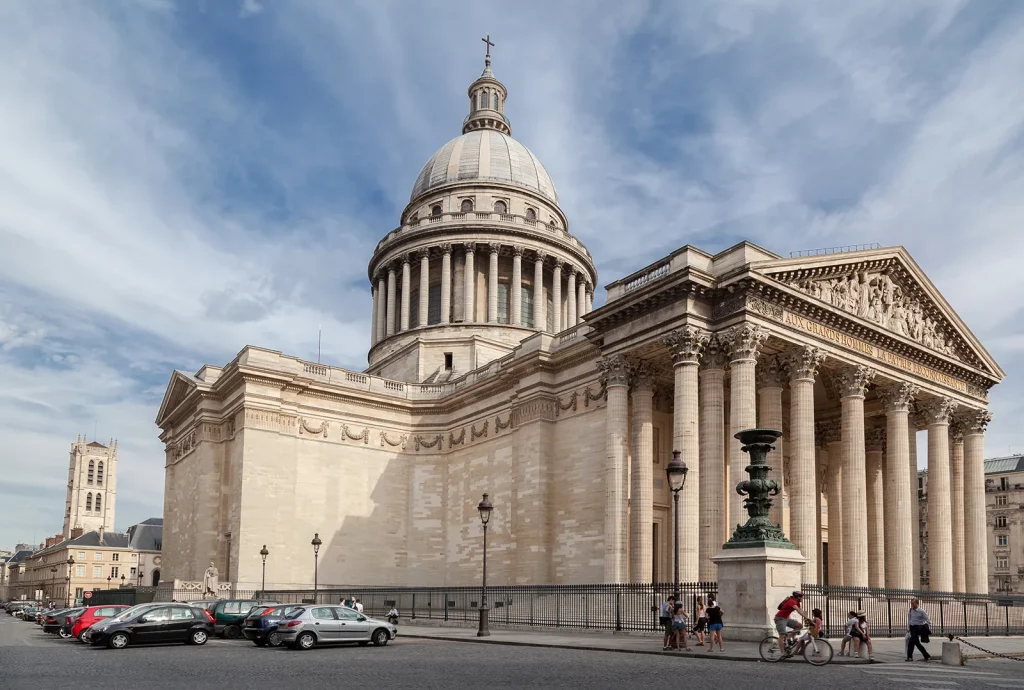
Neoclassical buildings are defined by grand porticos supported by Doric, Ionic, or Corinthian columns, triangular pediments adorned with minimal sculpture, smooth façades, and long horizontal lines. Interiors favour high ceilings, marble floors, geometric floor patterns, and restrained wall decoration. The use of symmetry is uncompromising, with entrances, windows, and structural forms aligned with mathematical precision. The style achieves drama not through ornament, but through scale—monumental columns, vast domes, and imposing symmetrical fronts that command attention without flamboyance.
Some of the world’s most recognisable structures were built in the Neoclassical tradition. The Pantheon in Paris, redesigned as a mausoleum by Jacques-Germain Soufflot, showcases soaring classical geometry. In the United States, the White House and the U.S. Capitol stand as monumental testaments to democratic ideals expressed through classical form. St. Petersburg’s Kazansky Cathedral and Admiralty Building reflect Russia’s embrace of Neoclassicism as a symbol of imperial power. London’s British Museum, with its sweeping colonnade, represents the intellectual spirit of the era, while Berlin’s Altes Museum by Karl Friedrich Schinkel stands as one of the style’s purest expressions of proportional harmony. These buildings prove that Neoclassicism transcended borders as the architectural language of civic pride and political ideals.
Influential Figures

Neoclassicism owes its identity to architects who treated design as both science and art. Andrea Palladio, though earlier, provided the blueprint for classical revival with his emphasis on symmetry and mathematical order. Jacques-Germain Soufflot brought monumental classicism to France with projects like the Pantheon, blending ancient inspiration with engineering innovation. Robert Adam, the Scottish architect, redefined British Neoclassicism with elegant interiors and refined façades. Germany’s Karl Friedrich Schinkel pushed the style toward purity and intellectual clarity, creating buildings that remain models of disciplined design. These figures established Neoclassicism as a global architectural philosophy rather than a passing fashion.