Why Watch Collectors Are Obsessed With Tantalum: The Ultimate Rare-Metal Timepiece Guide
Rare, technically demanding and visually distinctive, it offers collectors something beyond traditional precious metals, and from durability to craftsmanship, tantalum represents the future of unconventional luxury timepiece
In the world of luxury watches, where gold, platinum and titanium have long dominated conversations, a darker and far more mysterious material has been quietly stealing attention. Tantalum, a rare metal known for its deep blue-grey tone, exceptional density and almost stubborn resistance to corrosion, has become one of the most intriguing choices for modern watchmakers. It is not a material chosen simply because it looks different. Tantalum demands patience, specialised tools and extraordinary craftsmanship to transform it into a finished case. For collectors, that difficulty is precisely the attraction. A tantalum watch is not just another luxury object sitting on the wrist; it is proof that the brand was willing to take the harder road.
Tantalum’s Journey
Originally valued for its extreme resistance to heat and chemical corrosion, tantalum has been widely used in demanding industries including aerospace, medical technology and electronics. Its journey into watchmaking is a fascinating example of how high horology constantly borrows from engineering. Unlike conventional metals, tantalum offers a unique combination of toughness and elegance. It has a heavier feel than titanium, a more technical character than steel and a visual depth that changes subtly depending on the light.
The metal’s naturally dark blue-grey appearance gives watches a modern, understated personality. It does not shout like polished gold or sparkle like platinum, but it carries a quiet confidence that appeals to collectors who prefer rarity over obvious luxury.
The Craftsmanship Behind A Tantalum Case
Creating a tantalum watch case is not simply a matter of shaping metal. The material’s properties make finishing a delicate process. Traditional polishing techniques cannot always be applied easily, and manufacturers must carefully control machining speeds and temperatures. The result, when executed properly, is a case with a rich satin texture, deep reflections and a presence that feels completely different from conventional watch materials. The weight on the wrist immediately reminds the wearer that this is not an ordinary timepiece. For independent watchmakers and elite manufacturers, tantalum has become a playground for innovation, allowing them to create watches that feel both futuristic and timeless.
Also Read: Top Collaborative Timepieces Of 2026: The Most Exciting Watch Partnerships
The Unique Composition
Tantalum’s appeal begins at the atomic level. Classified as a transition metal, tantalum is an exceptionally dense element with the chemical symbol Ta and atomic number 73. It is naturally rare, with most of its supply extracted from mineral ores such as tantalite and coltan. Unlike many metals used in watchmaking, tantalum is almost completely resistant to corrosion because it forms a protective oxide layer on its surface when exposed to air. This natural barrier makes it incredibly stable and biocompatible, which is why it is also used in medical implants and advanced industrial applications. With a density close to platinum, tantalum delivers a substantial presence on the wrist, while its high melting point and extreme hardness make it one of the most challenging materials to machine. In watchmaking, this difficult composition is exactly what creates its exclusivity, requiring specialised techniques to shape, polish and finish each case with the precision expected from haute horlogerie.
Top Tantalum Novelties
J.N. Shapiro Infinity Tantalum Limited Edition
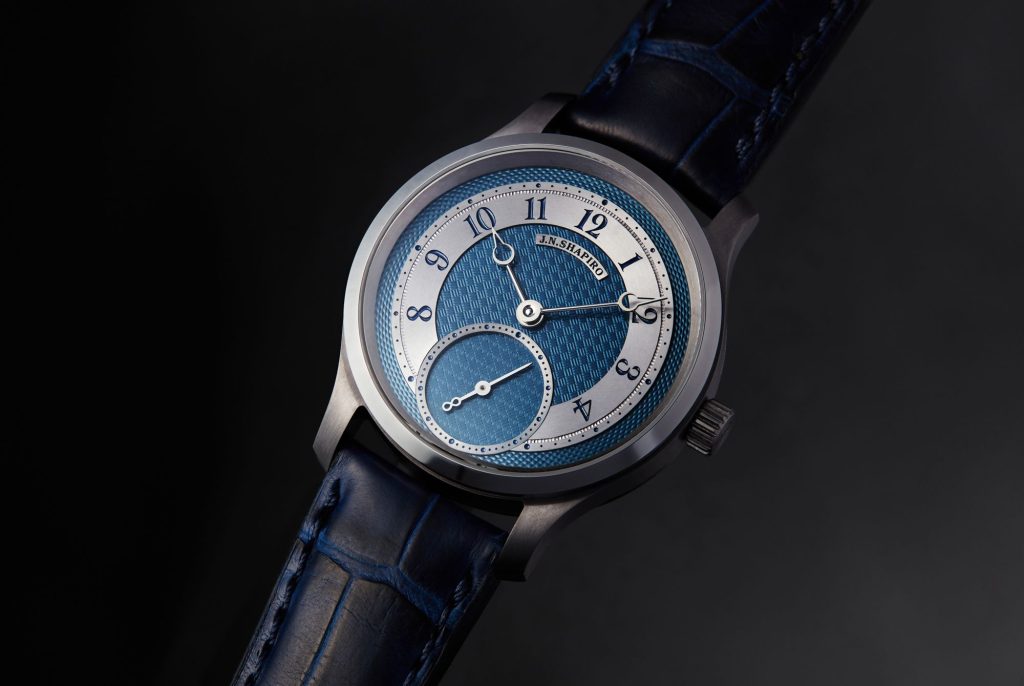
The watch is housed in a 39 mm tantalum case, combining brushed and polished finishes that highlight the metal’s distinctive blue-grey character and technical elegance. The case is protected by a sapphire crystal on both the front and caseback, allowing the design and movement to remain visible while maintaining everyday durability with 30 metres of water resistance. The dial reflects the same philosophy of material-focused craftsmanship, built on a palladium base with intricate engine-turned patterns. It is offered in three distinct executions: a palladium dial paired with tantalum chapter rings and blue enamel detailing, a black ruthenium-coated dial with tantalum hour rings and rose gold accents, and a blue dial version featuring tantalum chapter rings with matching blue enamel ink.
Powering the watch is the J.N. Shapiro Uwd, based on the German-made Uhren-Werke-Dresden Calibre 33.1. The hand-wound movement features an openworked construction, 19 jewels, a 33 mm diameter and beats at 21,600 vibrations per hour. Offering 53 hours of power reserve, it displays hours, minutes and small hacking seconds. The timepiece is completed with an alligator leather strap fitted with a tantalum pin buckle and is limited to just 26 pieces worldwide, making it an exceptionally rare expression of independent watchmaking and advanced material innovation.
Omega Seamaster Diver 300M
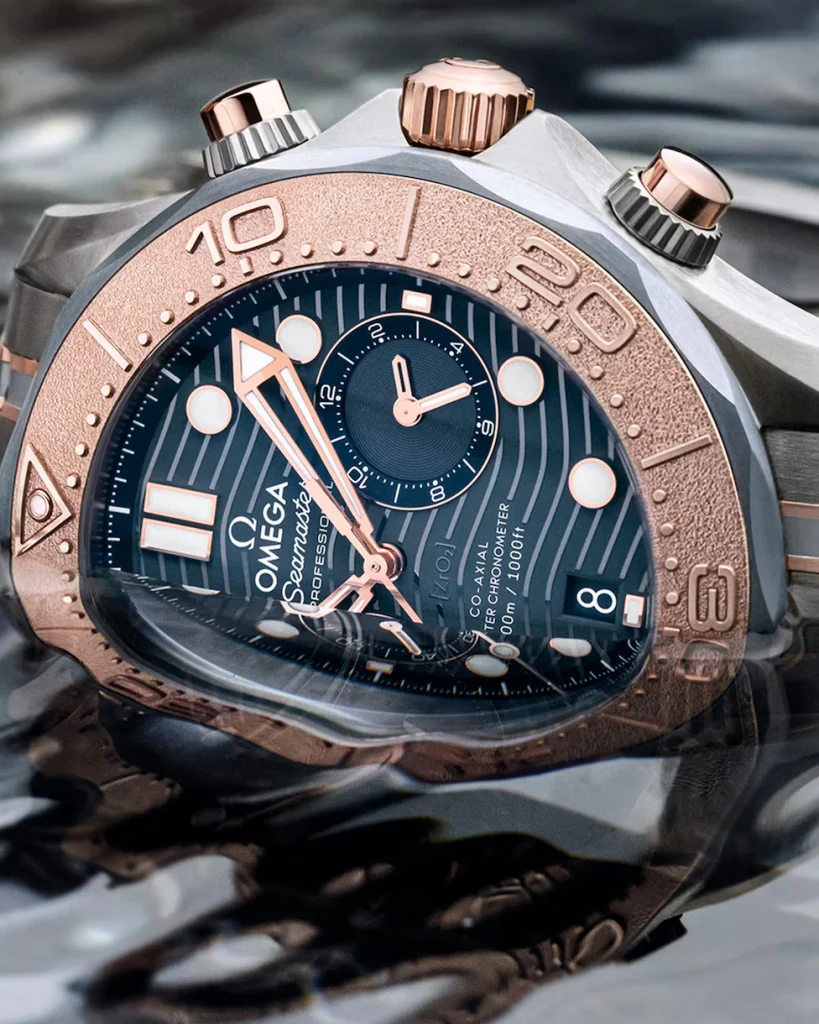
The OMEGA Seamaster Diver 300M 44mm Numbered Edition brings together three exceptional materials: lightweight grade 2 titanium, precious 18K Sedna™ gold, and rare tantalum, creating a modern interpretation of OMEGA’s legendary professional dive watch. The 44 mm case combines brushed titanium with tantalum accents, while the tantalum is integrated into the base of the bezel and the bracelet’s middle links, adding a distinctive blue-grey tone and enhanced material contrast.
The watch features an 18K Sedna™ gold bezel ring with a laser-ablated diving scale, paired with a polished blue ceramic dial engraved with laser-ablated wave patterns. The dial includes a date window at 6 o’clock, while the chronograph subdials are framed with Sedna™ gold detailing. A sapphire crystal with anti-reflective treatment protects the dial, while the helium escape valve and robust construction maintain its professional diving credentials.
Powering the timepiece is the OMEGA Co-Axial Master Chronometer Calibre 9900, a self-winding movement certified by METAS for precision, magnetic resistance and performance. The movement delivers a 60-hour power reserve and is visible through the sapphire caseback, where an engraved and lacquered OMEGA Seahorse emblem appears on the crystal. Finished with a titanium, tantalum and Sedna™ gold bracelet featuring a foldover clasp with comfort adjustment and diver extension, this 300-metre water-resistant Seamaster represents the perfect balance between technical innovation, luxury materials and diving heritage.
Atelier Wen Inflection
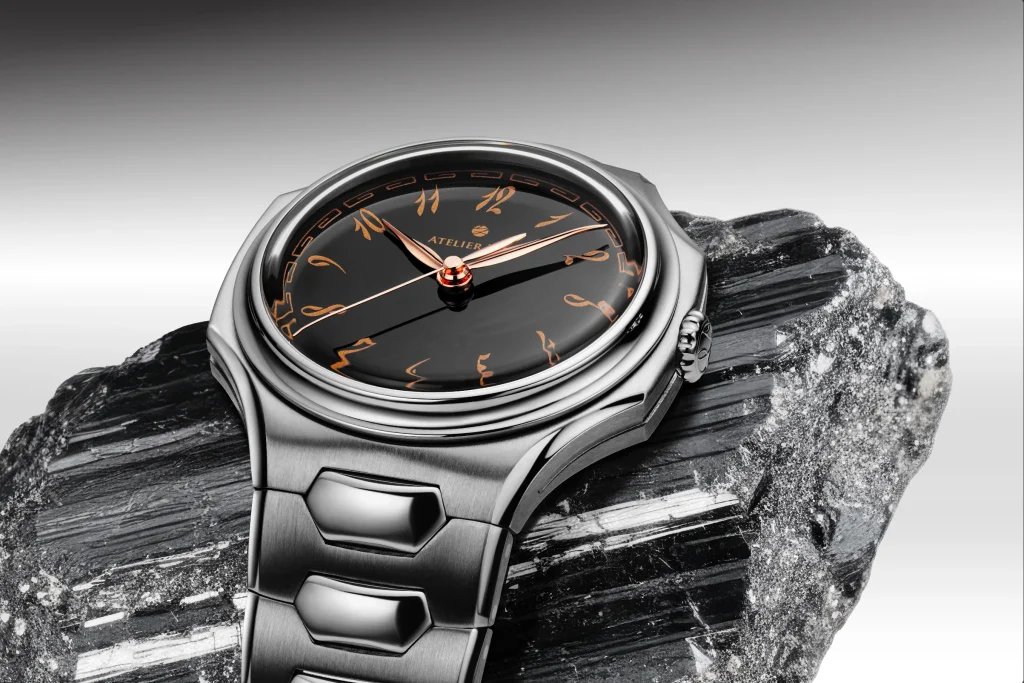
The watch is crafted from a 99.9% pure tantalum case, showcasing the rare metal’s distinctive character through a combination of concave and convex surfaces. Measuring 40 mm in diameter, 45 mm lug-to-lug and 10.2 mm thick including the crystal, the case features mirror-polished chamfers, strong vertical brushing and sandblasted accents that highlight the complexity of tantalum finishing. A screw-down crown completes the structure, offering water resistance up to 100 metres.
The dial is a true expression of artisanal watchmaking, built on a hand-hammered 925 silver base and finished with a Grand Feu fumé enamel gradient created by Kong Lingjun’s workshop in Beijing. Moving from pale green to deep viridian tones, the dial is complemented by Western-Arabic numeral hour markers designed by Lee Yuen-Rapati, inspired by the flowing forms of Chinese bamboo leaf calligraphy. Voluminous rhodium-plated leaf-shaped hands and hand-bent minute and seconds hands enhance readability while maintaining the artistic character.
Powering the timepiece is a customised Girard-Perregaux GP03300 automatic calibre, featuring Chinese wind-inspired skeletonised bridges with hand-finishing, anglage, exterior angles and radial wavy côtes. The movement receives a dark grey ruthenium treatment and operates at 28,800 vibrations per hour, with 27 jewels and a 48-hour power reserve. Adjusted to five positions and temperature, it also includes a stop-seconds function. This rare tantalum creation represents the meeting point of advanced materials, independent craftsmanship and traditional decorative arts.
MING 21.01 “Project 21”\
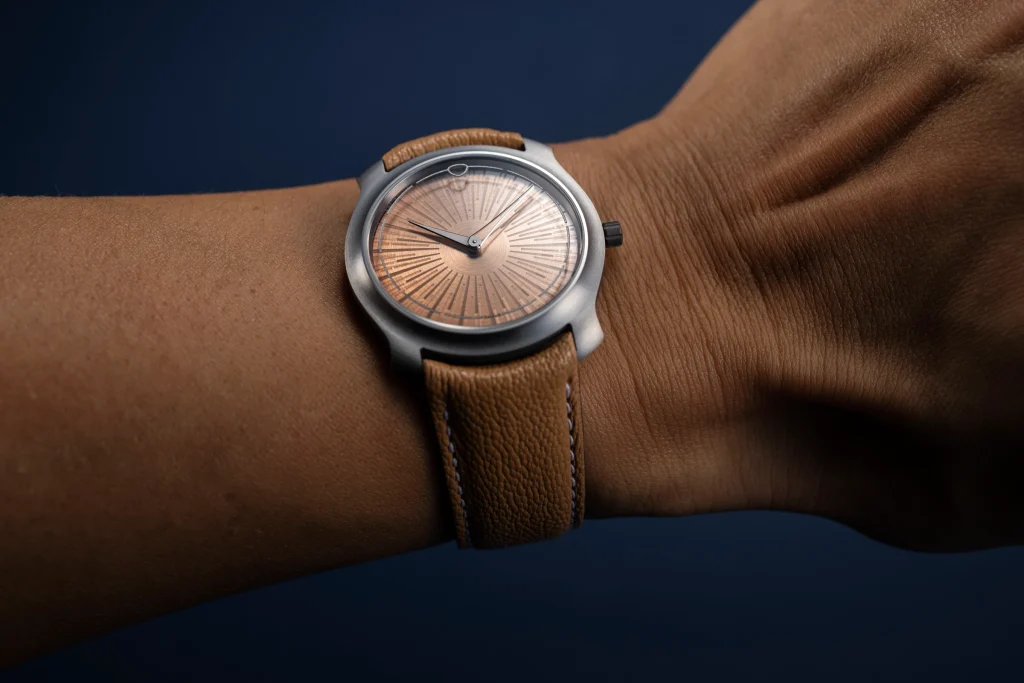
The watch features a 35 mm monobloc tantalum case crafted by J.N. Shapiro in California, combining polished, circular brushed and sandblasted surfaces to reveal the rare metal’s depth and texture. Measuring 6.9 mm thick, the case is fitted with flat sapphire crystals on both sides with anti-reflective coating, a discreet 3.5 mm crown, and a screw-secured caseback with four screws. The construction offers 50 metres of water resistance while maintaining an ultra-thin profile.
The dial is built as a two-layer architectural composition, featuring a lower 400-micron CVD-coated brass layer with a precision-milled strake pattern, topped by a Femtoprint fused borosilicate crystal layer. Hour markers are etched on the inner side of the crystal, creating a floating visual effect, while skeletonised hands with polished and angled flanks complete the minimalist display. The watch is available with a 5N rose gold-coated dial for the series edition or a blue version for the exclusive “Omakase” pieces.
Inside beats a restored and reworked Frederic Piguet 21 ultra-thin hand-wound movement, modified by Mathis Horlogerie and TitAl SA for MING. Measuring only 1.75 mm thick, the movement features 18 jewels, a 38-hour power reserve, and a frequency of 21,600 vibrations per hour. Its titanium skeletonised train bridge, sandblasted surfaces and polished anglage showcase traditional finishing. The watch is completed with a Jean Rousseau Paris calf leather strap, quick-release system and titanium tuck buckle, with an optional matching tantalum bracelet. Limited to 10 Omakase pieces and 15 series editions, it represents an exceptional blend of advanced materials and independent watchmaking.