Dan Kiley Biography: The Visionary Behind Modern American Landscape Design
Dan Kiley did not design gardens, he engineered landscapes with the precision of an architect and the discipline of a mathematician, where others saw trees and open land, he saw geometry, rhythm, and spatial control shaped into living modernism
From corporate atriums to intimate residences, Kiley redefined how nature could exist within the language of modern architecture. Most people think landscape design involves flowers, hedges, perhaps a decorative fountain shaped like a swan. Dan Kiley looked at that idea and essentially threw it into a hedge cutter. Because what he created was something altogether different. Precise. Ordered. Disciplined. Landscapes that felt less like gardens and more like architecture wearing leaves. In mid 20th century America, while cities expanded upward with glass towers and corporations transformed skylines into monuments of steel and ambition, Kiley quietly reshaped the ground beneath them. And he did it with rows of trees so perfectly arranged they could make a military parade look untidy.

Dan Kiley emerged during a transformative moment in post war America, when institutions, universities, civic centres, and corporate headquarters were redefining the physical identity of the nation. It was a period obsessed with modernism, efficiency, and structure. Architects like Ludwig Mies van der Rohe and Eero Saarinen were changing skylines with clean lines and rational forms. Kiley took those same ideas and applied them not to buildings, but to nature itself. And this is where he became extraordinary.
Also Read: Meet Fernanda Canales: The Visionary Shaping Contemporary Mexican Architecture
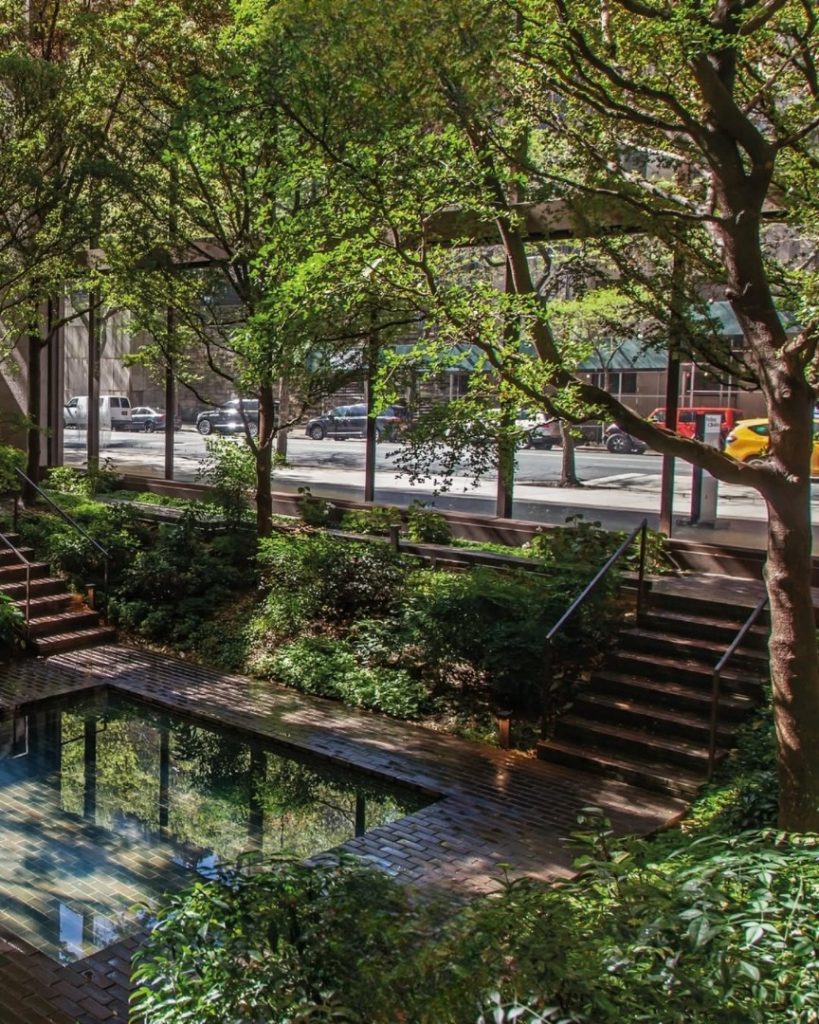
For Kiley, landscape was never random decoration. Trees were not planted casually. Open spaces were not empty gaps waiting to be filled. Everything operated as part of a larger visual system governed by geometry, rhythm, repetition, and movement. He treated landscapes almost like blueprints, where rows of trees became columns, pathways functioned like corridors, and voids created dramatic spatial tension. Nature, under Kiley’s hand, became organised without losing its beauty.

One of the clearest examples of this philosophy is the legendary Ford Foundation Building atrium in New York City. Now, most corporate interiors are about as emotionally engaging as a tax spreadsheet. Kiley changed that entirely. Inside the towering modernist structure, he created an indoor landscape where carefully ordered greenery transformed the cold logic of corporate architecture into something unexpectedly human. The atrium feels calm, almost silent, despite being surrounded by Manhattan chaos. Trees rise in disciplined grids beneath soaring glass walls, proving that even nature can speak the language of modernism when guided by the right mind.

But Kiley’s genius was not limited to monumental public spaces. He could apply the same disciplined philosophy to intimate residential environments without making them feel cold or sterile. At the Shapiro Phelan Residence in Westport, geometry softens into something more personal. The organisation remains unmistakably precise, yet the atmosphere becomes livable, almost relaxed. Pathways, lawns, and tree alignments shape movement and perspective in ways that feel natural despite being meticulously controlled. It is modernism adapted to domestic life, proving Kiley understood that discipline and comfort were not mutually exclusive.
This balance became the defining feature of his career. He was capable of immense order without suffocating nature’s vitality. His landscapes never felt chaotic, yet they also avoided becoming rigid exercises in symmetry. There was movement, rhythm, and emotional depth within the structure. Walking through a Kiley landscape often feels cinematic, as though every tree, shadow, and line of sight has been deliberately composed to guide experience. And perhaps that is why his work continues to feel astonishingly relevant today.
In an era where cities increasingly struggle between density and livability, Kiley’s projects offer a lesson in clarity. He demonstrated that landscapes are not leftover spaces surrounding architecture. They are architecture. Extensions of how humans move, gather, pause, and exist within built environments.
His influence can now be seen across generations of landscape architects who continue to explore minimalism, spatial sequencing, and geometric order in public and private design. Yet few achieve the same calm authority that defined Kiley’s work. His landscapes do not scream for attention. They endure quietly, with confidence. Because Dan Kiley understood something fundamental: nature becomes most powerful not when it is wild, but when it is thoughtfully framed. His legacy is not merely the planting of trees or the shaping of gardens. It is the transformation of landscape into structure itself. Silent, precise, and timelessly modern.