Top Reverso Caseback Art Designs: The Most Beautiful Creations On The Jaeger-LeCoultre Reverso
What began as a practical solution to protect a watch dial has evolved into an artistic tradition where the reversible case of the Jaeger-LeCoultre Reverso transforms into a canvas for miniature masterpieces that celebrate craftsmanship, storytelling and timeless elegance
There are watches that tell the time, and then there are watches that tell stories. The Jaeger-LeCoultre Reverso, perhaps more than any other timepiece in the world of haute horlogerie, belongs firmly in the latter category. Its most distinctive feature the ingenious reversible case was originally conceived in the early twentieth century as a pragmatic response to the rough and tumble world of polo, allowing the wearer to flip the dial safely away from the impact of flying mallets. Yet what began as a clever piece of engineering soon revealed something far more poetic. That smooth metal caseback, once merely a protective shield, gradually became an empty canvas waiting for imagination to leave its mark.
This tradition of artistry reflects the broader philosophy of Jaeger-LeCoultre itself, a maison that has long treated watchmaking as a marriage of technical ingenuity and decorative craftsmanship. The Reverso’s caseback, in particular, invites the wearer into a more intimate relationship with their watch. Flip the case, and suddenly the object on your wrist becomes something else entirely a personal gallery, a hidden narrative, a moment of artistic indulgence that exists purely for the pleasure of discovery. In this spirit, Outlook Luxe turns its attention to some of the most beautiful and imaginative caseback creations ever crafted on the Reverso, celebrating the artistry that transforms a watch into a wearable work of art.
Jaeger-LeCoultre Reverso One ‘Precious Colours’
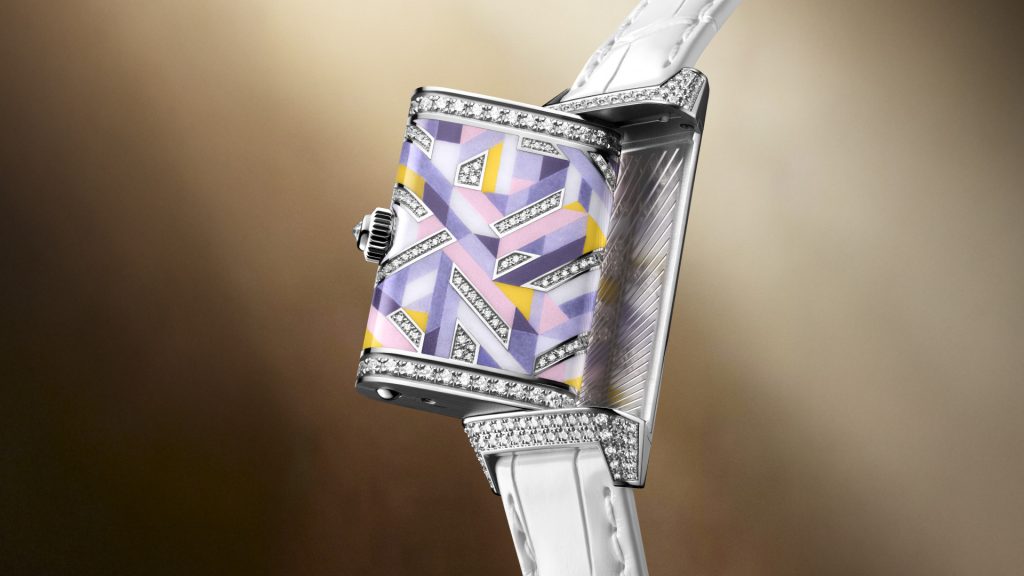
Paying homage to its origins, the Jaeger-LeCoultre Reverso One ‘Precious Colours’ draws direct inspiration from the exuberant elegance of Art Deco, a design language that emerged in the mid 1920s and was later named after the Exposition Internationale des Arts Décoratifs 1925 in Paris. Characterised by strong geometric lines, chevrons, zigzags and bold blocks of colour framed by gleaming metal accents, the style reflected the optimism and cultural transformation that followed the First World War. On this watch, a dazzling geometric motif envelops the entire caseback and flows seamlessly around the case sides, framing the dial while uniting the demanding crafts of miniature painted grand feu enamel and diamond setting.
The process begins with the precise mapping of areas destined for gemstones while the remaining surfaces are hollowed to ensure uniform enamel depth and colour intensity. After sealing the white gold base with fondant enamel and firing it, two layers of opaque white enamel are applied to create a pristine surface. The enameller then paints the intricate geometric pattern entirely by eye using a fine sable brush, carefully ensuring that no adjacent shapes are identical as the design extends across both the flat caseback and convex sides. Multiple coloured layers are applied with firing at nearly 800 degrees Celsius after each application, followed by transparent fondant layers that preserve the colours and create a glass like finish through the Geneva technique, a mastery that typically requires at least five years of experience. The enamelling process alone demands up to 15 firings and nearly 60 hours of work. The case is then entrusted to the gem setter, who uses the grain setting technique to secure 277 diamonds totalling 1.59 carats with tiny claws of white gold, a painstaking task requiring a further 40 hours of precision craftsmanship within the decorative arts atelier of Jaeger-LeCoultre.
Also Read: How India Shaped the Legacy of the Jaeger-LeCoultre Reverso Watch
Jaeger-LeCoultre Reverso One ‘Precious Flowers’ – Green Arums
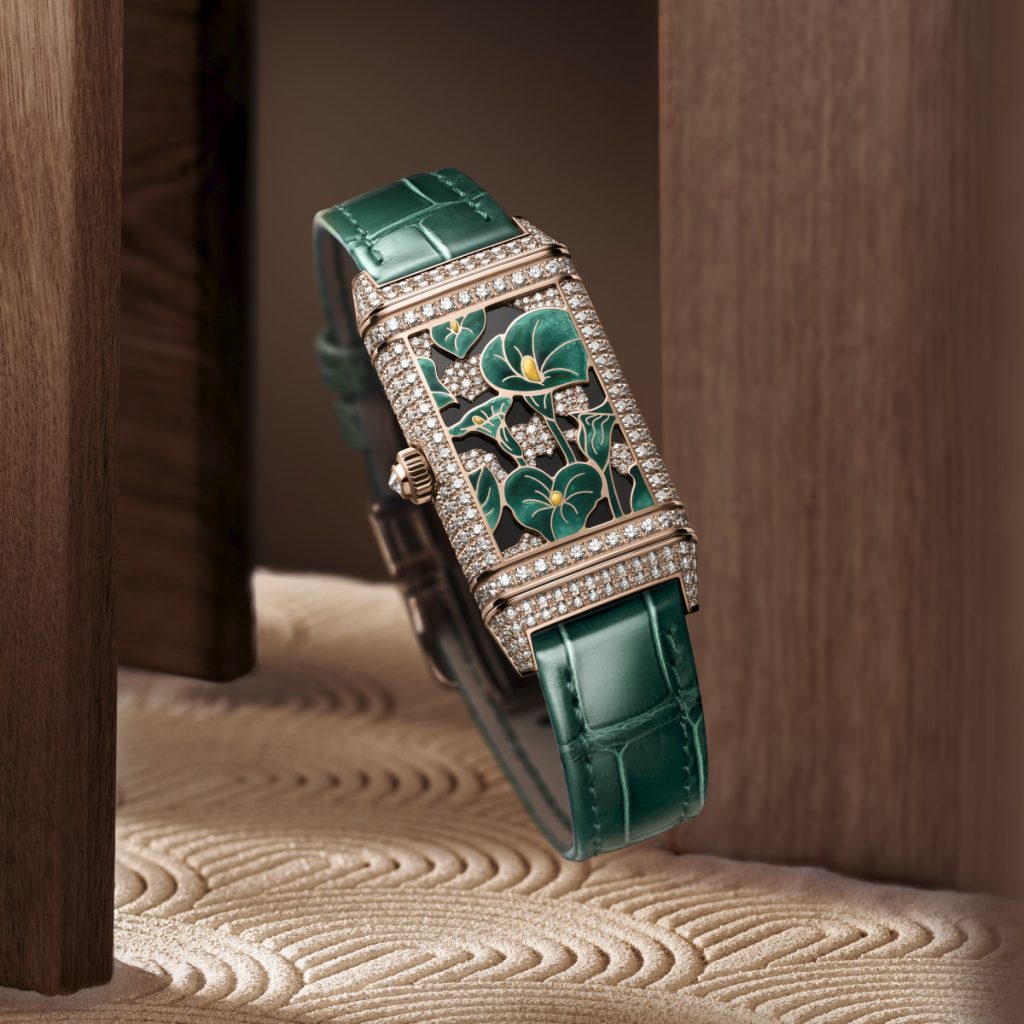
The 2025 Jaeger-LeCoultre Reverso One ‘Precious Flowers’ interpretations present a dazzling celebration of colour and craftsmanship, combining vivid grand feu enamel with brilliant cut diamonds to depict delicate bouquets of arums across the reversible case. Created using the demanding champlevé enamelling technique, the process begins by carefully hollowing the metal surface so that only the outlines of the flowers and leaves remain, forming shallow recesses that are then filled with powdered glass enamel. Each layer must be fired in a kiln at temperatures approaching 800 degrees Centigrade, with up to ten successive applications required to achieve the desired tonal depth, colour intensity and subtle shading. Mastering this intricate craft demands at least two years of rigorous training, as an experienced enameller must instinctively determine the exact moment to remove the piece from the kiln to prevent imperfections such as bubbles or cracks while also anticipating the way pigments transform under intense heat. In the Green Arums interpretation, the decorative composition brings together three artistic techniques in a carefully orchestrated process, with the green grand feu champlevé enamelling alone requiring approximately fifteen hours of meticulous work.
Surrounding the floral motif, a total of 409 diamonds weighing 2.59 carats are set using the snow setting and grain setting techniques, a painstaking stage that requires around forty five hours of precision craftsmanship. To heighten the visual depth and contrast of the composition, black lacquer is carefully applied between the flowers and leaves, with tiny fragments cut precisely to fit the spaces before being secured in place, demonstrating the remarkable decorative artistry cultivated within the ateliers of Jaeger-LeCoultre.
Jaeger-LeCoultre Reverso Rustam Pursues Akvan, the Onager-Div (Aga Khan Museum)
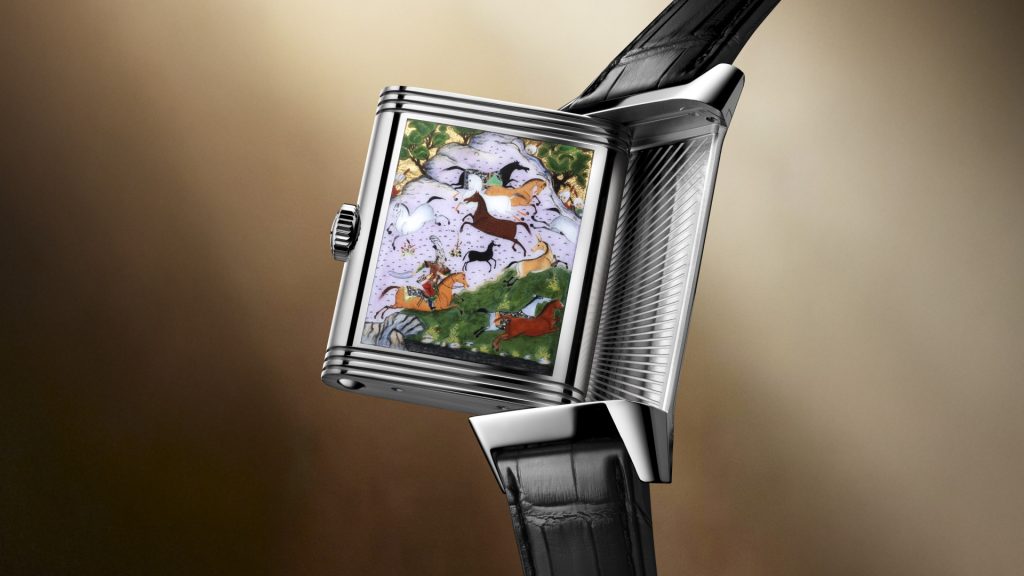
The Jaeger-LeCoultre Reverso Tribute Enamel Shahnameh series pays homage to one of the most revered works of Persian literature, the Shahnameh by the celebrated poet Ferdowsi, through a remarkable union of fine watchmaking and decorative artistry. One of the pieces draws inspiration from an illustrated folio painted circa 1530 to 1535 and attributed to Muzaffar Ali, depicting the legendary hero Rustam preparing to lasso a wild onager that has been threatening a Shah’s horses. In Persian folklore, Rustam, the son of Zal and grandson of Saam, stands among the greatest champions of mythic heroism, and in this scene the moment of action reveals a dramatic twist as the onager suddenly disappears, exposing its true identity as the demon Akvan.
This dramatic narrative is meticulously recreated on the caseback through miniature enamel painting, echoing the vibrant colours and intricate detailing of the historic manuscript. Complementing the richly illustrated reverse, the dial features deep green grand feu enamel applied over an elaborate guilloché lozenge pattern composed of 980 engraved lines, a process requiring approximately seven hours of painstaking craftsmanship. The result is a refined dialogue between front and back, where the decorative techniques of guillochage, grand feu enamelling, paillonnage and miniature enamel painting come together in extraordinary harmony. Comprising four distinct interpretations, each limited to just ten pieces, the series reflects the enduring artistic philosophy of Jaeger-LeCoultre, transforming the Reverso into both a timekeeping instrument and a canvas celebrating the grandeur of Persian storytelling.
Jaeger-LeCoultre Reverso Tribute Enamel ‘Horse’
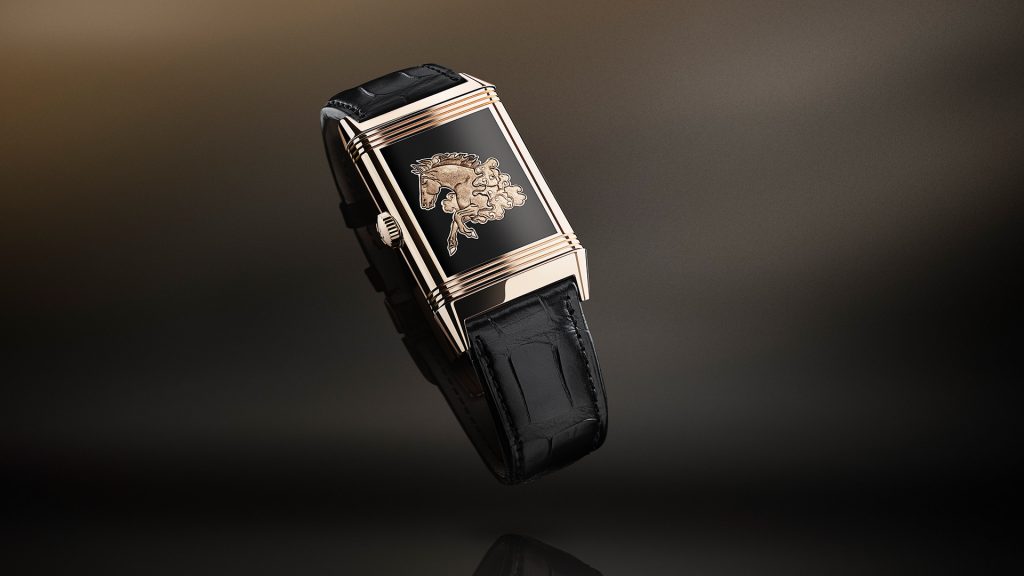
The Jaeger-LeCoultre Reverso Tribute Enamel Horse reveals its most captivating artistry when the case is turned to its reverse side, where a majestic hand engraved horse appears to leap dynamically from golden clouds suspended in the sky. The sculpted figure is surrounded by opaque black grand feu enamel, whose deep glossy surface heightens the brilliance of the horse’s polished metal contours, while delicate details on the mane, muzzle and hooves are enhanced with black rhodium accents to create a strikingly lifelike presence. A sand blasted texture applied to the surrounding clouds intensifies the sense of motion, adding depth and visual drama to the composition. To achieve this sculptural effect, the master engraver employed the demanding technique known as modelled engraving, carefully carving the figure with ten differently sized chisels over nearly eighty hours of meticulous work.
Unusually, the engraving was executed not on bare metal but on a surface already coated with grand feu enamel, requiring extraordinary precision to avoid damaging the flawless layer beneath. On the dial side, the watch retains the elegant simplicity of the classic Jaeger-LeCoultre Reverso Tribute aesthetic, featuring faceted appliqué hour markers, a chemin de fer minute track and Dauphine hands set against the same luminous black grand feu enamel background. Achieving this deep, velvety black demands five to six successive enamel layers, each carefully fired and cooled over several days before being polished for half a day to obtain a perfectly uniform sheen. The exact match between dial and caseback reflects the remarkable mastery preserved within the in house decorative ateliers of Jaeger-LeCoultre, one of the few manufactures to safeguard the ancient crafts of enamelling and engraving under a single roof.
Jaeger-LeCoultre Reverso The Doge’s Palace

Inspired by the atmospheric brilliance of a painting by Claude Monet, the Jaeger-LeCoultre Reverso Tribute Enamel Doge’s Palace captures the shimmering beauty of Doge’s Palace as seen from the waters of the Grand Canal in Venice. Painted from a gondola at around eight in the morning, Monet’s original work sought less to depict architecture and more to capture the fleeting atmosphere and reflections of morning light dancing across the water. Recreating this delicate interplay of colour and luminosity on the reverse of the watch required nearly seventy hours of meticulous miniature enamel painting by the artisans of Jaeger-LeCoultre. On the dial side, a refined lozenge guilloché pattern enhances the visual experience by creating subtle variations of light and shadow as the watch moves, echoing Monet’s lifelong fascination with changing natural light.
The intricate pattern is composed of 981 engraved lines, each requiring five precise passages of a hand operated lathe, resulting in a total of 4,905 passages during the engraving process. This painstaking work, taking approximately eight hours to complete, is then enriched with layers of translucent blue grand feu enamel, whose depth and radiance amplify the dynamic geometry of the guilloché surface while reflecting the fluid movement and luminous atmosphere of Monet’s celebrated Venetian masterpiece.