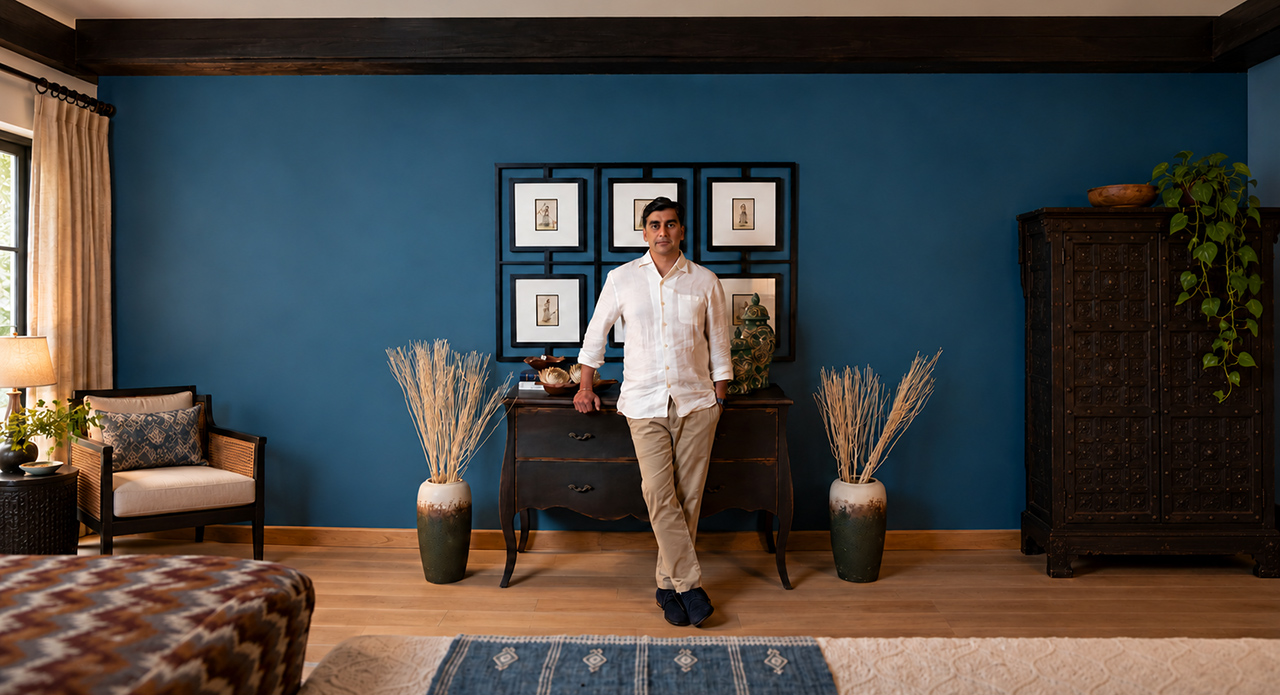
In a landscape saturated with mass-produced design, Intent Made stands as a rare force of quiet rebellion—where furniture becomes sculpture, and craft is treated as a concept. Founded by architect and designer Swetha Raju, the studio navigates the intersection of material innovation and heritage technique with startling clarity. Whether through the rhythmic poetry of hammered brass or the organic geometry of tree forks, Intent Made’s pieces embody a language that is both deeply Indian and unmistakably contemporary.
In the exclusive interview with Outlook Luxe, Swetha Raju reflects on the values that shape Intent Made: invisible craftsmanship, interdisciplinary experimentation, and the exciting future of Indian design on the global stage.
View this post on Instagram
Excerpts from the interview:
Intent Made stands at the confluence of architecture, design, and fine craftsmanship. How has your architectural training shaped the way you conceptualise furniture—not just as objects, but as spatial experiences?
Architectural training instills a sensitivity to scale, proportion, and context—principles that directly inform how furniture is approached at Intent Made. Each piece is conceived not just as an object but as an intervention within a space. The form, materiality, and detailing are all considered in relation to the environment and the human body. This spatial lens allows the studio to create furniture that shapes atmosphere and evokes a tactile, immersive experience.
In your early collaboration with ARUP, you explored biomimicry through tree forks and robotic milling. How did that technical and material experimentation influence the DNA of Intent Made?
This early exploration laid the foundation for a design process rooted in both nature and engineering. Studying natural systems like tree forks revealed the structural intelligence embedded in organic forms, while robotic milling enabled a precise, digital translation of those principles. This combination of intuitive and computational thinking continues to inform the studio’s approach—where material experimentation, structural logic, and craft coexist to produce work that is both poetic and performative.
Luxury in furniture often lies in the unseen—joinery, finishing, material integrity. How does Intent Made approach this invisible craftsmanship while maintaining a bold, sculptural presence?

Invisible craftsmanship is central to Intent Made’s philosophy. Every joint, contour, and finish is refined to the highest standards, even when not immediately visible. This quiet precision is what lends the work its longevity and character. At the same time, the studio embraces expressive forms—pieces that carry a sculptural identity. The result is a dialogue between restraint and statement, where the integrity of construction supports the boldness of form.
Your collections like Crafted Alchemy and An Escapade with Nature demonstrate a poetic conversation between nature and material. What does ‘contemporary Indian design’ mean to you in this context, and how do you reconcile it with global design expectations?
Contemporary Indian design, in this context, is defined by depth—of material understanding, cultural layering, and process-driven creation. It moves beyond stylistic motifs to engage with craftsmanship as a living, evolving language. Intent Made positions this philosophy within a global framework—not by adapting to international trends, but by presenting work that is grounded, rigorous, and emotionally resonant. The studio’s collections offer a new interpretation of Indian design—one that is deeply rooted, yet globally relevant.
In a world of mass manufacturing, Intent Made takes a ‘design-build’ approach. What does that studio model allow you to do that traditional furniture labels can’t?
View this post on Instagram
The design-build model allows for fluidity between ideation and execution. It enables rapid prototyping, material testing, and hands-on collaboration with artisans—all under one roof. Unlike traditional models, where design and production are often disconnected, this approach allows the final outcome to evolve organically. It also opens up space for innovation, particularly in terms of technique, form, and finish. The result is work that is more responsive and refined.
You’ve spoken about reviving traditional Indian techniques—marquetry, brass hammering, and carving—but within a contemporary silhouette. How do you ensure the craft doesn’t become decorative but structural to the design narrative?
At Intent Made, technique is integral to concept. Traditional crafts are not used as surface embellishments but as narrative and structural devices. Marquetry becomes a way to explore memory or erosion; brass hammering introduces rhythm or resonance; and carving brings depth and tactility. These crafts are embedded into the design language, not layered onto it—ensuring that the making is inseparable from the meaning.
Looking ahead, what excites you most about the intersection of material innovation and heritage craftsmanship? Are there any Indian crafts or indigenous materials you feel are still waiting to be rediscovered through design?
One of the most exciting frontiers is the potential of glass—particularly when approached through both traditional and contemporary lenses. India has a rich but underexplored history with hand-blown and cast glass, and there’s an opportunity to reframe this material beyond its conventional use. The studio is interested in exploring how glass can behave structurally, how it interacts with light and texture, and how it can be paired with brass or wood in unexpected ways.
In Conclusion…
As Indian design continues to evolve on the global stage, studios like Intent Made are defining what modern luxury can look and feel like—intimate, rooted, and intelligently crafted. Swetha Raju’s vision extends beyond aesthetics; it’s about cultivating a culture of thoughtful making, where every material, technique, and silhouette carries meaning. By blurring the lines between architecture, art, and craft, Intent Made isn’t just producing furniture—it’s shaping a new design vocabulary that honours heritage while pushing boundaries. The future of Indian design, it seems, is being built with intent.