

The Rolex Cyclops lens stands today as one of the most recognisable details in luxury watchmaking, yet its origins are rooted in a simple need for clarity rather than a desire to create a visual signature. In the early 1950s, Rolex founder Hans Wilsdorf realised that the date window on the Rolex Datejust, though innovative for its time, was difficult to read at a quick glance. According to the story often shared by Rolex historians, Wilsdorf was inspired after hearing that his wife found the date display too small, prompting him to seek a solution that would enlarge the numerals without enlarging the watch itself.

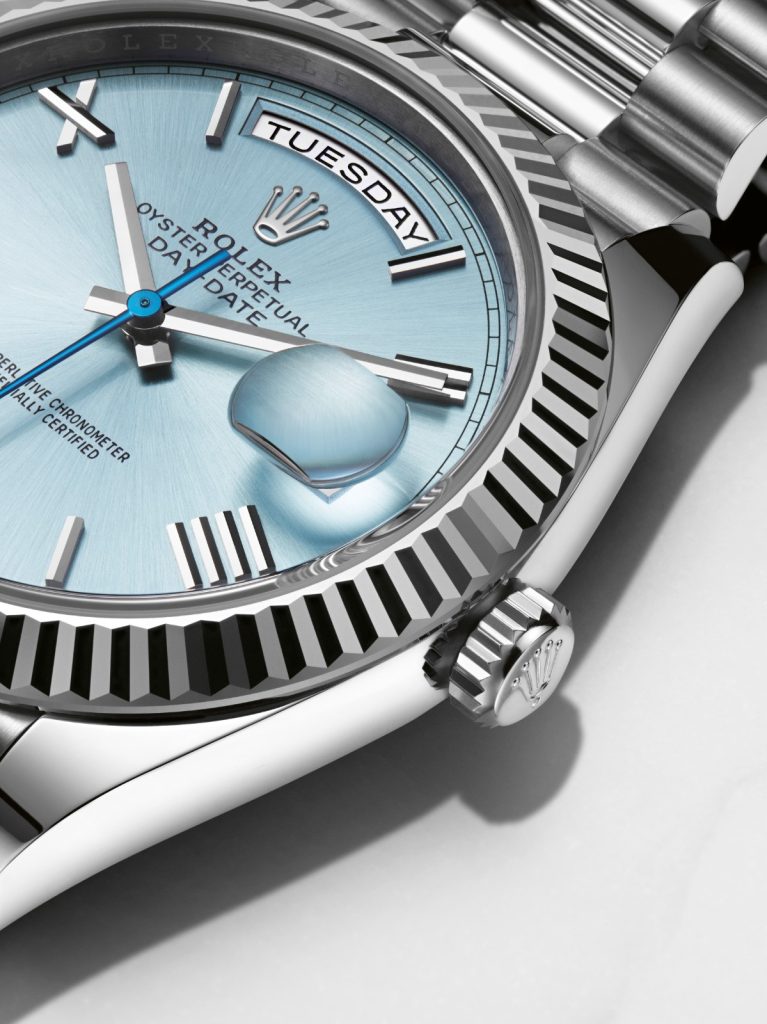
Rolex engineers responded by designing a small convex lens placed directly above the date window, a modest bubble that magnified the numerals by two and a half times and dramatically improved legibility. When the Cyclops lens made its debut in 1953, no one could have predicted that this tiny magnifying feature would become so deeply woven into the identity of the brand and eventually become one of its most enduring hallmarks.
Technical Evolution And Material Mastery
Although the Cyclops lens may appear simple, its creation demanded impressive precision and ingenuity. Early iterations were crafted into acrylic crystals, a material soft enough to mould and shape with relative ease. The lens needed perfect clarity, ideal curvature, and flawless alignment so the date could be read instantly without optical distortion. Over time, as Rolex sought improvements in durability, scratch resistance, and refinement, the brand began transitioning from acrylic to sapphire crystals, a notoriously hard substance that introduced new challenges.

Sapphire required advanced cutting and bonding methods because the Cyclops lens could no longer be moulded into the crystal but had to be affixed with exact precision. Rolex eventually developed a seamless fusion technique that allowed the lens to sit firmly on the sapphire surface, strong enough to withstand significant pressure and everyday wear. Modern versions also feature anti reflective coatings on both sides to ensure the enlarged date remains crisp and legible under any lighting condition. This evolution shows how the Cyclops lens reflects not only aesthetic identity but also Rolex’s commitment to continual innovation and technical improvement.
Cultural Impact And Watchmaking Significance
As the decades passed, the Cyclops lens became more than a functional enhancement. It became a cultural symbol and an unmistakable silhouette in the world of horology. A Rolex with a date function is almost always imagined with this tiny magnifying bubble above it, and its presence often serves as an unofficial authentication cue among enthusiasts because counterfeiters frequently fail to replicate the exact magnification ratio or optical clarity. While most Rolex models featuring a date use the Cyclops lens, certain professional watches historically avoided it. One notable example is the early Sea Dweller which lacked the Cyclops for many years because the added feature was difficult to secure under the extreme pressure endured by saturation divers.
Only after Rolex perfected a more resilient fusion technique did the modern Sea Dweller begin to feature the lens again. Despite its widespread acceptance, the Cyclops has inspired debate among collectors. Some love its distinctive character while others prefer the clean symmetry of an unbroken crystal. Yet its importance to Rolex’s design language cannot be denied. The Cyclops transforms a simple date function into a visual anchor, one easily spotted across a room and instantly associated with the brand’s heritage.
Legacy Of Function, Form, and Identity

The enduring appeal of the Cyclops lens lies in its ability to act as both a practical tool and a defining stylistic element. Rolex is known for refining rather than radically reinventing its aesthetic language, and the Cyclops perfectly embodies this philosophy. It adds convenience without compromising the watch’s integrity and introduces personality without overwhelming the design. It also highlights the way Rolex blends everyday usability with engineering excellence.
The magnified date improves the wearer’s experience and reinforces the concept of the watch as a trusted companion rather than just an accessory. At the same time, the lens has become a bold marker of identity, a small design flourish that has stood the test of time and trends. In a world where watch design evolves rapidly, the Cyclops lens remains reassuringly consistent. It is a testament to Rolex’s belief that great design is not about complexity but about clarity, reliability, and thoughtful execution. What began as a simple effort to improve legibility has grown into a symbol of Rolex itself, a tiny yet powerful reminder that in watchmaking it is often the smallest details that leave the greatest impact.