

There are watchmakers, and then there is Jaeger-LeCoultre, a name that does not merely exist within the industry but has, for nearly two centuries, quietly engineered its very foundation. Founded in 1833 by Antoine LeCoultre in the unforgiving isolation of the Vallée de Joux, the maison began not with grand declarations, but with an obsession for precision so exacting it bordered on madness, inventing tools capable of measuring microns long before such accuracy became standard practice. From those early days, it evolved into a workshop of relentless innovation, producing movements and complications so refined that many of the most revered names in watchmaking turned to it to power their own creations, often quietly, almost discreetly. The early 20th century partnership with Edmond Jaeger further shaped its identity, blending Swiss mechanical rigour with a refined Parisian design sensibility, giving rise to enduring icons like the Reverso in 1931, a watch born from function yet elevated into timeless design. Over the decades, Jaeger-LeCoultre has created more than a thousand calibres and secured hundreds of patents, a staggering contribution that reinforces why it is known as the Watchmaker of Watchmakers, not as a marketing line but as an industry truth. So when it steps onto the stage at Watches and Wonders 2026, it does so not in search of applause, but with the quiet authority of a brand that has long defined the very essence of horology, presenting new timepieces that are less about novelty and more about the continuation of a legacy built on precision, invention, and an unwavering commitment to mastery.
Master Hybris Mechanica Ultra Thin Minute Repeater Tourbillon

Jaeger-LeCoultre introduces the Master Hybris Mechanica Ultra Thin Minute Repeater Tourbillon, a striking new expression of its celebrated ultra-thin calibre that seamlessly brings together a minute repeater and a flying tourbillon. Housed in an 18K pink gold case measuring an astonishingly slim 8.25 mm, the watch reveals its entire mechanical architecture through sapphire transparency, while a pared-back, open-worked ring dial frames the movement in full view. This exceptional creation, rooted in Calibre 362 first unveiled in 2014, is protected by seven patents, six of which were developed specifically for this groundbreaking movement, and combines some of horology’s most revered complications, including a fully flying one-minute tourbillon and a richly resonant minute repeater. Measuring 41.4mm in diameter, the timepiece is powered by the automatic Jaeger-LeCoultre Calibre 362, offering hours and minutes, a minute repeater with silent time-lapse reduction, and a one-minute flying tourbillon, alongside a 42-hour power reserve. Its aesthetic is defined by a white gold open-worked dial on the front and a transparent sapphire caseback, paired with 30 metres of water resistance and a brown alligator leather strap secured by an 18K pink gold pin buckle, presented as reference Q13125S2 in a limited edition of just 10 pieces.

The artistry of integration lies at the heart of this watch, with its intricately engineered case composed of 60 parts and reinterpreted to accommodate the ultra-slim calibre, featuring a patented alternative to the traditional minute repeater slide through a retractable button at 10 o’clock paired with a locking and release mechanism at 8 o’clock, both redesigned to blend seamlessly into the refined case architecture. The dial itself is a study in contrast and craftsmanship, where the 18K pink gold case showcases a variety of finishes that play with light, encircling an open-worked white gold ring that reveals the guilloché 18K pink gold winding rotor, meticulously crafted within the Métiers Rares ateliers, while matching pink gold hour markers, logo, hands, and rotor create visual harmony. Central to its slender profile is the flying tourbillon, composed of 59 components and weighing a mere 0.248 grams, suspended without an upper bridge to reduce height and enhance visual lightness, eliminating excess material while preserving structural integrity. Complementing this is the peripheral oscillating mass, an ingenious departure from conventional central rotors, circling the movement to maintain slimness while ensuring efficient automatic winding.
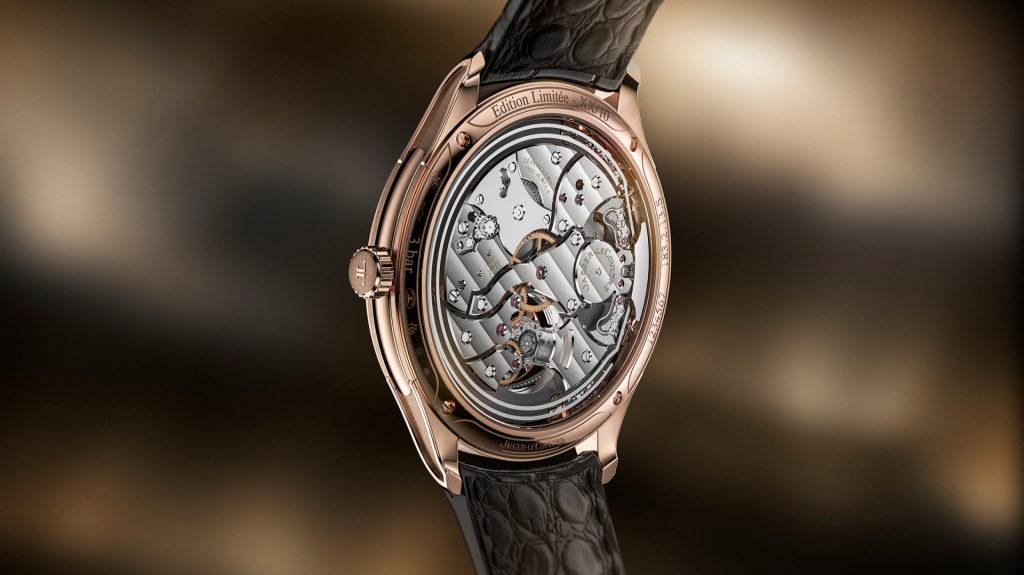
Every element of Calibre 362, from the minute repeater to the flying tourbillon and peripheral rotor, has been conceived not as an addition but as an integral contributor to thinness, exemplified by the 187-component minute repeater mechanism engineered for both acoustic excellence and compactness. Its one-piece, square-profile gongs are optimised for tonal clarity and resonance, paired with articulated trebuchet-style hammers that deliver precise, powerful strikes, while the patented silent time-lapse reduction mechanism ensures a seamless, uninterrupted chime sequence by minimising pauses between hour and minute strikes. The visual transparency of the movement is further enhanced by the absence of bridges supporting the tourbillon and the inclusion of a patented flying balance wheel, complemented by an innovative S-shaped hairspring designed to maintain concentric precision within the constraints of ultra-thin construction. Achieving this remarkable complexity within a movement just 5 mm thick is made possible by three key innovations, chief among them the peripheral rotor mounted on 36 ceramic ball bearings, which winds efficiently in both directions while preserving the watch’s extraordinary slimness and allowing an unobstructed view of its mechanical beauty from both sides.
Master Hybris Inventiva Gyrotourbillon À Stratosphère
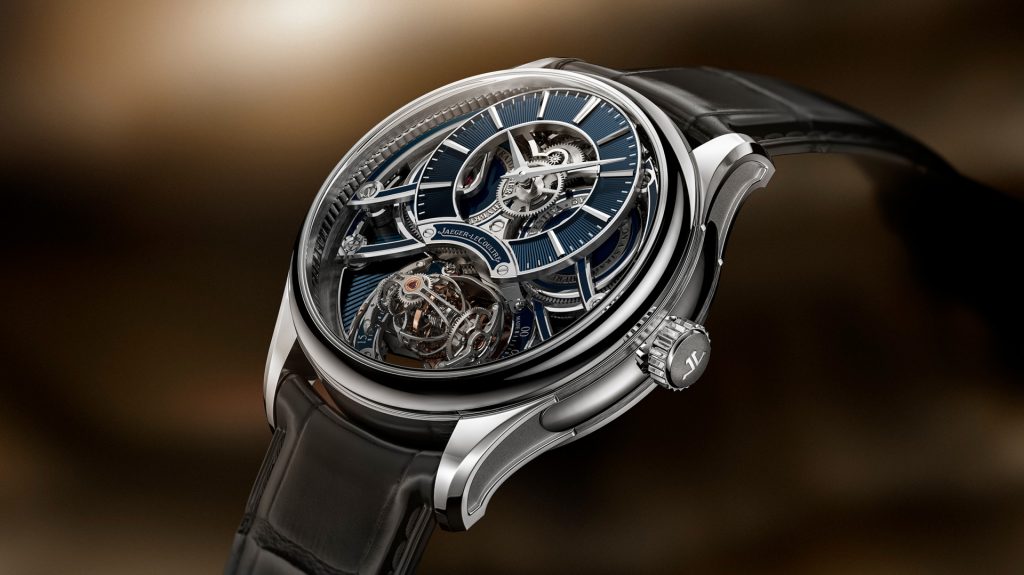
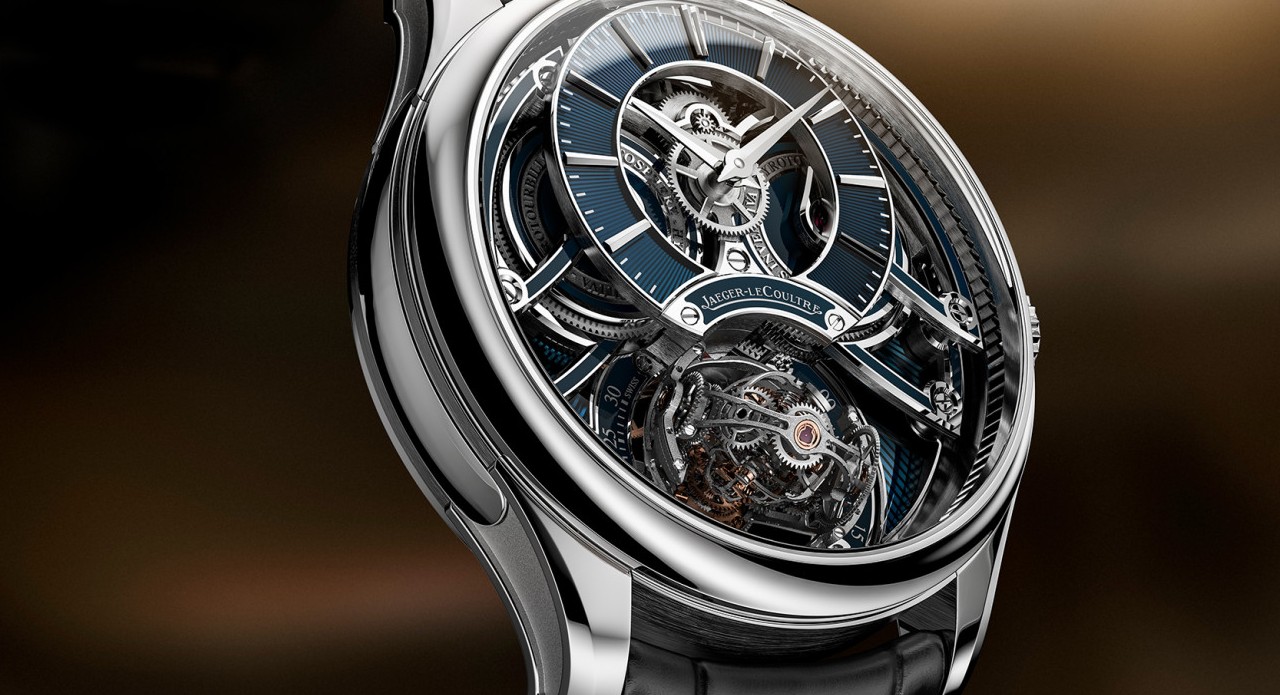
Jaeger-LeCoultre once again pushes the boundaries of horological possibility with the Master Hybris Inventiva Gyrotourbillon À Stratosphère, a timepiece that stands as the latest chapter in a near two-century-long pursuit of precision. At its core lies the extraordinary Calibre 178, a manually wound movement built around a triple-axis tourbillon construction that achieves an astonishing 98 percent positional coverage, arguably making it one of the most precise and mechanically ambitious tourbillon wristwatches ever created by the maison. This remarkable innovation also signals the debut of a new series within the Hybris universe, aptly named Hybris Inventiva, a platform dedicated to forward-thinking mechanical ingenuity. Encased in a 42 mm platinum case with a thickness of 16.15 mm, the watch houses a movement that is as visually captivating as it is technically complex, finished and decorated by hand using the brand’s revered Métiers Rares techniques, including guilloché, enamel, and lacquer, all of which accentuate the architecture of the calibre.
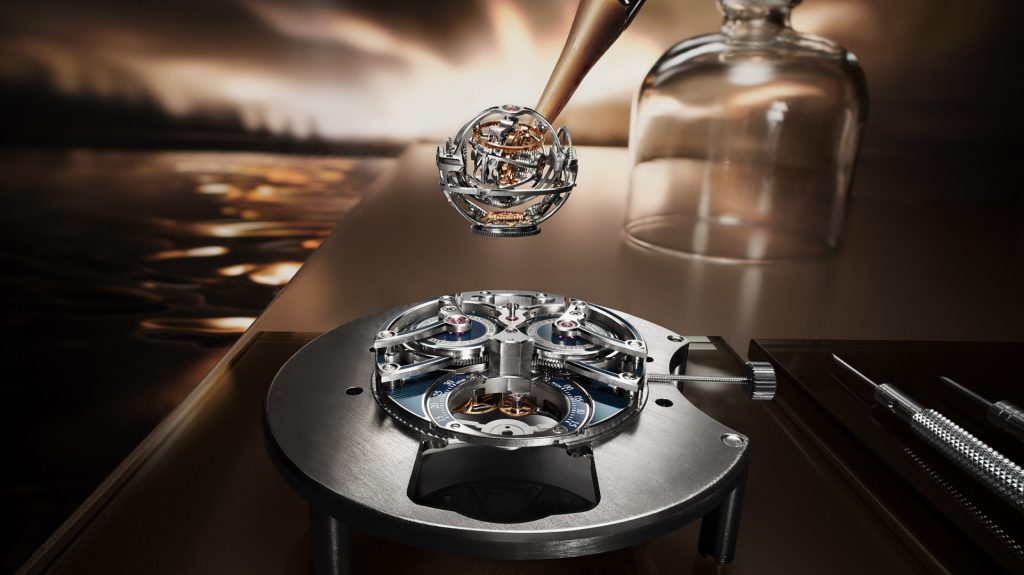
The specifications reflect its mechanical stature, with hours, minutes, and seconds displayed alongside the triple-axis Gyrotourbillon À Stratosphère, supported by a generous 72-hour power reserve and operating at a frequency of 4 Hz or 28,800 vibrations per hour. The front dial features a ring design adorned with guilloché and translucent blue enamel, while the transparent caseback offers an uninterrupted view of the movement, complemented by 50 metres of water resistance and a blue alligator leather strap secured with an 18K white gold folding buckle. Presented as reference Q5306480, the watch is limited to just 20 pieces, underscoring its exclusivity.
The depth of craftsmanship becomes immediately evident in the extraordinary hand-finishing, most notably through 65 hours dedicated to meticulous hand-bevelling. This painstaking work extends across 55 individual components, including 20 bridges, 18 elements of the tourbillon cage, 11 wheels, and six additional mechanism parts, culminating in an impressive 64 inner angles, each executed with extreme precision. Adding further complexity, the calibre incorporates 33 components crafted from solid gold, a choice that elevates both aesthetic richness and technical difficulty, as assembling such materials demands exceptional dexterity and care from the watchmaker.
Visually, the front of the watch is a striking composition of colour and texture, where 18K white gold movement plates are first decorated with sunray guilloché before being coated in translucent blue enamel, creating a luminous depth. Hollowed-out white gold bridges are filled with matching blue lacquer, while even the covers of the twin spring barrels, visible at approximately 2 and 10 o’clock, are engraved and hand-lacquered in the same tone, ensuring visual coherence. The dial architecture is further enhanced by two decentralised rings, one dedicated to hours and minutes with an open-worked centre revealing the hand arbour and barrel decorations, and the other encircling the Gyrotourbillon at 6 o’clock, marked for 30 seconds and animated by a small red arrow. This layered construction creates a dynamic interplay of volume and depth, transforming the calibre into a sculptural entity.

Despite the visual spectacle, the technical focus remains firmly on precision and performance, with the triple-axis tourbillon acting as the centrepiece, regulating timekeeping across multiple positions with remarkable stability. The platinum case, while outwardly restrained, reveals a sophisticated interplay of polished, brushed, and micro-blasted finishes that catch the light with subtle complexity, echoing the intricacy within. On the reverse, the transparent sapphire caseback unveils a breathtaking view of Calibre 178’s supporting structure, where solid 18K white gold bridges are decorated with Côtes de Genève, hand-bevelling, and mirror polishing, accompanied by 53 ruby jewels, some set in gold chatons, providing a vivid contrast against the monochrome palette.
Notably, the design of the polished steel bridge supporting the Gyrotourbillon from the back draws inspiration from a historic 1946 Jaeger-LeCoultre pocket watch tourbillon, while the choice of stainless steel for this component and the hours-minutes bridge reflects a deliberate engineering decision, favouring durability and resistance in critical structural areas. The result is a timepiece that not only embodies technical mastery but also pays homage to the maison’s heritage, seamlessly blending tradition with cutting-edge innovation in a way that few watchmakers can rival.
Master Grande Tradition Tourbillon Jumping Date

Jaeger-LeCoultre continues to refine its legacy of precision with the Master Grande Tradition Tourbillon Jumping Date, a sophisticated reinterpretation of the historically significant Calibre 978, now presented with a reimagined movement architecture and contemporary aesthetic. Originally introduced in 2009 and famously awarded first place in the modern-era chronometry competition held at the International Museum of Horology, Calibre 978 proved its exceptional accuracy and reliability during a rigorous 45-day trial that tested resistance to shocks, magnetism, and real-world wear, reaffirming both the relevance of the tourbillon escapement and the Manufacture’s mastery of precision engineering. In this latest iteration, the movement evolves visually and technically, with an open-worked dial design that brings its most compelling features to the forefront, including the tourbillon, the distinctive “jumping” date mechanism, and a cleverly integrated 24-hour disc, all framed within a newly designed 42 mm pink gold case composed of 60 meticulously finished components.
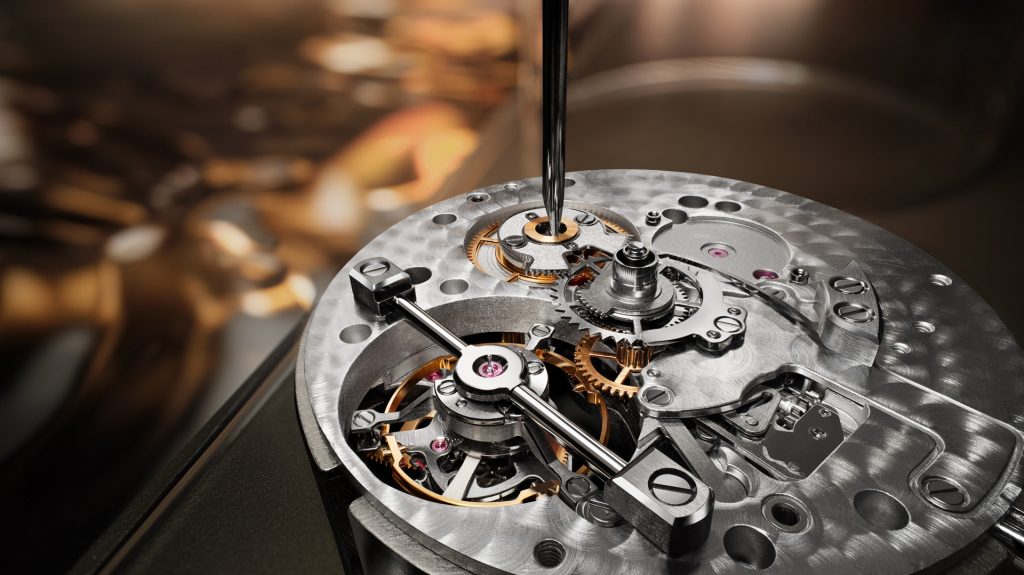
The specifications reflect both elegance and complexity, with the 18K pink gold case measuring 42 mm in diameter and 12.5 mm in thickness, housing the automatic Jaeger-LeCoultre Calibre 978 with a 45-hour power reserve. The watch displays hours, minutes, and seconds via a tourbillon subdial, alongside a jumping date and a second time zone indicated through a 24-hour disc, while the one-minute tourbillon remains central to its chronometric performance. The front dial features a rich blue enamel finish layered over a barleycorn guilloché pattern, contrasted by pink gold applied hour markers, while the transparent caseback reveals the movement’s refined finishing. With water resistance up to 5 bar, the timepiece is paired with a black alligator leather strap secured by an 18K pink gold folding buckle and is offered as reference Q4202480 in a limited edition of 100 pieces.
At the heart of its technical appeal is the ultra-light regulating organ, where the tourbillon, composed of 64 components, weighs less than 0.5 grams, contributing to both precision and efficiency. Equally distinctive is the intuitive jumping date mechanism, first introduced with Calibre 978, which displays the dates around the dial’s periphery, cleverly positioning the 15 and 16 on either side of the tourbillon aperture. At midnight on the 15th, the date hand glides seamlessly to the 16th, ensuring the tourbillon remains unobstructed, a thoughtful blend of functionality and visual clarity. Complementing this is the independently adjustable 24-hour disc, which not only indicates day and night when synchronised with the main time display but can also function as a second time zone indicator, adding practical versatility to the complication.
Aesthetically, the movement is elevated by exquisitely finished 18K white gold bridges for both the tourbillon and the 24-hour disc, shaped into elegant rounded profiles using the demanding high watchmaking technique of berçage. This intricate process, achieved through careful burnishing, creates a smooth half-moon form that enhances the visual harmony of the calibre. Viewed through the sapphire caseback, these bridges are adorned with Côtes de Genève soleillé, a signature Jaeger-LeCoultre finish, while the base plate radiates outward in alignment with the tourbillon’s architecture. The 22K pink gold monobloc oscillating weight, featuring a large cutaway, ensures an unobstructed view of the movement while maintaining efficient winding.
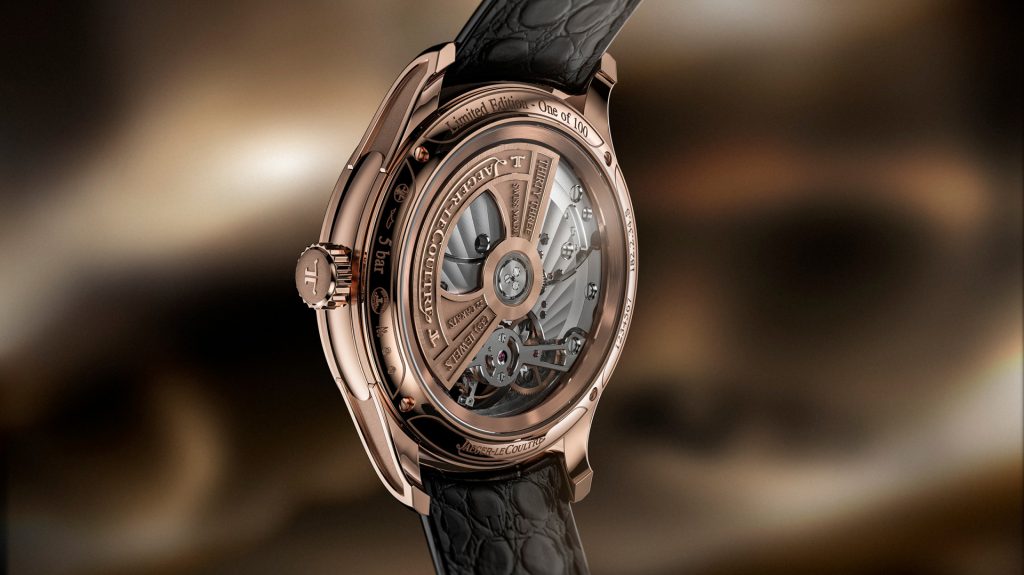
The redesigned dial further amplifies the mechanical spectacle, with carefully placed apertures revealing the inner workings, including the calendar driver mechanism at 9 o’clock, which governs the date hand’s rapid transition, and a secondary opening at 2 o’clock exposing structural screws, offering a rare glimpse into the watch’s construction. The interplay of textures is enhanced by deep blue translucent enamel layered over a barleycorn guilloché base, creating depth and richness, while a long pointer hand tipped with a red JL anchor indicates the date, complemented by a red arrow marking the 24-hour subdial. Encasing this complexity is a refined pink gold case that adheres to the Grande Tradition design language, combining polished, brushed, and micro-blasted finishes to create a dynamic play of light. With the Master Grande Tradition Tourbillon Jumping Date, Jaeger-LeCoultre not only honours the historical significance of Calibre 978 but also elevates it into a contemporary expression of precision, innovation, and timeless design.
Master Control Collection
Jaeger-LeCoultre refines its contemporary classicism with the Master Control Chronometre collection, a line defined by a sharply articulated aesthetic signature that translates vintage design codes into a modern, highly cohesive form. Characterised by sleek case proportions, a fully integrated metal bracelet, and a level of detail that is both rich and restrained, the collection achieves a remarkable harmony through its recurring Dauphine-inspired design language, visible across the hands, indexes, bracelet links, and overall geometry. This visual coherence is further enhanced by a sophisticated interplay of volumes and surfaces, where polished and brushed finishes contrast dynamically, while interlocking shapes and repeating angles create a subtle architectural tension across the watch. The seamless integration of case and bracelet is particularly striking, achieved through a fluid line that extends from the widest point of the case into the first bracelet link, with satin-brushed surfaces along the case sides and bracelet attachments contrasting against polished bezels, crowns, and bevels to create a continuous, light-catching silhouette that wraps elegantly around the wrist.
The three-row bracelet itself is a masterclass in both comfort and design, engineered for flexibility while showcasing a refined interplay of textures. The central row alternates between flat, vertically satin-brushed links and highly polished triangular prism-shaped elements, whose sharp facets are echoed in the outer rows through pronounced V-shaped bevels, also polished to enhance contrast. These angular motifs draw direct inspiration from the slim Dauphine hands and faceted hour markers, visually linking bracelet and dial into a unified composition. The dials, finished with a sunray-brushed texture, present a richly coloured yet subtly smoky backdrop, with a peripheral chapter ring marked for both minutes and seconds, and five-minute intervals indicated by dots aligned with the hour markers, reinforcing the technical precision of the chronometre designation. Beneath the sapphire caseback, an open-worked 22K pink gold rotor reveals finely decorated movements that embody the Manufacture’s expertise in balancing aesthetic refinement with mechanical performance, particularly through innovations that enhance energy efficiency while preserving slimness.
Central to this achievement is a re-engineered gear train designed to accommodate a central seconds display without increasing thickness, achieved through a side-by-side wheel arrangement that ensures efficient energy transmission. A silicon escapement further improves performance by reducing friction, wear, and sensitivity to magnetic fields, while a high-frequency balance wheel operating at 4 Hz delivers enhanced stability against shocks and environmental disturbances. This precision is visually expressed through a finely subdivided minute track that allows time to be read to the nearest quarter-second, a subtle yet telling indicator of chronometric capability. The movement finishing is equally meticulous, with bridges adorned with refined Côtes de Genève aligned with those on the rotor, reworked into cleaner, more architectural forms, all bevelled at 45 degrees with sunken jewels, while golden wheels and silvery-grey screws provide a balanced visual contrast.

Leading the collection is the Master Control Chronometre Date Power Reserve, debuting the new in-house Calibre 738, housed in a slim 39mm stainless steel case measuring just 9.2 mm thick. Its dial design pays homage to the 1951 Futurematic, with two symmetrically placed sub-dials at 9 o’clock and 3 o’clock, displaying power reserve and date respectively, both accented with red highlights that create visual continuity. The blue-grey dial features a subtle gradient, transitioning from lighter tones at the centre to darker edges, while the sub-dials are distinguished by an azuré finish. Measuring only 4.97 mm thick, Calibre 738 delivers an impressive 70-hour power reserve at a frequency of 4 Hz, exemplifying Jaeger-LeCoultre’s mastery of compact, efficient movement design.

The Master Control Chronometre Perpetual Calendar extends this technical sophistication with a full calendar display arranged across four sub-dials, indicating months and year, day, date, and moonphase, all driven by the ultra-thin Calibre 868. At just 4.72 mm thick, this movement accounts for varying month lengths and leap years, requiring no manual adjustment until 2100, provided it remains wound, with all indications adjustable simultaneously via a single corrector. Available in stainless steel with a cool blue-grey dial or in pink gold with a warm bronze-toned dial, the watch features intricate detailing, including opaline and azuré sub-dials and a moon phase rendered in hammered gold or platinum leaf, depending on the version, all supported by a 70-hour power reserve.

Completing the trio is the Master Control Chronometre Date, defined by its refined proportions of 38 mm in diameter and just 8.4 mm in thickness, offering versatility and elegance for any wrist. Available in stainless steel with a blue-grey gradient dial or in pink gold with a bronze-toned dial with a date window at 3 o’clock, it is powered by the latest iteration of Calibre 899, delivering the same 70-hour power reserve. Across the collection, Jaeger-LeCoultre demonstrates a seamless integration of form and function, where technical innovation, aesthetic discipline, and ergonomic design converge to create timepieces that are as precise as they are visually compelling.
Also Read: Top Reverso Caseback Art Designs: The Most Beautiful Creations On The Jaeger-LeCoultre Reverso
La Vallée des Merveilles
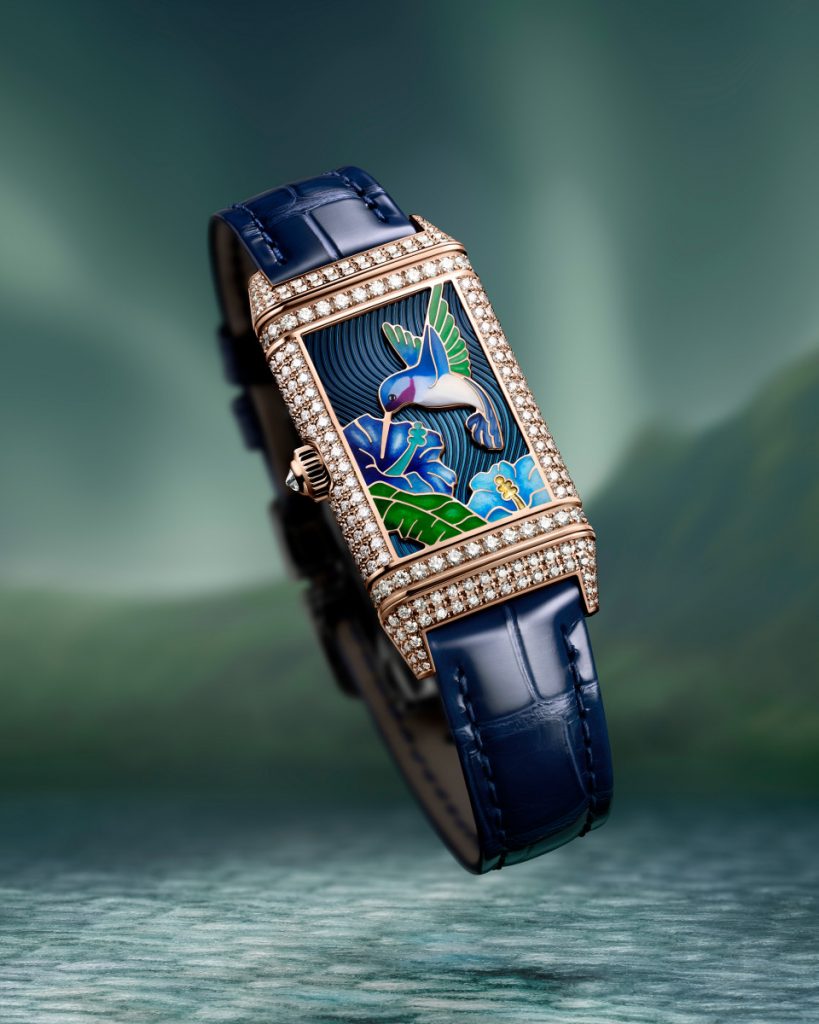
Jaeger-LeCoultre transforms nature into haute horology with its La Vallée des Merveilles creations, a poetic tribute to the enduring beauty of the natural world, drawing inspiration from untamed landscapes, delicate flora, and the quiet harmony between wilderness and cultivated design. Rooted in a centuries-old artistic tradition, this vision is brought to life through the maison’s Métiers Rares ateliers, where artisans reinterpret nature’s emotional resonance through exceptional craftsmanship. Nowhere is this more vividly expressed than in the Reverso One ‘Hibiscus Syriacus’, where the reverse of the case reveals an oneiric tableau of an Akialoa bird suspended mid-flight as it draws nectar from a blue hibiscus flower. The composition unfolds across two levels, with a deeply textured sky formed by engraved wave patterns beneath layers of vivid blue lacquer, while the foreground elements, hollowed directly into the case metal, are executed in Grand Feu champlevé enamel fired at temperatures reaching 800 degrees Celsius. The bird itself is rendered through miniature painting using nine distinct metal oxide pigments, while the surrounding foliage is built up through layers of translucent and opaque enamel, achieving a rich gradient created from ten different colours. The pistil of the hibiscus is accentuated with 24K gold-leaf paillonné enamel, and once complete, the two sections are assembled with mosaic-like precision. Encased in 18K pink gold and illuminated by 335 grain-set diamonds, the watch is paired with a blue alligator strap or, for a more opulent expression, an 18K pink gold bracelet set with an additional 384 diamonds.
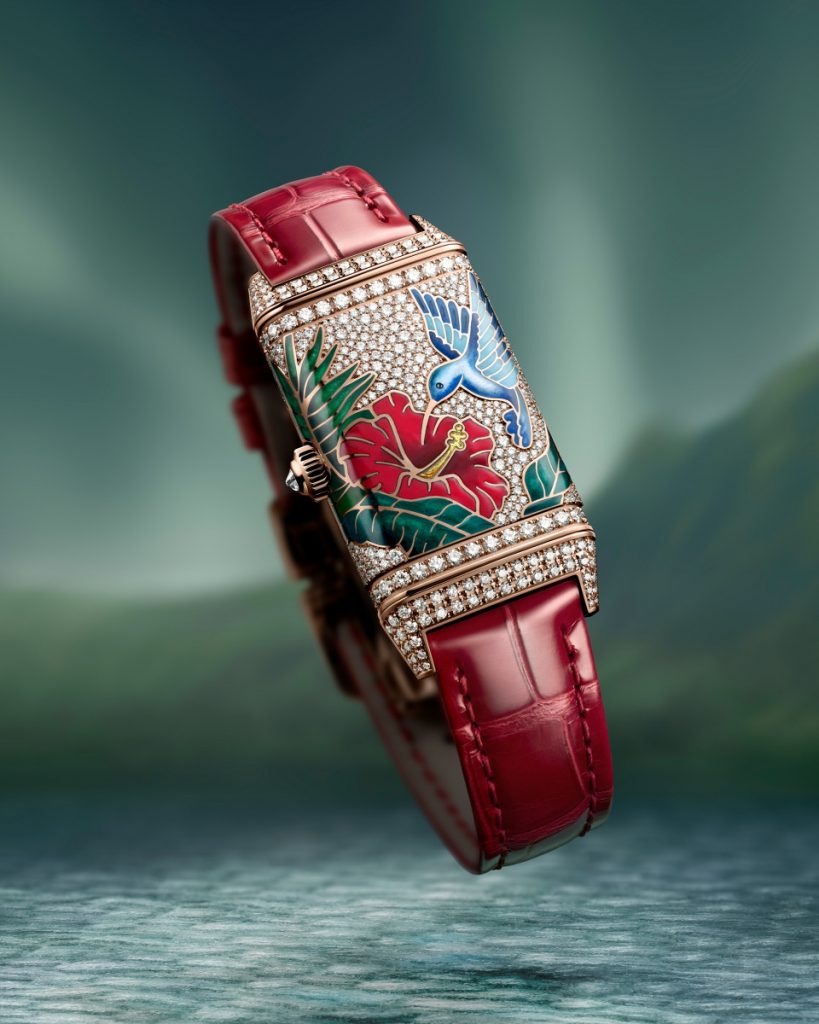
A second interpretation, the Reverso One ‘Hibiscus Rosa’, celebrates the tropical vibrancy of Hawaii through a striking depiction of an Akialoa bird poised above a vivid red hibiscus, the island’s emblematic bloom. This intricate scene, also crafted in Grand Feu champlevé enamel, demands extraordinary technical mastery, particularly in achieving the intensity of the red hues, which require no fewer than nine layers of enamel and carefully controlled multiple firings to prevent discolouration. The composition, enriched with tones of red, blue, and green, is subtly graduated to create depth and a sense of motion, while the pistil once again glows with 24K gold-leaf paillonné enamel. Surrounding the enamel work, 489 snow-set diamonds of varying sizes create a luminous, almost organic scattering of light, a technique that involves setting each stone individually using microscopic beads. The challenge is heightened by the curved surface of the case, demanding exceptional precision to maintain the fluidity of the motif. Requiring over 130 hours of Métiers Rares craftsmanship, the piece can be paired with either a fully diamond-set pink gold bracelet, itself demanding an additional 60 hours of gem-setting, or a glossy red alligator strap that echoes the intensity of the enamel.
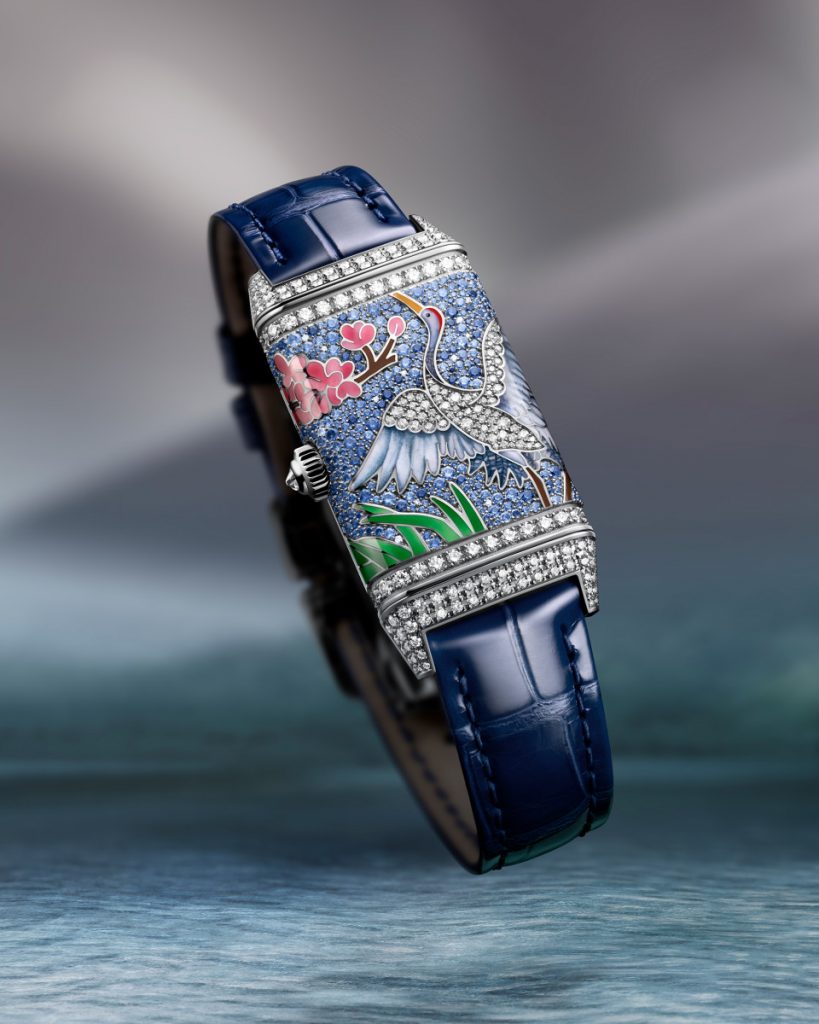
Turning to a more serene expression of nature, the Reverso One ‘Sakura’ draws inspiration from the fleeting beauty of Japanese cherry blossoms, a symbol deeply embedded in art and philosophy, representing both renewal and the transient nature of life. Influenced by the untamed landscapes of Hokkaido, the caseback presents a tranquil lakeside scene where a red-crowned crane stands beneath blossoming branches. The composition is rendered in Grand Feu champlevé enamel, with delicate pink blossoms, green reeds, and the crane’s vivid red accents contrasting against the cool sheen of the white gold case. The bird itself is brought to life through miniature painting, executed with remarkable precision using brushes crafted by the enameller, including a single-hair brush for the finest feather details. In a pioneering approach, the maison’s gem-setter employs the snow-setting technique with coloured gemstones for the first time, combining two shades of blue sapphires with brilliant-cut diamonds to recreate the shimmering reflection of sunlight on water. The intricate setting of 269 diamonds and 395 sapphires requires 125 hours of meticulous work, resulting in a luminous, almost painterly effect. Completed with a blue alligator strap that complements the tones of the decoration, the Reverso One ‘Sakura’ stands as a quiet yet powerful meditation on nature’s beauty, translated through the highest forms of watchmaking artistry.
Reverso Tribute Enamel Hokusai Waterfalls Series
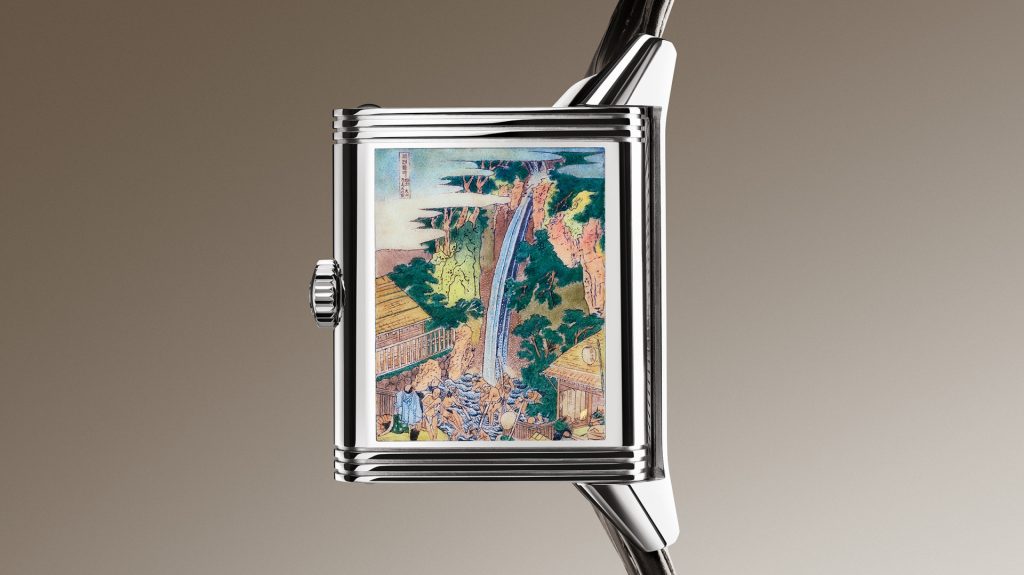
Jaeger-LeCoultre continues its artistic dialogue between horology and heritage with a series of Reverso creations inspired by the poetic landscapes of Katsushika Hokusai, translating iconic waterfall scenes into intricate métiers d’art dials that balance technical mastery with visual storytelling. In the interpretation of Kiyotaki Kannon Waterfall at Sakanoshita on the Tōkaidō, the cascading water is rendered not with force but with a delicate, almost silken grace, echoing Hokusai’s original composition where pilgrims ascend temple steps in search of spiritual renewal. This serene atmosphere is mirrored on the dial through a hand-guilloché pattern composed of 66 finely engraved wavy lines, each requiring three successive passages of the rose-engine lathe, resulting in 198 precise operations that create a shimmering texture beneath a translucent emerald-toned enamel.

Equally evocative is the depiction of the Yōrō Waterfall in Mino Province, a site steeped in legend where the waters were believed to transform into sake as a divine gift. Capturing both the narrative and the dramatic scale of the falls, the composition emphasises the insignificance of human figures against nature’s grandeur, a sentiment echoed in the dial’s intricate bamboo-style guilloché pattern. This design is brought to life through 48 engraved lines, each executed in three passages for a total of 144 meticulously crafted engravings, before being coated in a rich olive-coloured enamel that enhances its organic depth and texture.
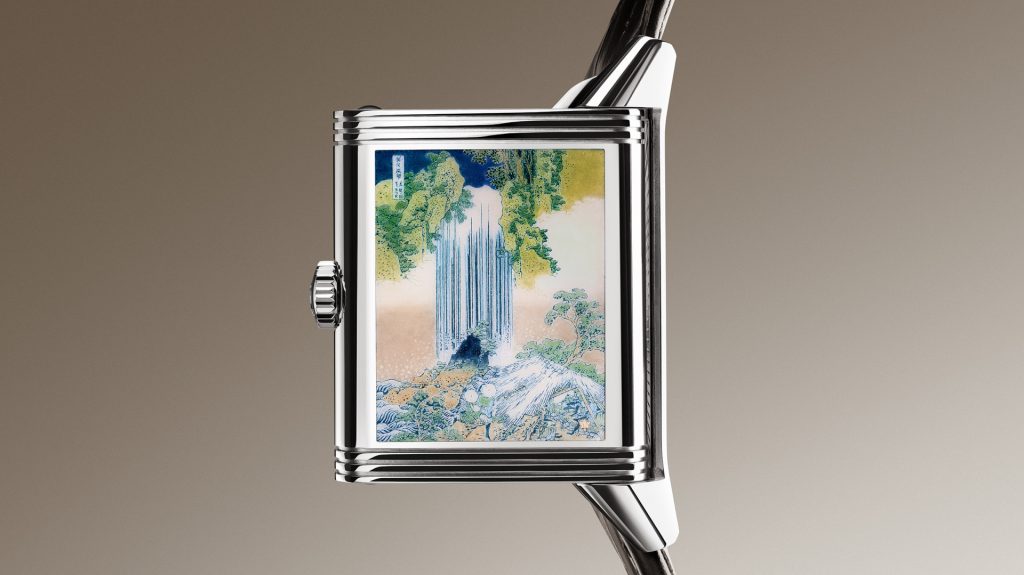
In contrast, The Falls at Aoigaoka in the Eastern Capital presents a more dynamic and forceful scene, where a powerful cascade tumbles over rugged rocks, juxtaposed against the calm waters that feed it, while figures in the foreground continue their daily routines, seemingly indifferent to the spectacle. This duality is expressed through a bold herringbone-style guilloché pattern on the dial, comprising 120 engraved lines, each requiring three passages to achieve a total of 360 precise cuts, all finished with a vibrant cyan-blue enamel that captures the energy and movement of the water.

Each of these limited-edition timepieces may be paired with either a black alligator leather strap fitted with an 18K white gold folding clasp or an elegant “Or Deco” Milanese bracelet in matching white gold, offering versatility between classic and jewellery-inspired wear. Powering these artistic expressions is the manually wound Calibre 822, a movement introduced in 1991 and specifically shaped to follow the contours of the iconic Reverso case. Measuring just 2.94 mm in thickness, it ensures the watch remains exceptionally slim and comfortable on the wrist, while delivering a 42-hour power reserve and operating at a frequency of 3 Hz, providing reliable precision beneath what is, ultimately, a finely executed work of wearable art.