Digital Cover: ‘Tech Guru’ Rajiv Makhni On Foldables, AI Smartphones & Aspirational Gadgets
Digital Cover: Rajiv Makhni on India’s Luxury Tech Obsession; From Samsung Galaxy Z Fold to AI Smartphones and the Rise of Aspirational Gadgets
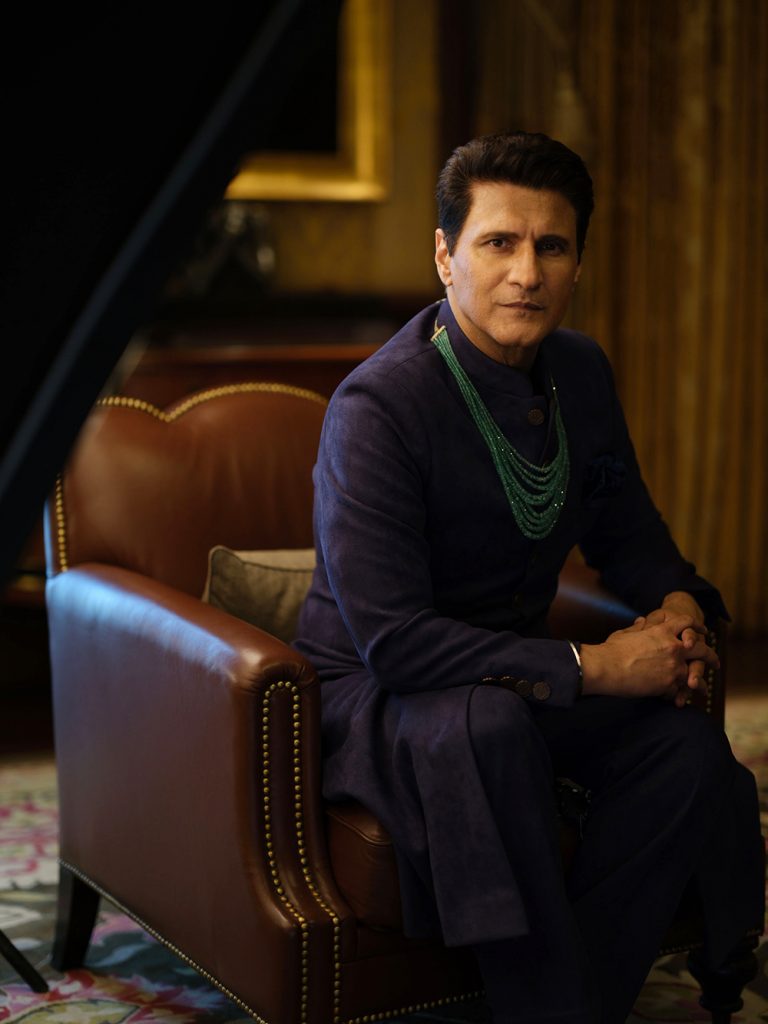
Rajiv Makhni has been a part of India’s tech revolution since the inception. He has been a staple authority figure on everything tech for millennials, Gen X and now he’s also “deinfluencing” Gen Z with his on-point Instagram reviews and breakdowns.
From starting his career as the founder of Slice of Italy in 1995 to being recognised as the Tech Guru of India, Rajiv Makhni redefined how technology shows should be consumed. With a sole aim to tell the consumers what to buy, more importantly what NOT to buy, his prime aim is to make technology less daunting and more commissioning.
During more than a decade in television, Makhni has seen brands flourish; disappear into the horizon while other have redefined the words ‘experience and innovation’ for the upcoming generation. The aced tech guru highlights how two-thirds of Indian gamers live in tier-2 and tier-3 cities, and how India is the world’s largest mobile gaming market by downloads
He sat down with Outlook Luxe recently to discuss every tech gadget that will take over the Indian market in the coming time, why he calls himself the “deinfluencer” and a lot more.
Also Read: Digital Cover: Michelle Poonawalla On Redefining Legacy In Modern India
What are the three gizmos in the luxury categories you believe Indians are most obsessed with right now — and why these in particular?
Rajiv Makhni: Fitness straps without screens, Audiophile speakers, and Foldable phones — and what’s fascinating is why the mix has shifted. During the 2024 festive season, India’s consumer electronics market grew only 3% in volume but 9% in value. Meaning we’re buying fewer gadgets but spending significantly more on each one. That’s not impulse buying — that’s aspiration tech. The Indian consumer has quietly moved from “how much does it cost?” to “What’s the best I can buy for me and my family?” No Cost EMI’s have really helped to become more aspirational than you can afford.
Five Tech Toys Indians should consider possessing in the coming days and are going to be game changers?
Rajiv Makhni: The first one is a bit of a surprise. I’m not going to say an EV, I’m going to say a hybrid. What we’re really looking forward to in the future is hybrids that can go about 100, 150 kilometres, no charging required, charges from the very action of the car itself. The second is a big surprise and that is smart glasses. Everybody will start owning smart glasses. The third one is gigantic TVs. Not 50 inches or 75 inches, start imagining 150 inches because micro LED TVs are coming into the market. Imagine giant walls of TVs around and they won’t even cost what a 75 inch TV costs right now. That becomes a big game changer again. The other one is the fact that you’ll be able to use literally all your AI now with a small little clip on, just a piece of hardware, maybe you wear it as something like a small little earphone or something that you just have as part of maybe even a band and every single thing that you want happens because the AI is like your own agent, your own assistant. So you don’t have to look at a screen anymore. The AI agent knows you, you know the AI. So if you want to get her into a restaurant, you want to book a ticket, you want something that has to be done where three friends have to be coordinated with, just speak into it. It’s like your assistant, but on your wrist or literally in your ear. And the last one will be phones that will be charged once a month.
Also Read: Rajiv Makhni On Curiosity, Gadget Guru And Shaping The Way A Nation Understands Innovation
Smartphones remain at the centre of Indian tech culture — what keeps the upgrade cycle so emotionally compelling for consumers?
RM: Because in India, your phone isn’t a device — it’s infrastructure. It’s your bank, your ticket counter, your doctor’s waiting room, your TV, and occasionally your marriage counsellor. India now has 659 million smartphone owners, second only to China. But here’s the part that stops people mid-sentence: we’re the world’s largest mobile gaming market by downloads — 8.45 billion installs in a single year. And we are the largest population by far transacting online. We UPI like our life depends on it. When one device does that much, upgrading it isn’t a purchase. It’s a life event.

Smartwatches and fitness bands have exploded in popularity. Are people buying them for health, fashion, or social signalling?
RM: All three — but the market just gave us a reality check. India peaked at 134 million smartwatch shipments in 2023, making us the biggest smartwatch market on the planet. Then in 2024, volumes dropped 34%. And it’s dropping like a stone everyday. What that tells you is that Indians have finished the “curiosity” phase. They’re now buying up, not just buying. They want more than a black screen on your wrist.
Wireless earbuds and audio gear have become almost universal — what does this say about changing lifestyles and content consumption in India?
RM: It says we’ve found the most socially acceptable way to opt out of a conversation. But seriously — India shipped 83.5 million earwear units in 2024, and ‘import from China and relabel with your brand’ is dying and dying fast. Companies like boat flooded the market with digital junk and now it’s time to announce their funeral date and time. The next frontier is already here: better quality and real innovation with features like real-time translation across multiple Indian languages. Because apparently subtitles weren’t enough.
Are foldable phones and premium devices becoming the new symbols of tech prestige?
RM: Yes — and the numbers are genuinely surprising. The premium smartphone segment above ₹1 lakh is growing close to 30% year on year in India, even as mid-range growth slows. The Samsung Galaxy Z Fold is backordered in ways that would make a car showroom jealous. But what I find more interesting is who’s buying them — its increasingly first-generation wealth in tier-2 cities. Surat. Indore. Coimbatore. The foldable isn’t just a Mumbai and South Delhi flex anymore.
Gaming gadgets — consoles, handhelds, and accessories — seem to be gaining serious momentum. Is gaming now a mainstream tech obsession in India?
RM: 591 million gamers. That’s India’s current gamer base — nearly 42% of the entire population. We are the world’s largest mobile gaming market by downloads. And here’s the statistic that genuinely humbles me every time: two-thirds of Indian gamers live in tier-2 and tier-3 cities. Gaming didn’t go mainstream here — it went everywhere. The interesting challenge now is monetisation. India generates only 1.1% of global gaming revenue despite 20% of the world’s gamers. That gap is either a massive failure — or the most extraordinary opportunity in consumer tech right now.
How much of this growth is driven by younger demographics versus working professionals seeking leisure escapes?
RM: The 15–24 age group is 39% of India’s gamer base — that part isn’t surprising. What is surprising is that the 25–44 cohort shows the highest familiarity with gaming, at over 70%. And female participation in gaming in India is growing at 15% annually — faster than any other demographic. The industry keeps acting like this is new information. It’s not. They just need to wake up to this fact and act on it
Are Indians ready for fully connected homes, or are they still selectively embracing convenience tech?
RM: Here’s the honest data: search interest for “smart home devices in India” was effectively zero for most of 2025. Meanwhile, smartphone search interest peaked at 16 times that. We are not a smart home market yet — we are a smart pocket market. That’s not a failing. It’s a priority. We’ll automate our homes the moment it becomes as frictionless as UPI. Right now it still needs a router, an app, three firmware updates, and a YouTube tutorial. The moment someone solves that, India becomes the biggest smart home market on earth overnight.
AI has suddenly moved from software to hardware — what AI-powered gadgets do you see Indians gravitating toward most right now?
RM: AI cameras, without question — and you already own one. The computational photography in today’s mid-range Indian phones from Vivo, Oppo, and Samsung is doing real-time scene detection, skin tone correction calibrated for South Asian complexions, and low-light processing that would have required a studio five years ago. That is AI hardware, running on a device that costs ₹20,000. But the quiet revolution is happening at ₹15,000 in a Jaipur college student’s pocket.
If you had to pick one AI-powered device that symbolises the present moment in consumer tech, what would it be and why?
RM: The mid-range Android smartphone. Not the flagship — the mid-range. The one 400 million Indians actually use. It now runs almost all AI on-device, that doesn’t need the cloud, handles 22 Indian languages, processes payments, detects health anomalies, and generates images. The global tech industry spent the last two years obsessing over AI pins and smart glasses and robot butlers. Meanwhile, the most consequential AI deployment in human history quietly happened on a ₹18,000 phone on a college bus. We just weren’t paying attention because it didn’t come with a press conference and PR email.