

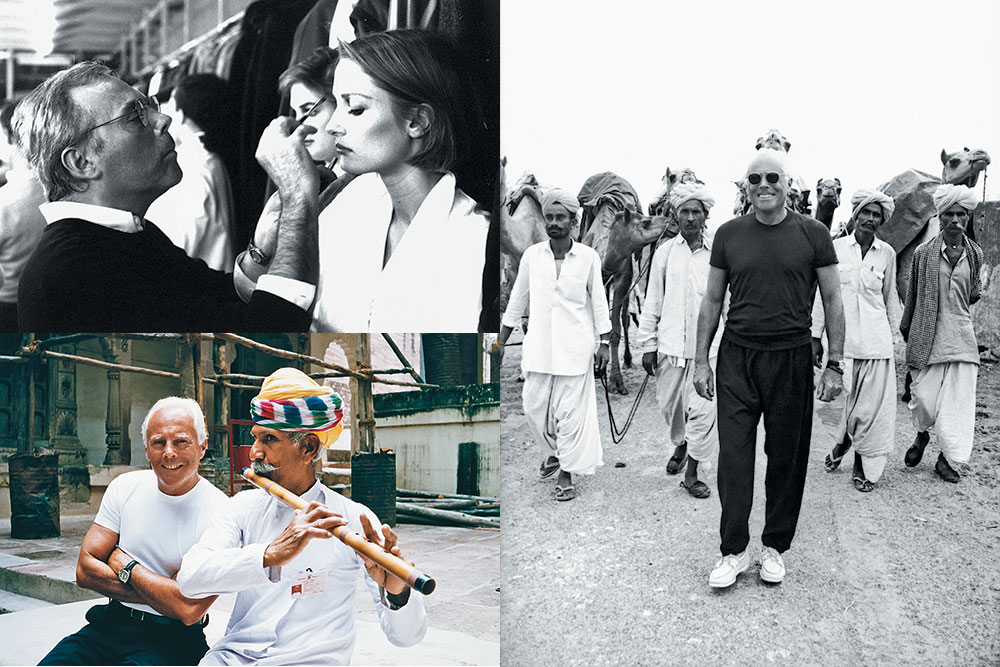
In 1994, years before Armani launched in India, Giorgio Armani took a trip to the country, soaking in the atmosphere like anyone on their first India visit, driving around to India’s far-flung villages in a Mercedes limousine. Armani never forgot his trip to India, and it featured in surprising ways in different parts of his creations. His India-inspired achkan collection came two decades later, featured the Armani logo inside a lotus iconography, in a typeface inspired from the Devnagri script. He believed fashion was made for the streets, to be worn, not for fashion editorials. He honoured his connection to India by releasing multiple collections in the recent years, reimagined versions of the achkan, that took the popular festive outfit and made it an item worthy of being handed down as an heirloom. That is really the true power of his design aesthetic, to create timeless silhouettes for men and women that were relevant long after they were created.
The 1994 trip to India
Giorgio Armani’s trip to India was a cultural immersion that inspired his design aesthetic for years to come. He came up with multiple collections post his introduction to the textile traditions of the country. His achkan collection, done in a restrained signature Armani aesthetic, combined the timelessness of Italian tailoring with the grace of an Indian silhouette. The luxurious fabrics used in the production of the collection elevated it to a luxury piece that has cemented its place in the modern silhouettes of today. Far from cultural appropriation that a lot of western brands have been accused of lately, this was a cultural dialogue, a symphony between Indian aesthetics and his signature tailoring that has remained in the cultural consciousness of the Indian fashion industry for years after.
The achkan saw a 2020 edit, reimagined in lush velvets and cashmere, released in an India-exclusive edit in time for the festive season. The collection was very representative of the brand’s aesthetic — clean cut suiting in a restrained colour palette. Yet, the luxe fabrics, from wool to cashmere, and the statement buttons that adorned the otherwise plain achkan, to be worn buttoned down by itself, or with a white shirt. The collection remains popular in the country, and a good example of how Western labels can interact with Indian fashion and culture without stepping into the territory of cultural appropriation.
India has been an important part of the Armani empire’s global prowess. Soon after its store launch, Armani Caffé opened at Jio World Plaza, in Mumbai, to give the country a taste of the Armani experience. The bistro is right next to its retail store and only the fifth store worldwide to open in India. While it opened its first flagship store in New Delhi in 2008, it has since expanded to different cities in diverse retail formats across Bengaluru, Kolkata and Ahmedabad.
Lasting Legacy
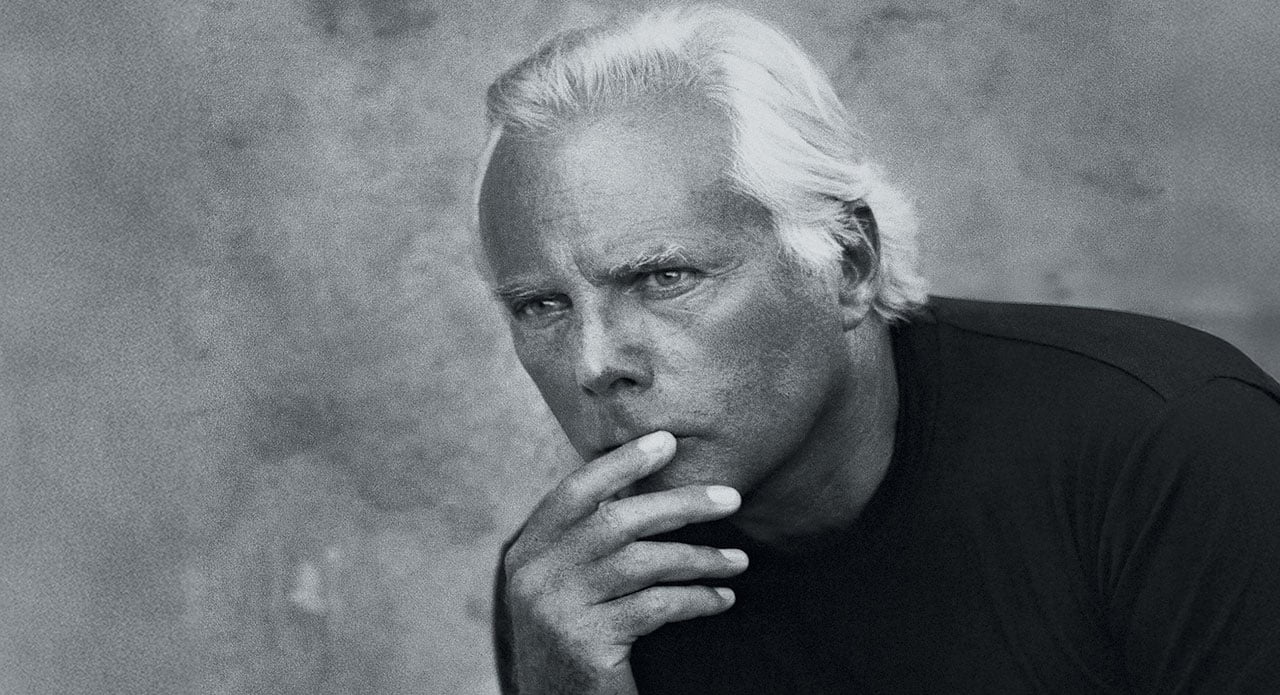
Few designers have had as much of an impact on how people dress worldwide as much as Giorgio Armani. Born in the rigid times of pre-World War, he is widely credited for introducing fluidity in form — from the famous Armani suit that chose a sharper silhouette while getting rid of rigid shoulder pads, to his ‘liquid suit’, appropriate for milder climates. His power suits for women saw a slew of celebrities endorsing them, as a bold statement. Celebrities all across the world, from Julia Roberts to Aishwarya Rai have donned Armani’s power suits on the red carpet.
Armani, along with his lifetime partner Sergio Galleoti created an empire that made Milan a force to reckon with in European fashion, becoming the largest-selling designer in the US in the ’80s. Many have claimed how dressing Richard Gere in the film American Gigolo propelled him to cult status and was the beginning of him dominating the entire fashion industry. Once a window dresser, Armani had learnt his craft on the shop floor, rather than in any fashion school. He forever believed in the immediacy of fashion, and his business progression is proof of how much he had a pulse on what the market wanted. Soon after, he launched Armani Jeans and Emporio Armani, alongwith Armani fragrances in a contract with L’Oreal. Currently, his business empire, following a 2017 restructuring, has a diversity of brands including Armani Privé, its haute couture line, Giorgio Armani, the original Armani brand, Emporio Armani, EA7, the athleisure line as well as Armani Exchange (A|X).
A perfectionist till the end
Giorgio Armani continued to work till his last days, at the age of 91, only pausing for a few health breaks. When he didn’t attend his own Armani Privé haute couture show last year, it was a cause of much public discussion, such was his dedication to his work and craft. And yet, his perfectionism took a toll on him. In his last interview to the Financial Times, a few weeks before his demise, he expressed regret about the fact that he worked so hard all his life. He was quoted saying, “My only regret in life was spending too many hours working and not enough time with friends and family.” And yet the man was known as ‘Papa’ to the entire Armani ecosystem, taking care of employees in his company with deep interest. This dichotomy was alive in him till the end, while some knew him as a perfectionist, who had to get every detail right, others were privy to his protective nature, and the support of his larger-than-life presence throughout their lives.