

There are watches, and then there are watches that seem to have been designed by someone who looked at an aircraft cockpit and thought, “Yes, I would quite like a bit of that on my wrist.” And that is precisely where Breitling has always excelled. Because long before aviation became comfortable and mildly tedious, Breitling was right there in the thick of it, strapping precision instruments onto the wrists of pilots who were far more concerned about fuel consumption and altitude than whether their cuff matched their tie. At the centre of this airborne legacy sits the Navitimer, a watch so unapologetically functional that it could calculate speed, distance, and fuel burn using its circular slide rule, while the rest of the world was still fumbling with basic arithmetic. It effectively turned the wrist into a miniature flight computer. And now, in a move that feels equal parts nostalgic and brilliantly ambitious, Breitling has decided to push this legend even further by unveiling not one but two new chronographs: the Navitimer B01 Chronograph 43 Tribute to Concorde (Ref. AB01389C1C1P1), and the Navitimer Perpetual Calendar Chronograph (Ref.LB19211A1C1P1). The former is a rather glorious nod to one of the most outrageous machines ever to grace the skies, the Concorde; an aircraft that did not merely fly, but thundered through the air faster than the speed of sound with a kind of effortless arrogance that modern aviation can only dream of. This spirit is captured beautifully in a watch that feels every bit as purposeful and precise. The latter, however, takes a more intricate route. The Navitimer Perpetual Calendar Chronograph is not about brute speed, but about intellectual brilliance, combining the already complex chronograph function with a perpetual calendar that quietly keeps track of months, dates, and leap years without so much as breaking a sweat.
Breitling Navitimer B01 Chronograph 43 Tribute to Concorde

If ever there was a machine that made the world feel gloriously small and slightly inadequate at the same time, it was the Aérospatiale-BAC Concorde, nicknamed “the White Bird”. First introduced into commercial service in 1976, courtesy of the wonderfully stubborn partnership between Britain and France, this was not just an aeroplane, it was a statement. While everyone else was plodding along at subsonic speeds, Concorde simply lit the afterburners and punched a neat hole through the sky at over twice the speed of sound, cruising at around Mach 2.04 and altitudes touching 60,000 feet, which, for context, is so high you could practically see the curvature of the Earth. A flight from London to New York took just about three and a half hours, meaning you could leave after breakfast and arrive before you had quite finished complaining about it. The droop nose, the delta wings, the sheer noise of takeoff, it was all wonderfully excessive. Concorde did not just travel faster, it made everything else feel slow, dull, and frankly a bit pointless.

The Navitimer B01 Chronograph 43 Tribute to Concorde has a 43mm stainless steel case, lugs, two chronograph pushers at 2 o’clock, 4 o’clock, a non screw-locked, two gaskets crown at 3 o’clock, and a platinum, bidirectional bezel with circular slide rule. The chronograph has spiral finished white subdials for the 12-hour counter at 6 o’clock with an integrated date window against a whitebackground, a 60-second counter at 9 o’clock and a 30-minute counter at 3 o’clock. The 593 piece limited-edition watch gets super-LumiNova coated luminescent hour markers, hour and minute hands.
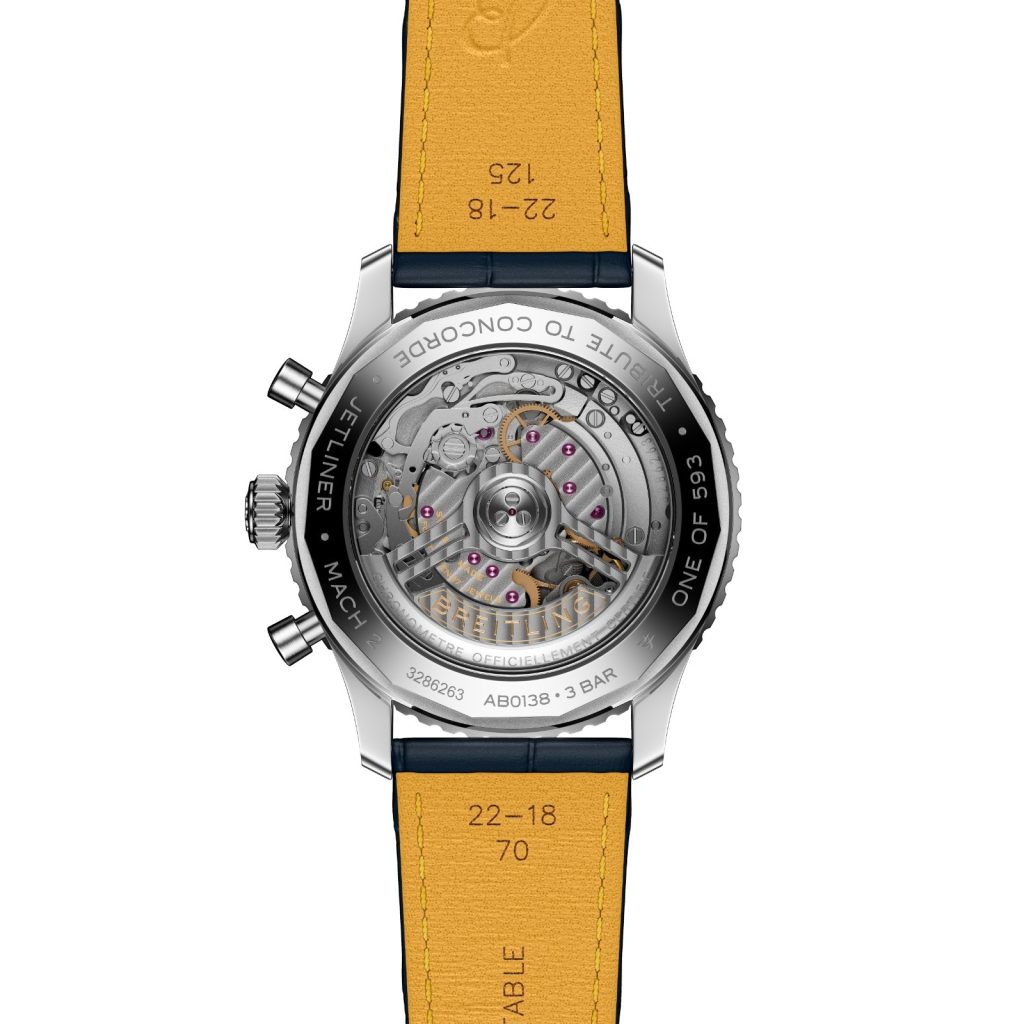
Powering the watch is Breitling Manufacture Caliber B01, a self-winding mechanical, bidirectional with ball bearing movement with a 70-hour power reserve. Turning the watch showcases the sapphire caseback with the engraving of “One of 593,” “Tribute to Concorde,” “Jetliner,” and “Mach 2,” the aircraft’s cruising speed beyond the sound barrier. The timepiece is finished on a blue alligator leather strap with a stainless-steel folding buckle.
Breitling Navitimer Perpetual Calendar Chronograph

There is something almost mischievously brilliant about a perpetual calendar, the sort of complication that feels less like engineering and more like quiet wizardry. It knows, without being told, the differing lengths of months, the rhythm of leap years, and the peculiar quirks of our calendar, ticking along with serene confidence as if time itself had been neatly organised inside a handful of gears. No adjustments, no fuss, just an intricate mechanical mind that keeps everything in perfect order, year after year, as though it has already seen the future and decided to keep it to itself. This 43mm platinum timepiece gets lugs, two chronograph pushers at 2 o’clock, 4 o’clock, a non screw-locked, two gaskets platinum crown at 3 o’clock, and a platinum, bidirectional bezel with circular slide rule.
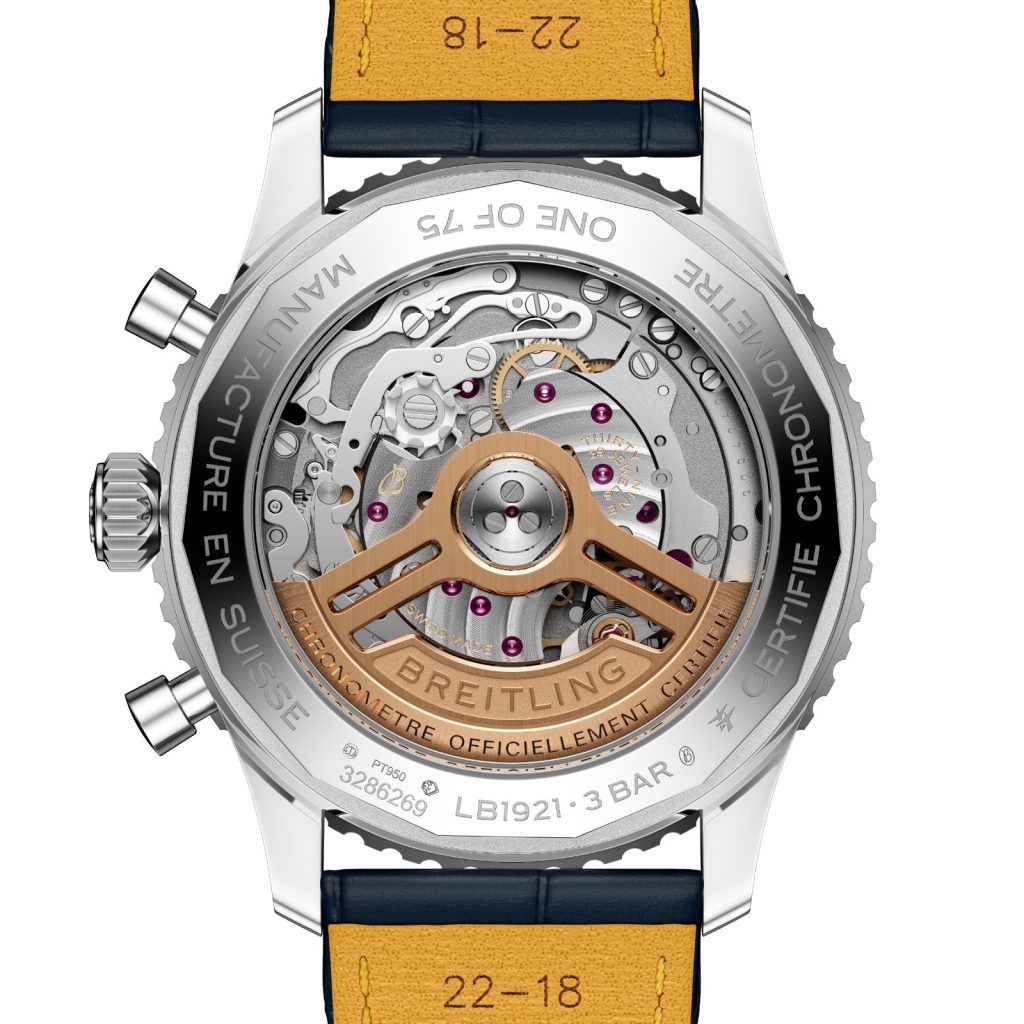
The marine blue dial has a moonphase complication at 12 o’clock, a date and 30-minute counter at 3 o’clock, a month and leap year counter at 6 o’clock, and day and small seconds at 9 o’clock with a central chronograph seconds. The watch is powered by Breitling Manufacture Caliber B19, a self-winding, mechanical, bidirectional movement, with a ball bearing, a 22 ct red gold rotor, and a power reserve of 96 hours. The model is finished on a blue alligator leather strap with a white gold folding buckle.
It is the sort of mechanical wizardry that makes you stop and wonder how on earth it all fits inside a case that sits so neatly on the wrist. Together, these two watches do something rather special. They remind you that the Navitimer is not just a relic of aviation history, but a living, evolving icon—one that continues to celebrate the romance of flight while proving that, even in an age of digital everything, there is still something utterly captivating about gears, springs, and the quiet confidence of a machine that simply gets on with the job.