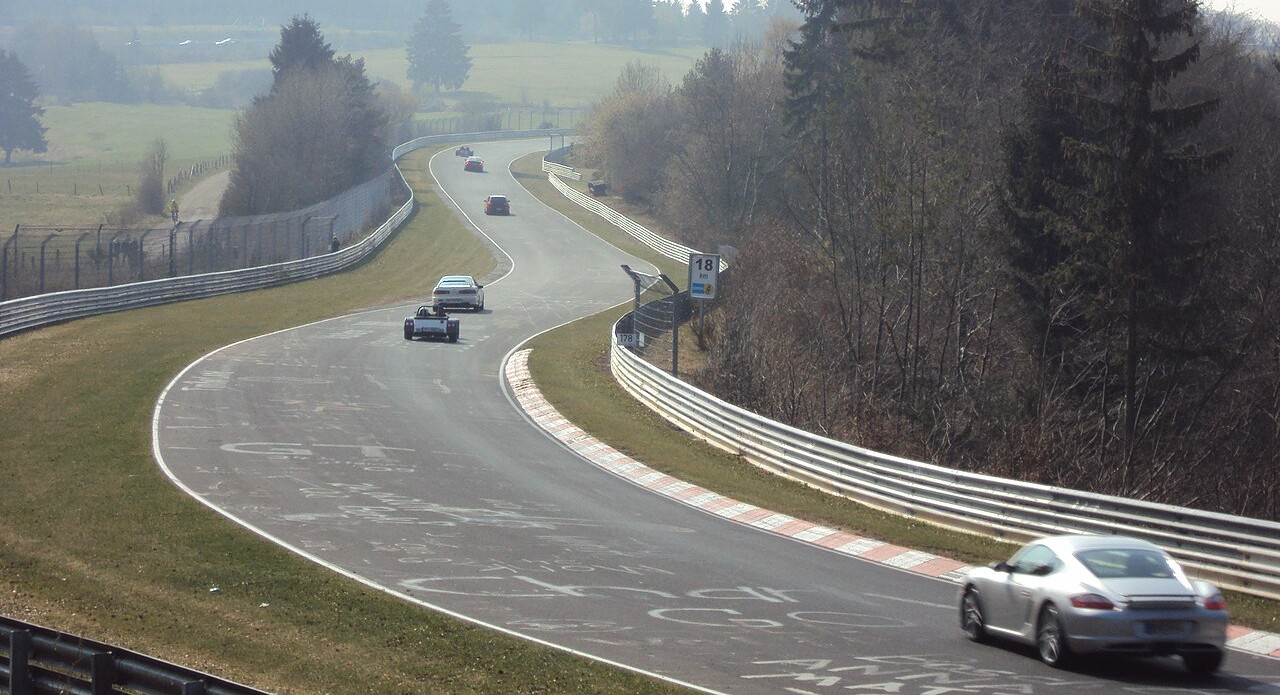


Few circuits in the annals of motorsport evoke as much awe and trepidation as the Nürburgring Nordschleife. Twisting through the brooding forests of Germany’s Eifel region, this 20.8 kilometre serpentine of asphalt was less a racetrack and more an ordeal by fire. Drivers did not merely compete here; they survived it. When Formula One first raced at the circuit in the 1950s, the Nordschleife embodied the heroic excesses of early motorsport. With more than 150 corners, violent elevation changes, unpredictable weather and minimal safety infrastructure, it was the kind of circuit where the difference between triumph and catastrophe could hinge on a moment’s misjudgement.
It was Jackie Stewart who famously christened it “The Green Hell” after a rain-soaked victory in 1968. The phrase stuck because it captured a truth drivers knew all too well: the Nordschleife was terrifyingly beautiful and lethally unforgiving. In the romantic mythology of racing, this danger became a badge of honour. Legends such as Juan Manuel Fangio and Jim Clark etched their names into history by mastering its daunting sweep of blind crests and plunging valleys. Yet as Formula One evolved from a gentlemanly pursuit into a global sporting spectacle governed by science, engineering and safety regulation, the Nordschleife increasingly looked like a relic of a more perilous age.
The decisive rupture arrived in 1976 German Grand Prix, when Niki Lauda suffered a horrific crash that nearly claimed his life. His Ferrari burst into flames after striking barriers at high speed, and it took fellow drivers to pull him from the wreckage. The accident was not merely dramatic—it was emblematic of the circuit’s fundamental incompatibility with modern safety expectations.
At over 20 kilometres in length, the Nordschleife posed logistical challenges that were nearly impossible to overcome. Medical crews could not reach accident sites quickly enough. Marshals were spread thin along the forested expanse. Installing the level of run-off areas, barriers and surveillance systems required for contemporary racing would have meant radically altering the circuit’s historic character—an undertaking both financially prohibitive and architecturally impractical.
Formula One, meanwhile, was entering an era of professionalisation. Under the stewardship of organisations like the Fédération Internationale de l’Automobile, the sport was gradually reshaping itself around stricter safety standards, improved circuit design and faster emergency response systems.
In that new calculus, the Nordschleife was simply too vast, too wild and too dangerous. The Nürburgring Grand Prix Circuit, a shorter and safer layout built adjacent to the original course, eventually replaced it as Germany’s Formula One venue. It offered wider run-off zones, modern pit facilities and a configuration that television cameras—and safety teams—could monitor far more effectively.
Yet the departure of Formula One did not diminish the Nordschleife’s mystique. If anything, it amplified it. Today the track exists as a pilgrimage site for automotive enthusiasts, endurance racers and manufacturers who test their machines against its punishing geography. To conquer the Nordschleife remains one of motorsport’s most coveted achievements. Thus the story of Formula One and the Nordschleife is not one of rejection, but of evolution. The sport that once celebrated raw bravery gradually learned to prioritise survival alongside spectacle. And so the Green Hell endures—no longer as Formula One’s battlefield, but as motorsport’s most formidable monument to a bygone era of audacity.