There are luxury watches, and then there are Métiers d’Art timepieces so outrageously handcrafted, so ludicrously detailed, that the very idea of calling them “watches” feels like calling a Bugatti a “car.” These things aren’t made; they’re summoned into existence by artisans with the sort of microscopic precision and monastic dedication that would make even Michelangelo mutter, “Bit much, isn’t it?” You’ve got master enamellers coaxing molten glass into colours you didn’t know existed. Engravers carving gold with such precision you’d assume they signed a pact with higher powers. Guillocheurs spinning hypnotic patterns on antique machines that look like props from a Victorian sci-fi epic. And gem setters casually placing diamonds so tiny they probably need a separate postcode.
Wearing a Métiers d’Art watch is like strapping the Sistine Chapel onto your wrist—except the Sistine Chapel didn’t have to survive shock tests, water resistance checks, and some bloke at a dinner party asking, “Why is it so expensive?” Because this isn’t just horology—it’s time, talent, legacy, flames, gemstones, and sheer artistic audacity packed into something smaller than a biscuit. And the result? Pure, unapologetic horological swagger.In the increasingly high-tech world of modern watchmaking where precision machinery, computer-aided design, and industrial engineering dominate; there exists a rarefied corner of the craft that deliberately rejects efficiency. This is the domain of Métiers d’Art, a French term translating to “artistic crafts,” but in horology, it means something far more profound: the preservation, elevation, and celebration of centuries old artisanal techniques that transform watches into wearable masterpieces.
This is not a category defined by complications or movement engineering. Instead, it concerns the surfaces, textures, and visual expression of the watch. It represents the aesthetic soul of traditional craftsmanship—the human touch that brings emotional depth to mechanical precision. Renowned timepiece makers like Vacheron Constantin, Cartier, Jaquet Droz, Piaget, Bovet, and Van Cleef & Arpels have dedicated entire collections to these crafts, each contributing to the revival of skills once on the brink of extinction.
A Symphony of Ancient Techniques
At the heart of Métiers d’Art lies an extraordinary ensemble of artistic disciplines. Miniature painting, often executed with brushes no thicker than a strand of hair, captures entire scenes on dial surfaces often no larger than a coin. The level of detail is astonishing; delicate shading, micro-colour gradients, and lifelike forms that defy the scale.
Where Art Meets Timekeeping
While haute horlogerie focuses on mechanical ingenuity—tourbillons, minute repeaters, perpetual calendars—Métiers d’Art focuses on emotional resonance. A Métiers d’Art watch tells a story before it tells the time. It blends horology with fine art, engineering with poetry. Collectors value these pieces not only for their rarity but for their cultural significance. A Métiers d’Art watch isn’t produced by the thousands. Sometimes only a handful exist. Every brushstroke, every engraved line, every fired enamel layer is unique.
Exceptional Métiers d’Art Creations
Vacheron Constantin Les Cabinotiers Tribute To The Tour De L’île
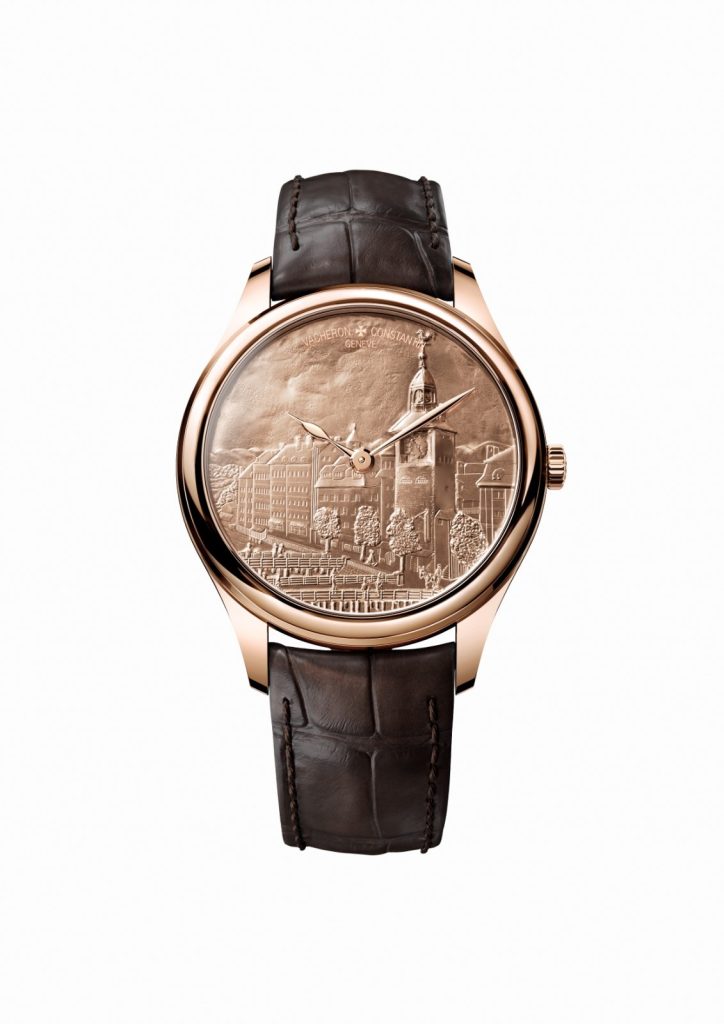
Vacheron Constantin has chosen a simple display of hours and minutes in order to focus on the artistic beauty of the dials. At 40mmin diameter and 9.42mm thick, this timepiece has a 18K pink gold case, and a polished bezel. On the reverse side of the watch, an officer-style caseback reveals the beauty of the movement beneath a transparent sapphire crystal. The mechanical elegance of the self-winding manufacture Calibre 2460 is enhanced by the finest of finishing, in the tradition of Haute Horlogerie inherited from the Age of Enlightenment. Each dial gives full rein to the artistic savoir-faire of the Métiers d’Art atelier. Capturing the spirit of Geneva, each of the three Tribute to the Tour de l’Île dials features a view of the tower inspired by an historic lithograph and reinterpreted by Vacheron Constantin’s designer.
Jaeger-LeCoultre Reverso One ‘Precious Colours’
This 40mm 18k white gold gets a set of 277 diamonds (1.59 carats) that decorate the Reverso One ‘Precious Colours’ requires 40 hours of work. Turn the swivelling case over, and the Reverso One ‘Precious Colours’ becomes a piece of High Jewellery, with six different enamel colours complemented by brilliant-cut white diamonds. Three pastel shades in nuances of grey, mauve and pink – colours that epitomise Art Deco style. Powering the watch is manually-wound Calibre 846 with a 50-hour power reserve.
Jaquet Droz La Ronde Des Baisers” Automaton

Crafted with an exquisite fusion of rare materials and mechanical artistry, this timepiece features a hand-painted black onyx dial framed by an 18k red gold applied ring and housed within a matching 18k red gold case. Its static dial showcases a striking composition of black onyx stone marquetry and pristine white cacholong, contrasted by a mobile secondary dial in 18-karat white gold, snow-set with diamonds and accented with black onyx. Inside, a hand-wound mechanical automaton movement—complete with a push-button triggering mechanism and animated disc complication—brings a poetic mechanical spectacle to life, while a separate self-winding mechanical movement keeps the hours and minutes with effortless precision. With a power reserve of 68 hours and a bold 43 mm diameter, the watch blends high artistry, technical mastery, and sculptural elegance in a singular creation. Complementing it is a hand-wound automaton featuring an animated record and signature logo, powered by its own double barrel and activated via a crown-integrated push-button mechanism.
Louis Moinet Fuego Nuevo
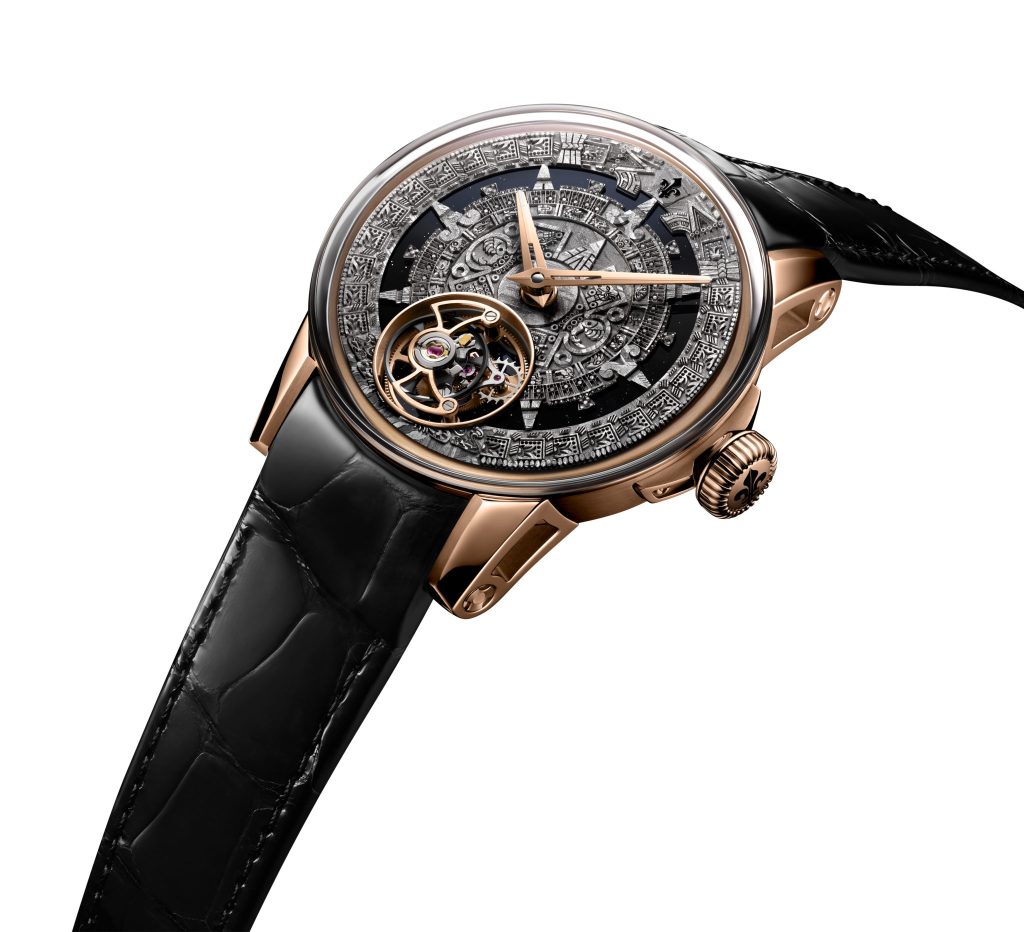
The Fuego Nuevo is a unique horological masterpiece inspired by the monumental Aztec Piedra del Sol, carved in 1479 during Emperor Axayacatl’s reign to honour the Festival of the New Fire. Echoing this cosmic rebirth, its dial is crafted from a 0.5-mm slice of the ancient Muonionalusta meteorite—formed 4.5 billion years ago—revealing striking Widmanstätten patterns. Using ultra-precise femtosecond-pulse laser engraving, Louis Moinet reproduced 9,800 lines of Aztec cosmogony across three depths, enriched further by a ring of deep aventurine that heightens contrast and mystery. At its heart beats the LM135 calibre, a hand-wound movement developed with Concepto, featuring an off-centre flying tourbillon at six o’clock and a “volte-face” double barrel delivering a robust 96-hour power reserve. This celestial creation is housed in a noble 40.7 mm case combining 18k red gold with a grade 5 titanium inner chamber, topped by a high-tech sapphire dome that reveals the sculptural dial. Openworked lugs ensure seamless bracelet integration, while skeletonised, facetted SLN-treated hands mark the hours and minutes.