

There exists, buried deep within the labyrinth of gears and springs, a component so small and so absurdly intricate that it appears almost laughable. And yet, this tiny contraption is the reason a mechanical watch does not simply unwind itself into oblivion within minutes like an overenthusiastic party guest. This, of course, is the escapement. It is not glamorous. It does not shimmer like a polished bridge or seduce like a hand finished dial. It is not something that draws admiring glances across a room. But without it, even the most expensive watch in the world would be about as useful as a chocolate teapot. The escapement is the referee, the conductor, and the metronome all rolled into one. It dictates order in a world that would otherwise collapse into chaos.

How the Escapement Actually Works
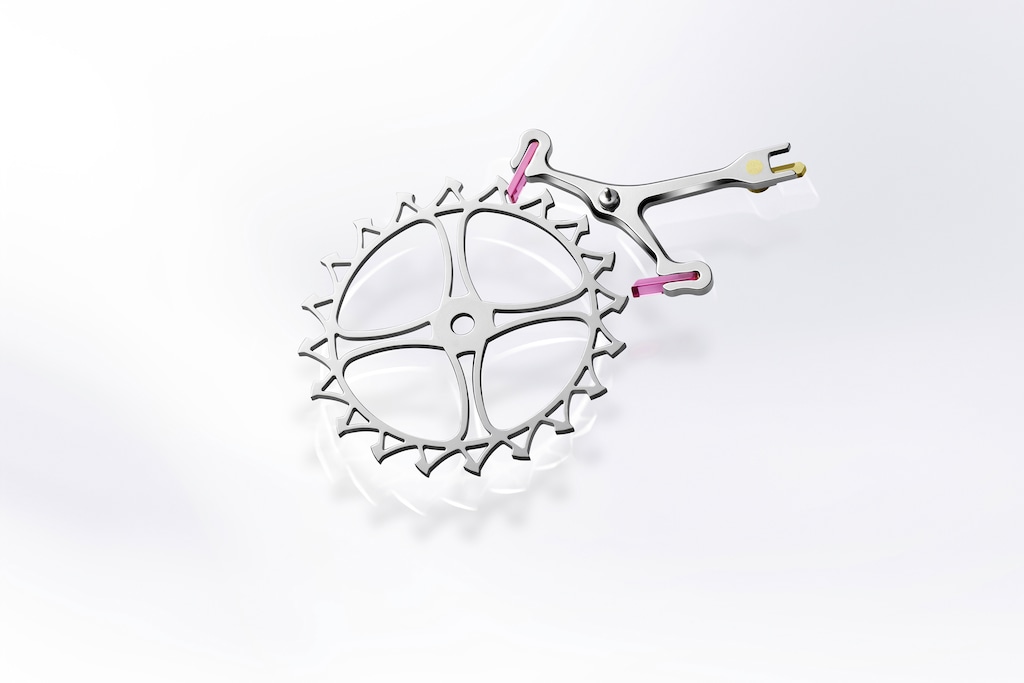
At its core, the escapement performs a deceptively simple task. It takes the stored energy from the mainspring and releases it in carefully measured, bite sized portions. Imagine a tightly wound spring eager to unleash all its energy at once. Without control, that energy would rush through the gear train in a violent frenzy, spinning the hands wildly before stopping altogether. The escapement intervenes and says, quite firmly, not so fast. The system consists primarily of three key elements. The escape wheel, the pallet fork, and the balance wheel. The escape wheel is constantly trying to rotate under the force of the mainspring.
The pallet fork, armed with tiny jewel tipped pallets, locks and unlocks the escape wheel teeth in rapid succession. Each release allows the wheel to advance by a single tooth. Now comes the clever part. The pallet fork transfers a small impulse of energy to the balance wheel, which oscillates back and forth with remarkable consistency. Each swing of the balance wheel dictates when the pallet fork unlocks the escape wheel again. This creates a rhythmic tick, a controlled release of energy that divides time into equal intervals. Tick. Tock. Tick. Tock. That sound is not merely charming. It is the sound of precision being enforced.
Precision Is Everything
In the world of mechanical watches, precision is not a luxury. It is the entire point. The escapement determines how evenly energy is delivered to the regulating organ. Any inconsistency, any microscopic inefficiency, results in timekeeping errors. Seconds drift into minutes, and suddenly a watch becomes little more than an expensive bracelet. Collectors understand this instinctively. A well engineered escapement is not just a technical achievement. It is a declaration of intent. It says that the watchmaker has conquered one of horology’s greatest challenges. Because maintaining consistent energy flow is not easy. Friction, gravity, temperature changes, and positional variance all conspire to disrupt the delicate balance. The escapement stands in the middle of this storm, maintaining order with relentless discipline.
Also Read: Top 5 Most Complicated Watches Ever Made Every Serious Collector Must Know
The Evolution of the Escapement
Historically, escapements have evolved in the same way cars have. Early versions were crude, inefficient, and rather unreliable. Then came refinement, innovation, and the occasional moment of genius. The verge escapement, one of the earliest designs, was robust but wildly inaccurate. It was the horological equivalent of a steam engine that coughed and wheezed its way through timekeeping. Then came the lever escapement, which changed everything. It introduced improved efficiency, reduced friction, and far greater accuracy. Even today, the Swiss lever escapement remains the dominant design in modern mechanical watches. But of course, watchmakers are not content with merely good enough. There are detent escapements, prized for their efficiency but delicate in nature. There are co axial escapements, designed to reduce friction and improve long term stability. Each innovation attempts to answer the same fundamental question. How can energy be delivered more consistently?
The Battle Against Friction
If there is a single villain in this story, it is friction. Every interaction within the escapement generates resistance. Metal meets jewel, surfaces slide against one another, and energy is inevitably lost. Over time, this leads to wear, inefficiency, and degraded performance. Modern watchmaking combats this with advanced materials, precision engineering, and lubrication techniques that border on the obsessive. Synthetic rubies are used to minimise wear. Special oils are applied in quantities so small that they can barely be seen. Some modern escapements even attempt to eliminate sliding friction altogether, relying instead on impulses that reduce contact. It is a constant battle, and one that defines the quality of a movement.
The Soul of Mechanical Watchmaking
Quartz watches, with their clinical accuracy, have no need for escapements in the traditional sense. They are precise, reliable, and utterly devoid of romance. A mechanical watch, on the other hand, is gloriously imperfect. It relies on a system of controlled chaos, governed by an escapement that ticks away with stubborn determination. That is where the magic lies. The escapement is not just regulating time. It is embodying centuries of craftsmanship, innovation, and human ingenuity. It is a reminder that precision can be achieved not only through electronics, but through the careful orchestration of springs, wheels, and levers.