Patek Philippe Rare Handcrafts 2026 Exhibition: A Masterclass In Luxury Watch Artistry
A celebration of craftsmanship where timekeeping becomes a canvas for centuries old artistry, blending tradition, patience, and obsessive detail into objects of extraordinary beauty
There are watches, and then there are things that make watches look like they have not been trying hard enough. The Patek Philippe Rare Handcrafts 2026 Exhibition falls firmly into the latter category. It is less about telling the time and more about demonstrating, with almost theatrical confidence, what happens when centuries of craftsmanship are allowed to run completely wild.
Because while most watchmakers are busy shaving microns off movements or adding yet another complication, Patek Philippe has quietly continued doing something far more interesting. It has been preserving the sort of artisanal techniques that date back over four hundred years, the kind that require patience, skill, and an alarming tolerance for getting things wrong before getting them right.
The result is not just a collection of watches. It is a gallery. Pocket watches, wristwatches, and even table clocks, all transformed into miniature works of art that just happen to tell the time as a secondary function.
And yes, pocket watches still make an appearance. In an era dominated by wristwatches, they remain the ultimate stage for these métiers d’art. Larger surfaces, more room for detail, and frankly, a better excuse to show off. They are not practical in the modern sense, but then practicality is not really the point here.
Lake Geneva Barque
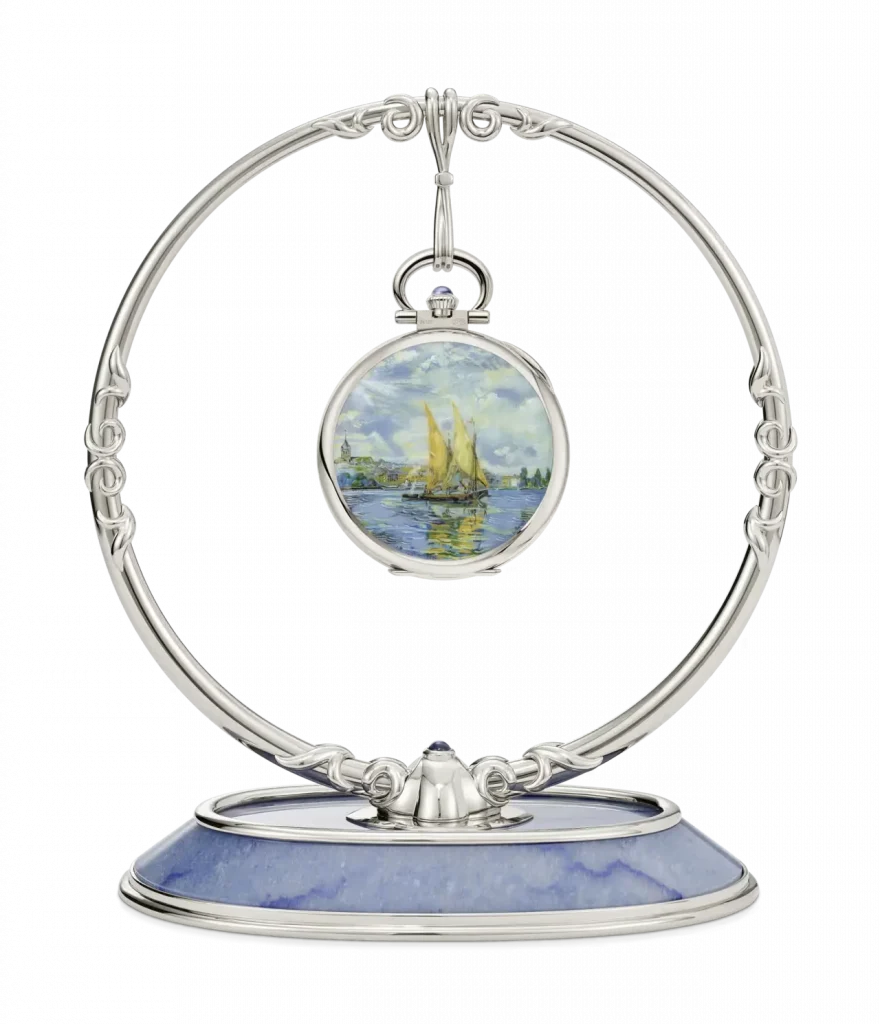
Take the Lake Geneva Barque, for instance. This is not merely a watch, it is a painting that has somehow found its way onto a dial. Crafted in white gold and inspired by Louis Baudit’s work depicting a barque leaving Geneva, it captures a moment in time with astonishing delicacy. The scene is not printed or stamped. It is built, layer by painstaking layer, using traditional enamel techniques that demand absolute precision. Colours are fired repeatedly in a kiln, each pass carrying the risk of ruining hours of work. And yet, the final result feels effortless. Calm waters, soft light, and a sense of quiet movement, all contained within something small enough to fit in a pocket. Reference 992/187G-001 is, quite simply, Geneva on a dial.
Also Read: Inside The New Ressence Type 11: A Game-Changer With Its First Proprietary Movement
Skiing in Days Gone By

Then there is Skiing in Days Gone By, which takes a completely different approach. Where the barque is serene and painterly, this one is vibrant, nostalgic, and just a little bit playful. Inspired by vintage Swiss ski posters, it uses Grand Feu cloisonné enamel to recreate the bold graphics and colours of a bygone era. This was a time when travel posters were not just advertisements but works of art in their own right, full of character and charm. The enamel here is separated by fine gold wires, forming tiny compartments that are individually filled and fired. It is meticulous work, the sort that requires a steady hand and an even steadier nerve. The result is a dial that feels alive, capturing the energy and optimism of early Alpine tourism. Reference 20191M-001 does not just tell the time, it tells a story, one of snow covered slopes and a world that felt just a bit more glamorous.
Yellow Crested Cockatoo
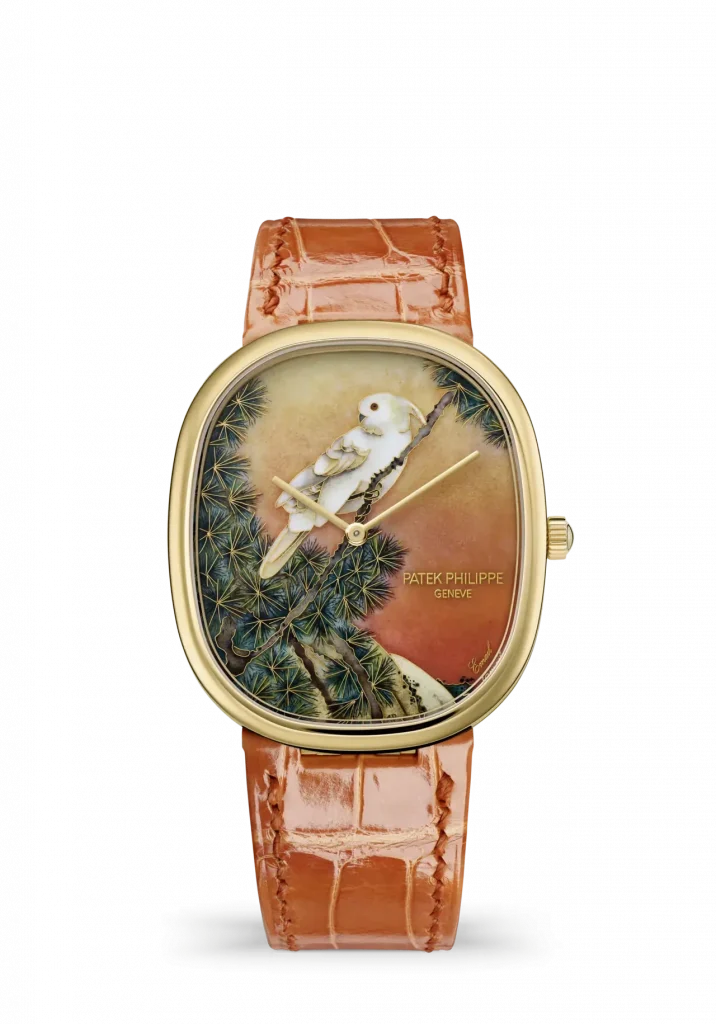
And then things take a turn towards the exotic with the Yellow Crested Cockatoo. Inspired by a painting on silk by the Japanese artist Itô Jakuchô, this piece is part of a limited edition of just ten watches, which means it is about as exclusive as it gets. The dial depicts the cockatoo perched delicately on a pine branch, rendered in Grand Feu cloisonné enamel with extraordinary detail. Feathers, leaves, subtle shifts in colour, all of it executed with a level of precision that borders on obsessive. This is not merely decoration. It is interpretation. The original artwork has been translated into enamel, a medium that behaves very differently from paint, yet somehow retains the spirit and nuance of the original. Reference 5738/50J-011 is less a watch and more a conversation between cultures, techniques, and centuries.
What ties all of these pieces together is not just skill, but intent. In a world increasingly obsessed with speed and efficiency, these watches represent the opposite. They are slow, deliberate, and unapologetically complex in their creation. Each piece requires hundreds of hours of work. Each carries the risk of failure at every stage. And yet, that is precisely what makes them so compelling. They are not just manufactured objects, they are the result of human effort, patience, and an almost stubborn refusal to cut corners.
The Rare Handcrafts exhibition is, in many ways, a reminder. A reminder that watchmaking is not just about precision engineering or mechanical innovation. It is also about artistry, about storytelling, and about preserving techniques that might otherwise be lost. And Patek Philippe, in its own quietly confident way, continues to ensure that they are not. Because in the end, these are not watches that shout for attention. They do not need to. They simply sit there, quietly extraordinary, waiting for someone to notice just how much effort has gone into making something so impossibly beautiful.