

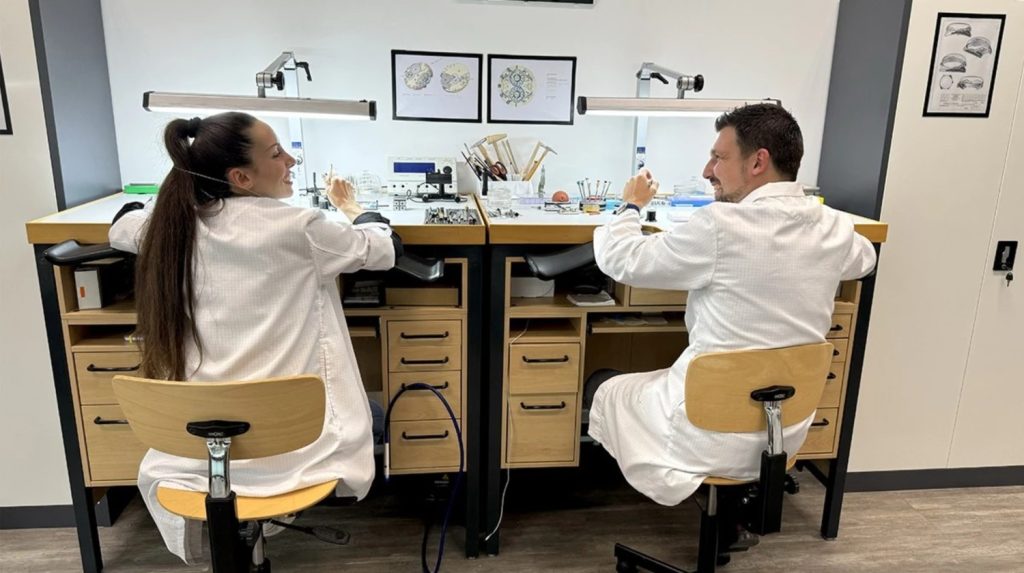
If you think the global luxury watch market is driven only by the usual suspects with deep pockets and predictable tastes then allow Sebastien Billieres to politely disagree and then completely dismantle that idea. The Co-founder, and Master Watchmaker of GENUS Watches speaks about India with the sort of excitement usually reserved for a newly discovered mountain pass or a V twelve engine that refuses to behave. To him India is not a checkbox market but a thinking market full of collectors who ask why before they ask how much and who are refreshingly open to watches that look nothing like what their neighbour is wearing in an interaction with Outlook Luxe.
India Watch Weekend has become a space where unconventional watchmaking is not only accepted but seriously discussed. What does it mean for GENUS to be present in Mumbai in 2026?
Sébastien Billières: It is both deeply meaningful and genuinely exciting. I first visited India over thirty years ago, and those memories stayed with me — the intensity, the contrasts, the sense of movement everywhere. Returning now with GENUS feels like closing a circle. For us, India represents a market of great cultural depth, curiosity, and openness to unconventional thinking. Being present at India Watch Weekend 2026 in Mumbai marks the beginning of a new adventure, one rooted in dialogue, discovery, and shared passion for exceptional craftsmanship.
GENUS watches rarely explain themselves at first glance. How important is it for you to personally guide collectors through the idea rather than relying on immediate visual understanding?
SB: It is essential. GENUS watches are not designed to be instantly decoded — they are designed to be discovered. Guiding collectors personally allows me to create a direct connection, to explain the mechanical logic, the philosophy behind our time display, and the intention behind every detail. This exchange ensures that collectors truly understand our unique way of telling
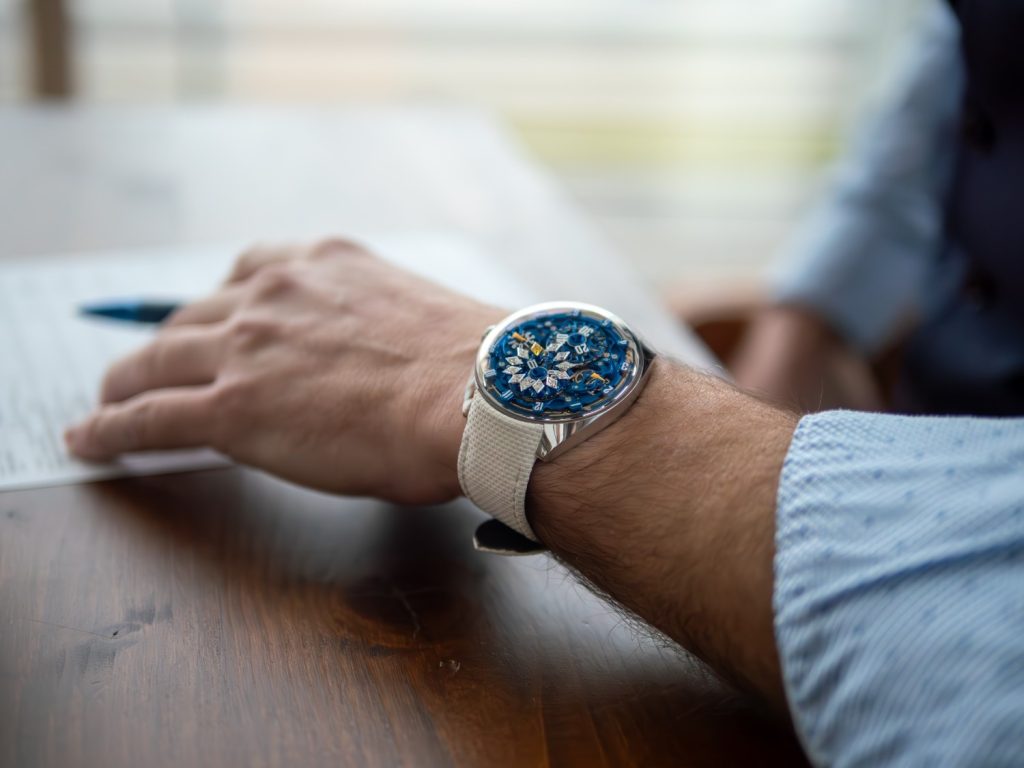
Mumbai thrives on layered systems and constant motion. Do you see any parallels between the city and the way GENUS represents time?
SB: Absolutely. Mumbai never sleeps — it is perpetually in motion. Time, in our view, behaves in the same way: continuous, layered, never static. GENUS does not freeze time into fixed positions; it lets it flow. In that sense, the rhythm of the city and our representation of time feel deeply connected.
GENUS made the radical choice to eliminate the central axis entirely. At what point did you realise that this was not just a design decision but the foundation of the brand?
SB: From the very beginning. The challenge was never to remove the axis for aesthetic reasons alone, but to invent a new way to mechanically illustrate time along a figure-eight path — the universal symbol of infinity. This concept guided the entire movement architecture and ultimately became the foundation of the GENUS identity.
Also Read: Pave Diamond Setting in Watches: Meaning, Craftsmanship And Value
The GNS1 series introduced exposed mechanical trains and an entirely new way of reading time. What part of that first execution still defines GENUS most clearly for you today?
SB: Our mechanical patent that enables the figure-eight path. It gives us an absolute freedom of movement for components — something entirely unique in watchmaking. That freedom is still at the core of everything we create today.
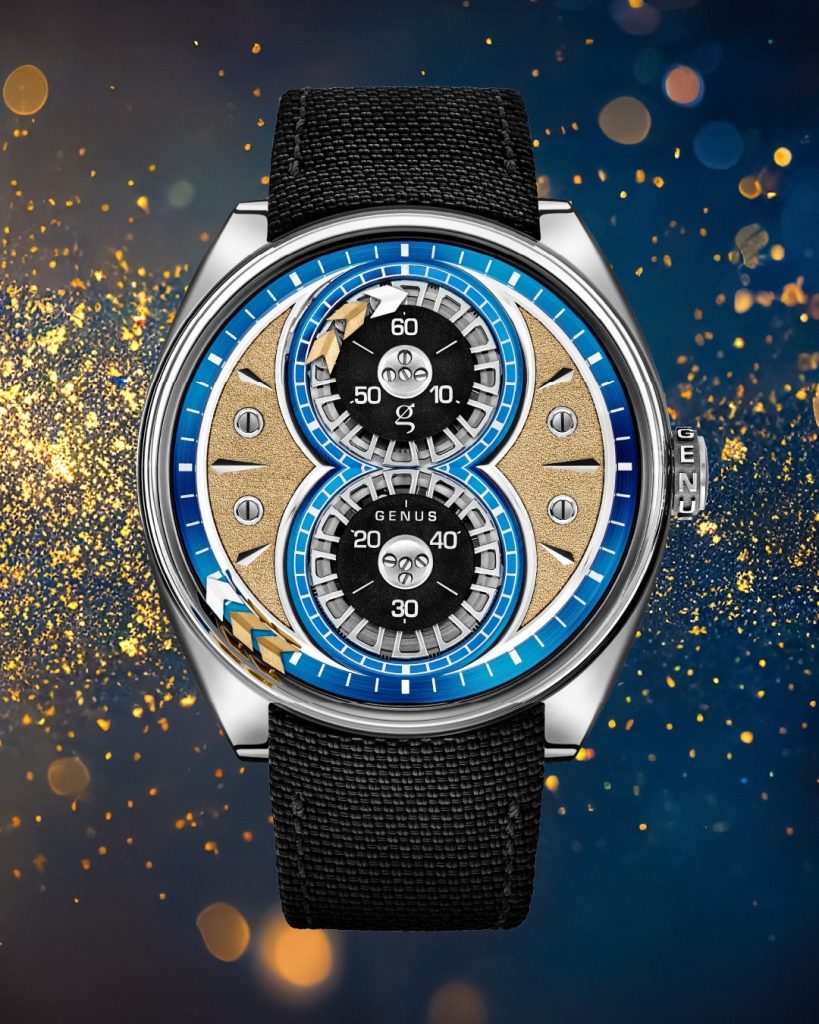
With GNS2, the same movement is wrapped in a calmer, more architectural dial. Was this about maturity of design or about making the concept easier to live with daily?
SB: Both. The addition of the dials stabilises the eye and allows the viewer to focus more clearly on the figure-eight path.
These dials are entirely made and hand-decorated in our atelier, and they shift the emphasis from pure mechanical exposure toward aesthetics and artistic expression — without sacrificing complexity.
Four pieces from GNS1 and four from GNS2 are being presented here. How should collectors think about these two families when deciding which one speaks to them?
SB: GNS1 pieces are unique, highly expressive creations that maximise mechanical choreography and visual movement.
GNS2 offers a calmer, more architectural and artistic interpretation of the same philosophy. Both speak the same language — but with different tones. At the heart of both lines is the calibre 260Rh-2 with two counter-rotating wheels forming an infinity path.
Why was the figure eight the only shape that truly worked for continuous time?
SB: Because it naturally embodies continuity. The figure eight has long symbolised infinity, and mechanically, it allows uninterrupted motion without a beginning or an end. It was the most honest shape to express our vision of time.
Removing the axis means removing one of the most instinctive reference points in watchmaking.
What was the hardest habit to unlearn during development?
SB: Letting go of traditional mechanical architecture. Everything had to be rethought — how components interact, how energy is transmitted, and how time can be shown mechanically without relying on a central axis at all.
The movement relies on hundreds of hand-finished components to move sculptural elements along tracks. What part of this mechanism took the longest to stabilise?
SB: Depending on the version, GNS1 watches contain over 400 components across two patented display complications, while GNS2 has one display patent and 278 components. The most challenging aspect was perfecting the bi-directional passage of free-moving elements along the figure-eight path. These components must repeatedly pass from one minute wheel to the other while remaining robust enough to withstand daily wear — and countless manual demonstrations — yet light enough to ensure accurate timekeeping for up to 50 hours of power reserve.
GENUS refers to these moving elements as genera. How does thinking in biological terms change the way you design mechanical systems?
SB: It encourages us to think in terms of interaction rather than domination. Each genus has its role, its rhythm, its relationship with the others. Instead of a hierarchy of static parts, we design living systems where elements coexist, influence one another, and evolve through motion — much like a biological ecosystem.
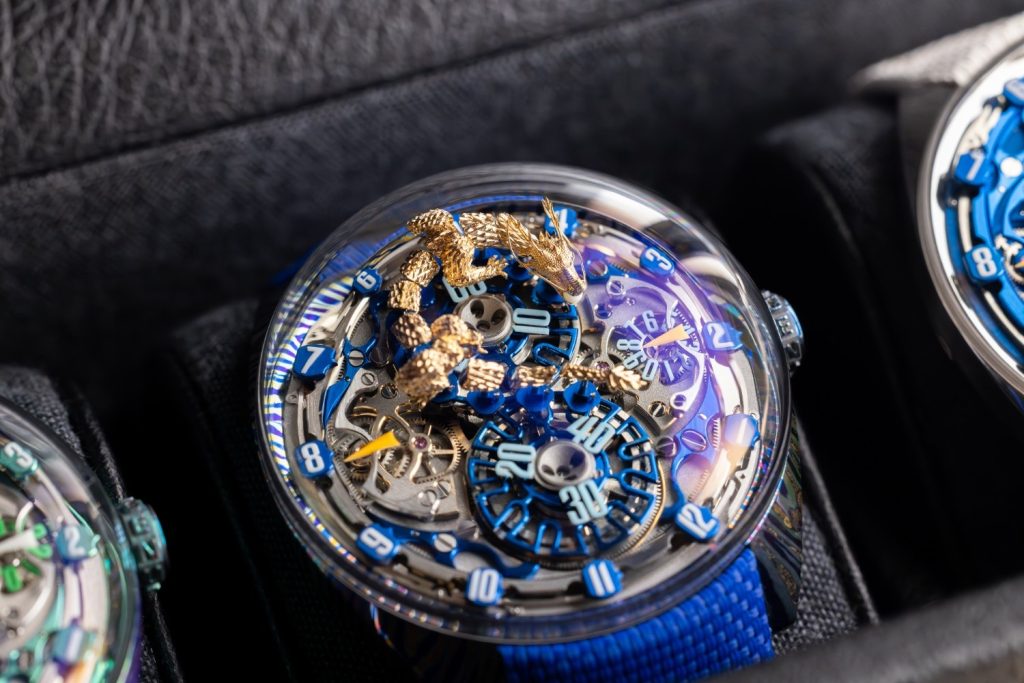
In some pieces an eleven-segment hand-carved gold dragon travels the infinity path to mark tens of minutes. How do you decide when symbolism adds meaning rather than distraction?
SB: Mechanical automata and mythical creatures have fascinated me since childhood. The challenge was not to decorate a watch with a dragon, but to give life to one — and prove that it could tell time. Many dragons exist in watchmaking, but the GENUS Dragon is the only one that truly measures time. When symbolism becomes functional, it gains legitimacy.
GENUS watches reward patience and observation rather than instant clarity. Do you see this slower reading of time as a quiet resistance to modern speed?
SB: Yes — and in a poetic way. It invites the wearer to slow down, to observe, and to reconnect with time as a flow rather than a countdown.
Indian collectors often engage deeply with stories behind objects. What kind of questions do they ask you that differ from collectors elsewhere?
SB: They are particularly curious about meaning — not just how something works, but why it exists. Questions often revolve around symbolism, intention, craftsmanship, and the human hands behind the object. It leads to very rich and thoughtful conversations.
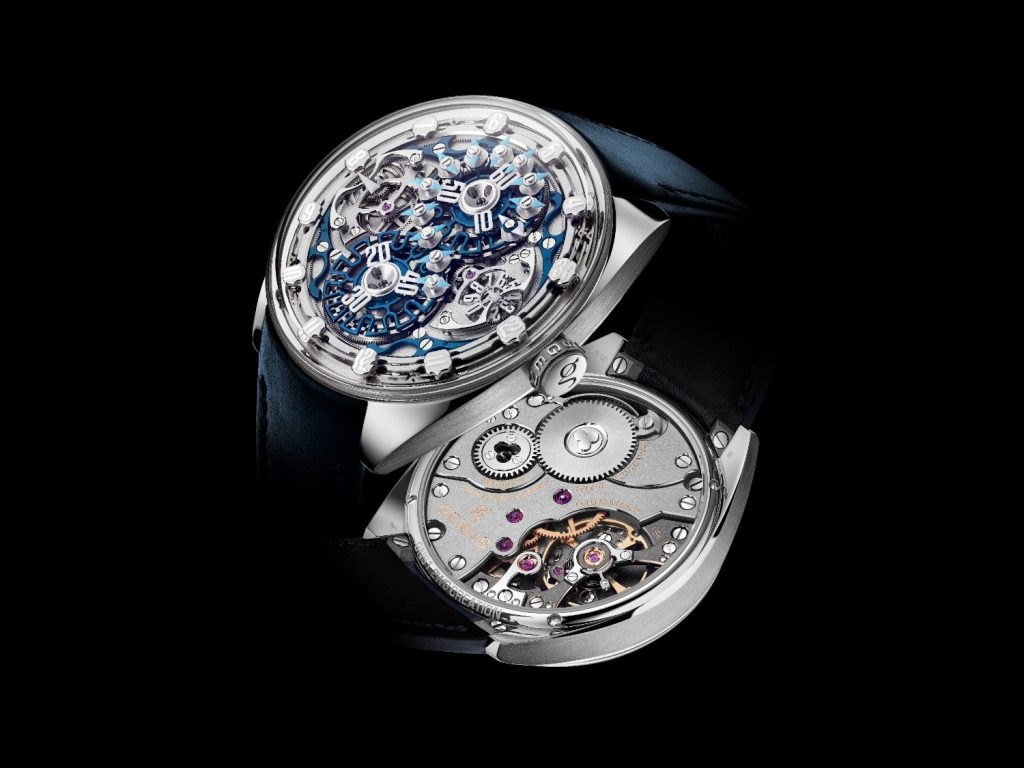
As GENUS evolves, how do you decide what must remain untouched and where evolution is allowed, as seen from GNS1 to GNS2?
SB: We are open to evolution in display, form, and expression — but we will never compromise on emotion or originality. GENUS will always strive to introduce unexpected sensations and new ways of reading time within the Art of Fine Watchmaking.
When someone in India encounters a GENUS watch for the first time, what do you hope they feel before fully understanding how time is being shown?
SB: A sense of astonishment. That instant where they realize they are discovering something entirely different — something truly unique. We love hearing: “Wow… I’ve never seen this before.”