

In Jaipur, a city that wears history with quiet confidence, Laalee reveals itself slowly. It does not announce itself with spectacle. Instead, it invites you to step in, pause, and listen. To stories whispered through painted walls, hand worked surfaces, filtered light, and spaces shaped by memory, faith, and love.
Laalee is not simply a boutique retreat. It is a deeply personal universe, created as much from emotion and belief as from craft and design. For me, Laalee represents a lifetime of influences distilled into a space that is meant to be felt as much as it is seen.
A Design Language Rooted In Storytelling
My design philosophy is simple. It’s never just about how a space looks. It is about what it means.
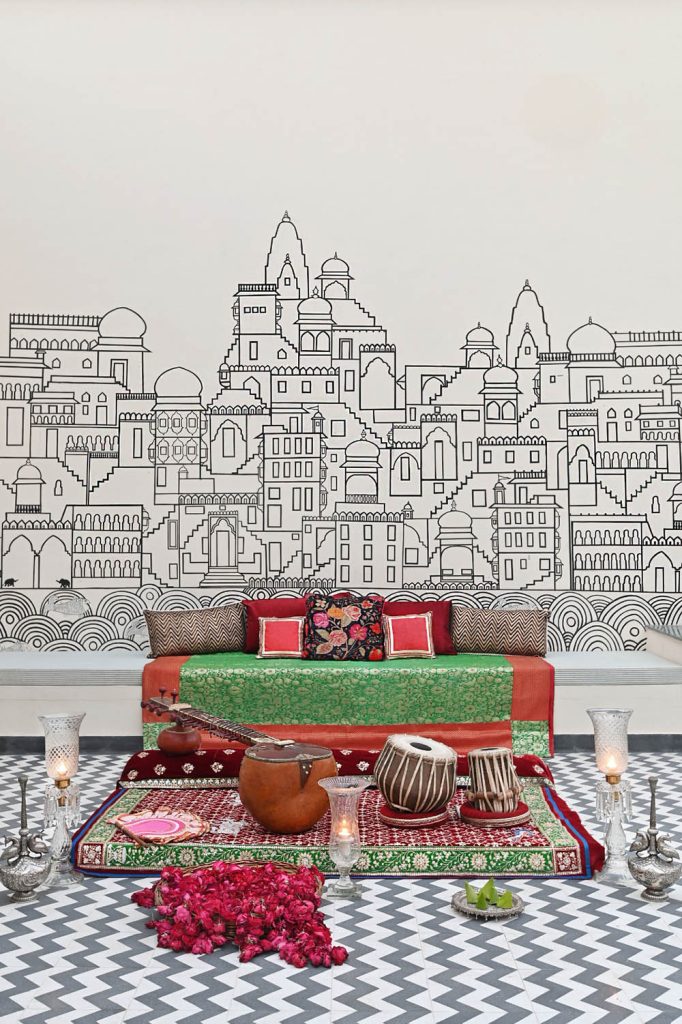
You’ll see that my signature style is rooted in layering, maximalism, and balance. I, as the creator, interior designer and an artist have treated every surface with lots of care and intention. Hand painted walls form the soul of my work, allowing spaces to breathe, speak, and evolve with emotion. For me, surface decoration is not ornamental. It is narrative. Each wall becomes a page, each motif a word.
India, with its centuries of cultural exchange, living craft traditions, and indigenous knowledge systems, remains a constant source of inspiration. These traditions are not replicated nostalgically but carried forward in a contemporary, sensitive manner. The result is a visual language that feels timeless yet deeply grounded in the present.
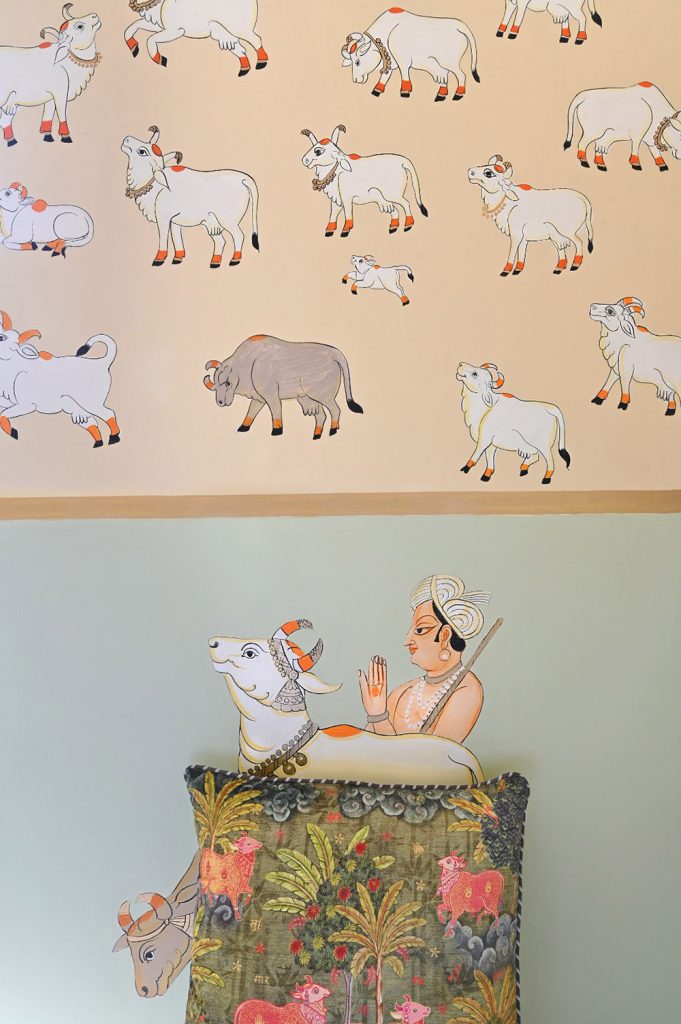
Central to my inspiration is the figure of Shrinathji and the ancient Pushtimarg traditions. The Pichwais of Nathdwara, sacred hand painted textiles created as backdrops for temple rituals, have shaped my visual imagination since childhood. Their devotion, symbolism, and meticulous detail continue to inform my work till date.
Laalee is my ode to the story of Lord Krishna. A space where devotion, art, culture, and storytelling merge into an immersive experience.
The Making Of A Dream Retreat
In the early stages of ideation, I had shared my dream of creating a boutique retreat in Jaipur with my wife, Devyani. She’s also a passionate host, and together we’ve always imagined a home centred on warmth, good food, and togetherness – a place where people are welcomed not as guests, but as extended family.
For years, this dream lived quietly in conversation and prayer, imagined as something for a later chapter in life. To be quite honest, we were both deeply immersed in our respective careers, and the idea of a retreat felt distant, aspirational.
Then, one evening, during a visit from close friends Ganesh and Preeti from Mumbai, our shared dream found momentum. What began as a casual conversation about future aspirations transformed into action. Encouraged by their belief and support, the idea became reality for us. Ganesh and Preeti chose to invest in the project; becoming partners in a journey built on friendship, trust, and shared vision.
The house was acquired in February 2023. By October 2023, just eight months later, Laalee stood ready.
An existing structure was completely reimagined. An entire floor was added. Rooms were redesigned, bathrooms rebuilt, plumbing and electrical systems replaced, fire safety installed, and structural elements reworked. Vastu Shastra guided the renovation process. Renovating rather than building from scratch brought its own challenges, but clarity of vision informed every decision.
Light and openness became our central themes. All rooms open into a central atrium, the heart of the house, allowing natural light to flood every space. Gardens surround the property, and the very first act after purchase was planting trees. Over 280 trees now grow in and around Laalee, creating an oasis that welcomes birds, squirrels, and stillness.
A Space By Space Journey Through Laalee
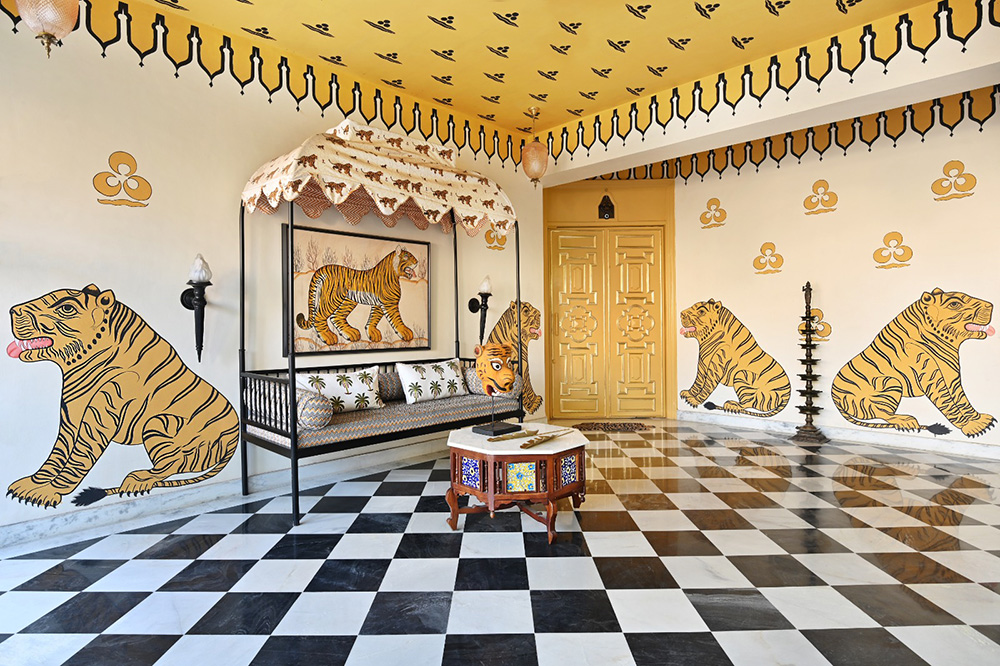
The journey begins at a black iron gate with cut outs shaped like gulab danis, traditional vessels used to welcome guests with rose water. A stone lined passage with mirror work niches on one side and tall bamboo plants on the other leads to the entrance verandah, known as Singh Dwar, the tiger gate.
Here, five majestic tigers are hand painted as guardians. In temple and fort traditions across Rajasthan, the Singh Dwar signifies protection. The choice is also symbolic of Lord Krishna’s journey as an infant, when he was carried across the Yamuna to safety, accompanied by a tiger as a divine protector.
Inside, the central atrium serves as the lobby and emotional core of Laalee. Dedicated to the Raas Leela, its walls are animated by 28 gopis, painted in full regalia, carrying offerings and ceremonial objects as they move towards Krishna, depicted in the central archway. A large fabric globe light suspended from above represents the autumn full moon of Sharad Purnima, the night of the cosmic dance. A black marble skirting running along the floors symbolizes the Yamuna, on whose banks the Raas unfolds.
Each room at Laalee carries a name rather than a number, reinforcing the idea that every space has its own identity.
Mayur celebrates the peacock, Krishna’s beloved companion, through sage green walls adorned with dancing peacocks and peahens, painted with single hair brushes. Padma floats in the serenity of lotuses, inspired by the Yamuna and Shrinathji’s symbolism, while Basant captures the freshness of spring, childhood gardens, and the joy of Holi.
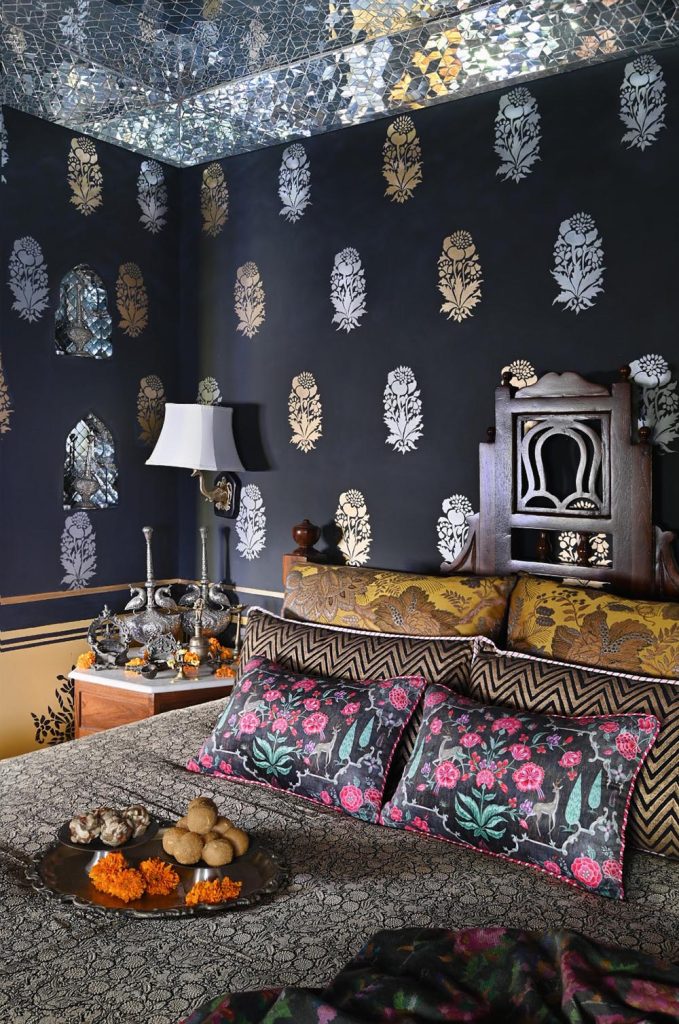
Diwali, set on the mezzanine, is dramatic and introspective. Black walls evoke the new moon night, while gold and silver floral motifs and mirror work reflect light like ceremonial lamps. Gowdhuli on the first floor captures the golden hour when cows return from the pastures, a moment of quiet poetry in Krishna’s life.
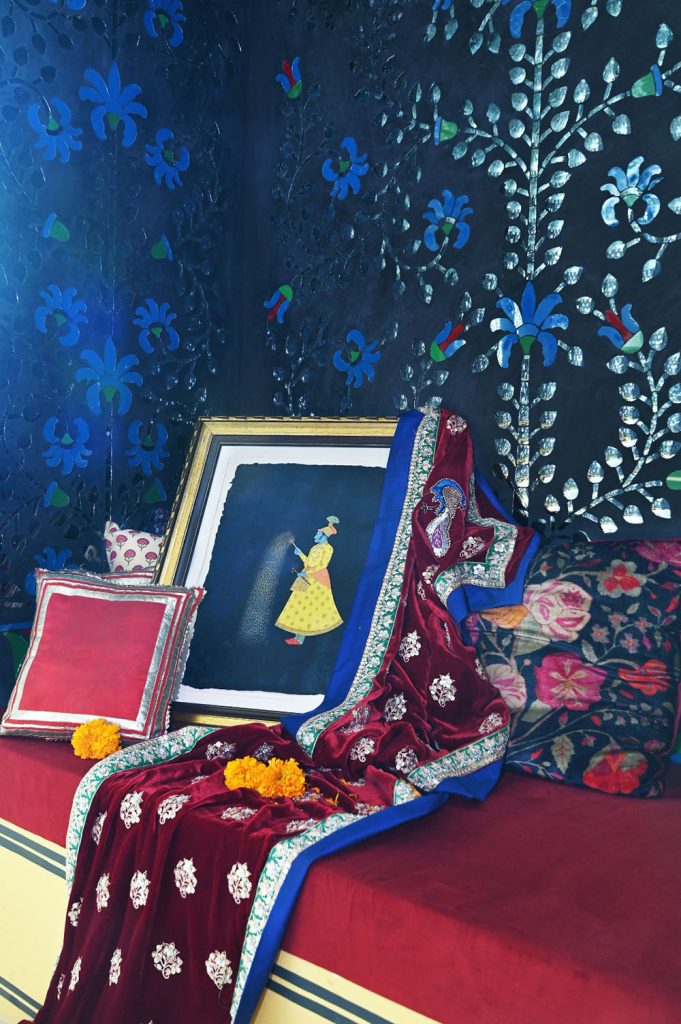
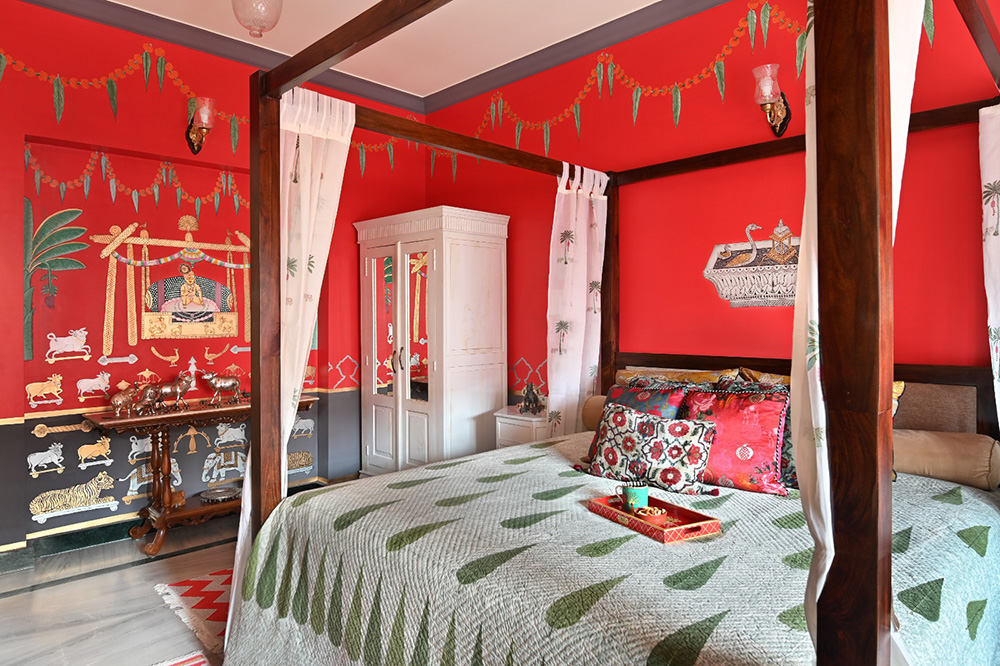
Utsav celebrates childhood and maternal love, filled with marigolds, toys, and imagery of baby Krishna. Jal, a suite adorned with cranes, speaks of loyal love and lifelong companionship. Sawan welcomes the romance of the monsoon, with leheriya borders, cloud motifs, and rare narrative Pichwais.
The largest suite, Sankrant, crowns the second floor. Dedicated to Jaipur’s beloved kite festival, it opens onto a private terrace overlooking Hathroi Fort. Kites, clouds, and mirror work celebrate a living craft tradition that continues to animate winter skies.
Spaces To Gather, Reflect, And Belong
Beyond the rooms, Laalee offers spaces designed for connection. The dining areas draw inspiration from the surrounding gardens, with hand painted trees referencing those that grow outside. Mirror work ceilings echo the geometry of kaju katli, a beloved Indian sweet wrapped in silver varak.
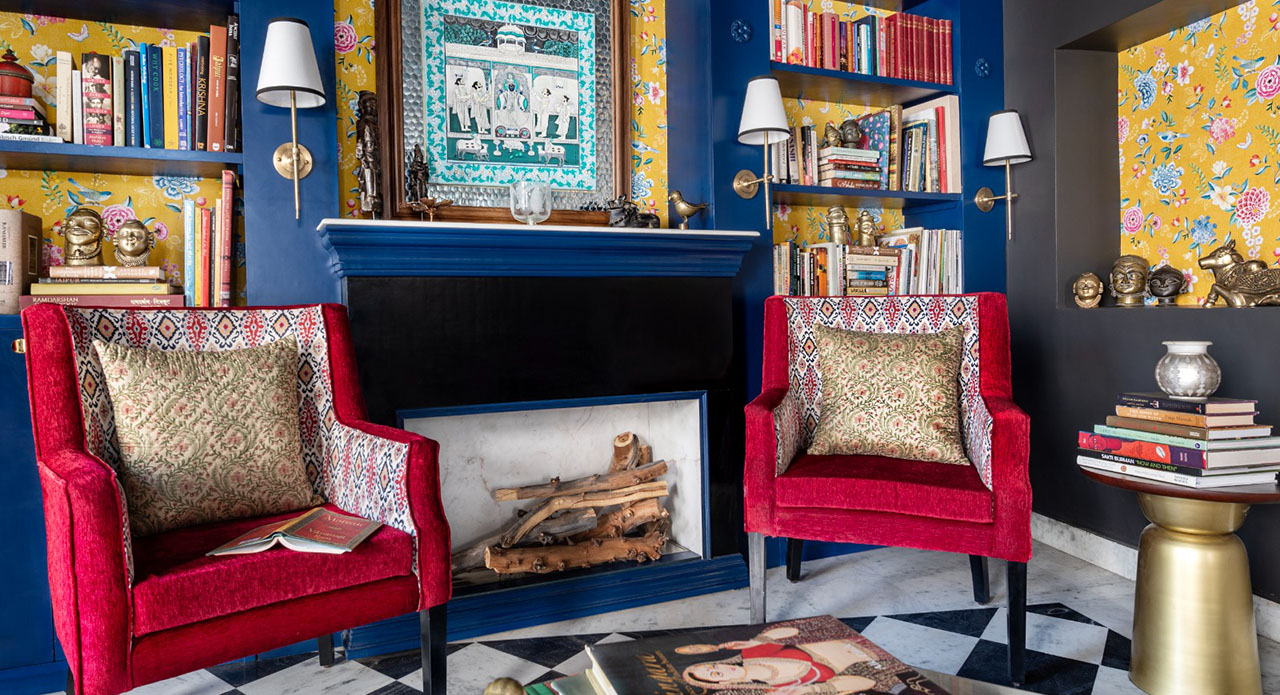
The library lounge opens onto the garden through arched windows, filled with books, warmth, and a fireplace for winter evenings. Its ceiling is painted with monsoon clouds, a recurring motif of renewal.
The pool, named Radha Kund, sits nestled among trees, with lotus shaped marble fountains crafted by artisans from Jaipur’s old city. Every object here carries the imprint of human hands.
Laalee was never meant to be just a place to stay. It was envisioned as a space to slow down, to reflect, and to reconnect. We invite our guests to engage with Jaipur beyond its surface, through experiences thoughtfully curated by me and my wife, Devyani.
An Experience Beyond Stay
As part of the whole immersive experience, I also conduct heritage craft walks through the old city, offering our guests a deeper understanding of Jaipur’s living craft traditions and the communities that sustain them. Another much loved experience is the Pichwai painting workshop. For this, one does not need to be an artist. In three hours, I try to introduce guests to ancient techniques and motifs used in Pichwais, allowing them to experience the meditative rhythm of this sacred art form.
Devyani, my wife, also happens to be a celebrated home chef and she hosts intimate cooking sessions at Laalee, using seasonal local produce and family recipes. Our house is also open to our guests. They can come and enjoy a meal at our ancestral home, just a stone’s throw away. The home, lovingly called The Artist’s Mansion, offers guests a rare experience of dining amidst a personal museum of antiques, artworks, and heirlooms, while savouring signature dishes prepared by my lovely spouse.
By now, you all would have gauged that hospitality, for us, is deeply personal. Guest experience and the sharing of Jaipur’s stories go far beyond the idea of a hotel stay where one is simply a number. At Laalee, we welcome our guests into a narrative, a way of life, and a sense of belonging.
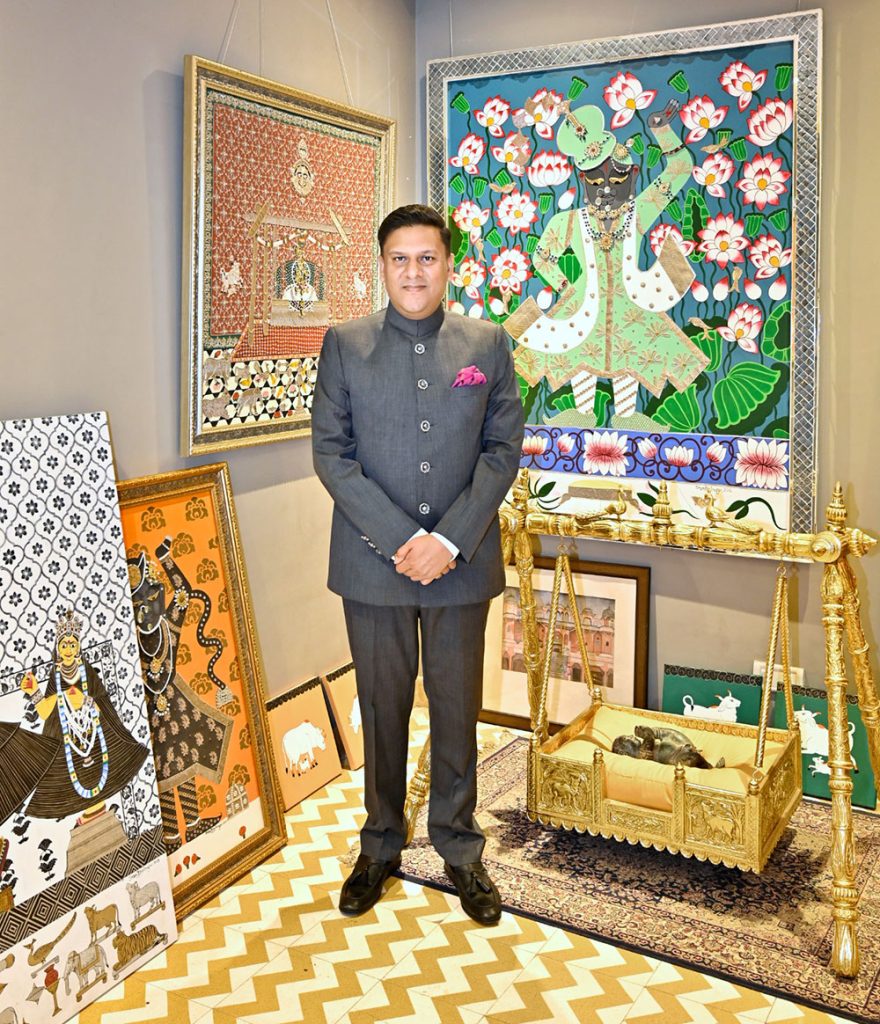
If Laalee is an ode to the beloved, then everything within it had to be created with love. For us, that love extends to the craftsmen, the traditions they carry, and the guests who walk through its doors.
At Laalee, you do not simply check in. You enter a story, and for a while, it becomes your own.
(All images have been contributed by Taha Ahmad)
Shan Bhatnagar is an artist, interior designer and hotelier.