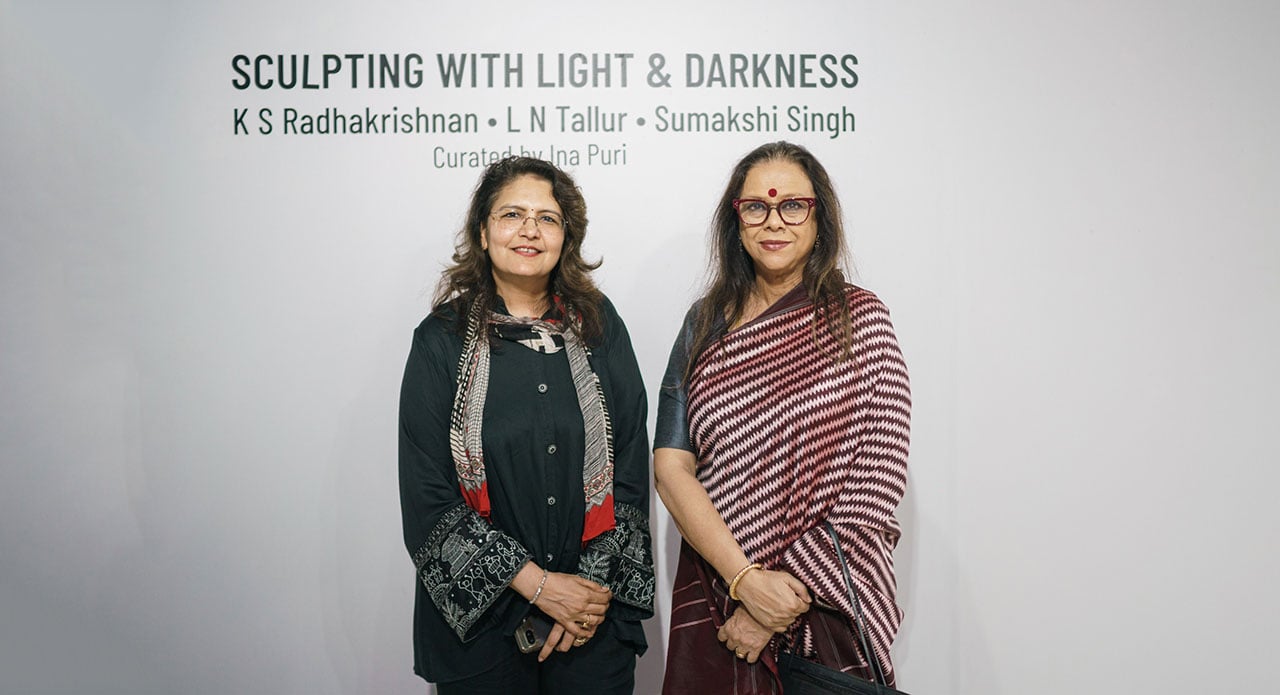


In the vast and occasionally bewildering universe of contemporary art, it’s rare to find an exhibition that doesn’t just demand your attention—but quietly rearranges the way you see space, shadow, and even silence. Sculpting with Light & Darkness does precisely that. Bringing together the industrial sorcery of LN Tallur, the fluid bronze poetics of KS Radhakrishnan, and the gossamer architectural illusions of Sumakshi Singh, the exhibition feels like a conversation between three different elements—earth, movement, and air—held together by beams of light and pockets of darkness. At the heart of this meticulously orchestrated interplay stand two women who know how to turn a curatorial idea into a cultural moment: the ever-curious, ever-poetic curator Ina Puri and the steadfast, visionary gallerist Rekha Lahoti. Outlook Luxe had a conversation with both of them.
The exhibition seems to traverse not just light & darkness but emotional, cultural even historical shadow and illumination. How do you see that reflected in the works?
Ina Puri: “The most powerful weapon we have is our ability to play and dream, to be able to discover alternatives and pursue them. The oppressive forces fear this weapon the most because as long as we are able to imagine another kind of world, we have the power to fight for our dreams.” These words of Jonatan Stanzak (co-founder of The Freedom Theatre) ring especially true in our times. Art. I believe, must be a reflection to the times we are living through, a response to our lived histories. The sculpture show draws upon the experiences of three contemporary artists spanning diverse age groups who present their works through the lens of their beliefs, knowledge and emotion. What endures in a world defined by fleeting impermanence? Art filters the views and shapes the works we see of Sumakshi Singh, Tallur LN and KS Radhakrishnan, the mediums and artistic styles depicting their own histories and memories.
How do you want viewers to engage-intellectually, emotionally, or sensorially-with the dialogue between concealment and revelation?
I.P: The age group of the viewers spanned generations, from veteran art practitioners to young students who were perhaps engaging with contemporary art practitioners for the first time, who were exhibiting together in Hyderabad for the first time. Collectively, the response one observed was that of curiosity, of the desire to engage intellectually with work practices that ranged from Radhakrishnan’s to Tallur’s and Sumakshi’s, each narrative vividly distinctive and unique. Ideally, responses need to be individualistic, because each work deserves a response that applies to that particular work. Be it the fragile thread work by Sumakshi mapping ancestral memories or Tallur’s quirky ‘Chirag the Chabot’!
In what ways do you see sculpture as a particularly powerful medium to embody this duality of light and darkness?
I.P: Through the display and conversations, the participants from varying age groups, geographies and cultural histories investigate intimate and complex issues – ranging from history, geopolitics and artificial intelligence to the realm of the personal. Animations, sculpture and installations form the threshold that explores sociopolitical and constructed binaries. Sculpture as an art form has the powerful capacity to position artists as “long-term activators of largescale authorship who participate in creating value.”
You’ve curated across decades from Manjit Bawa to Jayasri Burman and beyond. How has your curatorial lens evolved over the years?
I.P: I would like to believe that varying pluralities can co-exist and inform each other. I have enjoyed my curatorial projects with veteran artists as much as working with young art practitioners. What happens next; how one moves further is where the next part of the journey begins, with newer challenges and experiments. I believe that one can continue to evolve even while revisiting past projects. For instance, I am looking forward to curating an exhibition of Manjit Bawa’s at the 2026 India Art Fair, this alongside an exhibition at Birla Academy titled ‘Zameen’, which will feature some brilliant young contemporary voices like Vikrant Bhise and Mithu Sen (to name a few).
How does working on a sculptural show differ from your previous projects that engaged with painting, photography or performance?
I.P: “Once I saw a violinist playing and I thought: between/ his right hand and his left hand-only the violin/ but what a between, what music!” In the words of the poet Yehuda Amichai, ultimately what matters is the art that is created. If that art made equal music. I couldn’t agree more or say it better.
As someone deeply invested in storytelling-through books, films, and exhibitions-how do you weave narrative through form in your curatorial process?
I.P: By trying to create stories as accompaniments to the art, not as explanations or theories, but as nuanced variations on themes, that traverse boundless horizons in the process.
You’ve written that artists are “keepers of fleeting impressions”. In this exhibition, how do you see the artists translating memory into form?
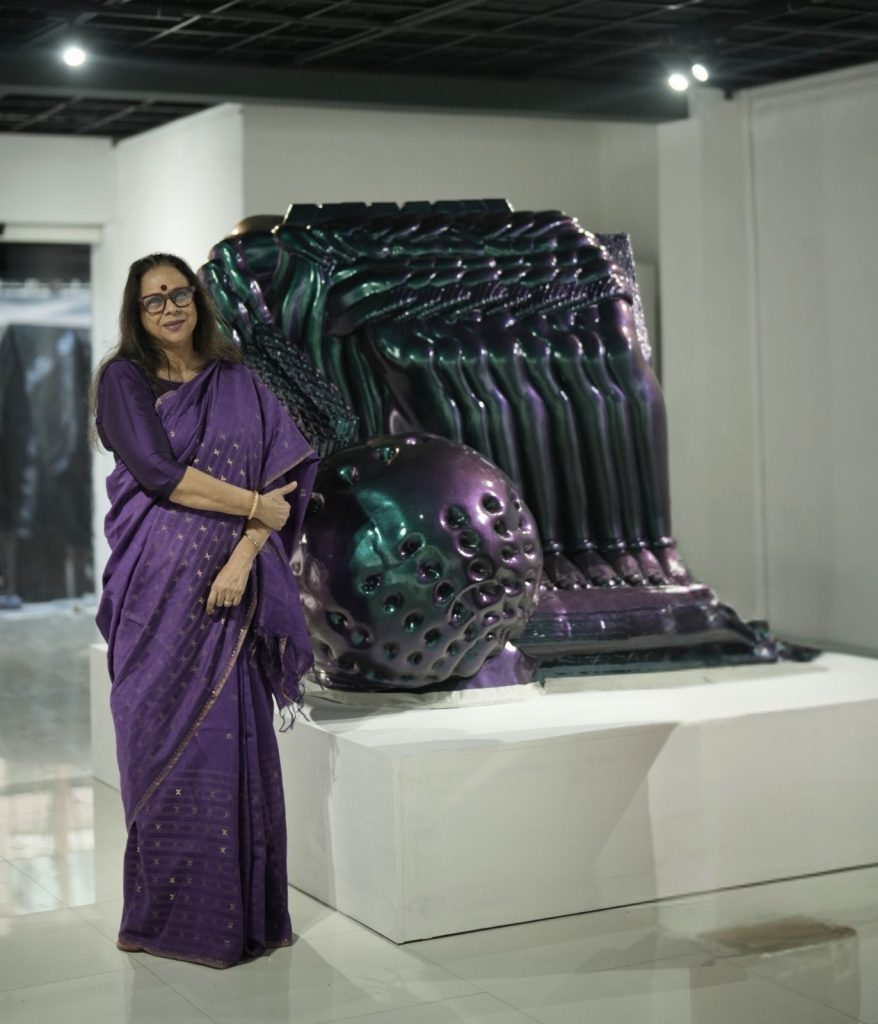
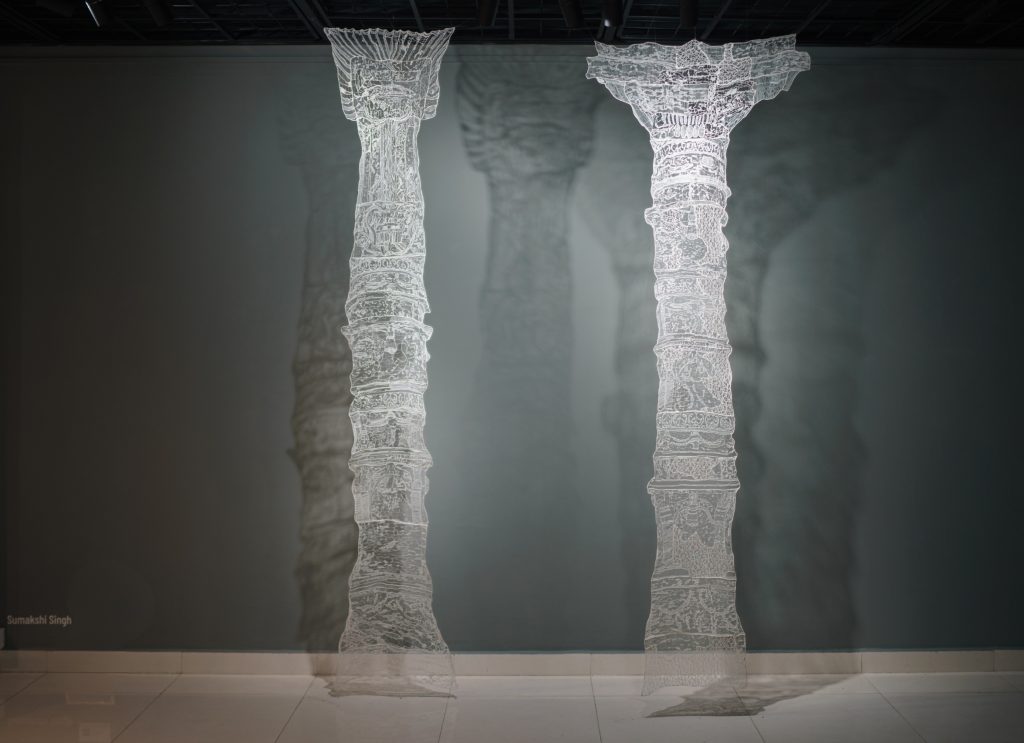
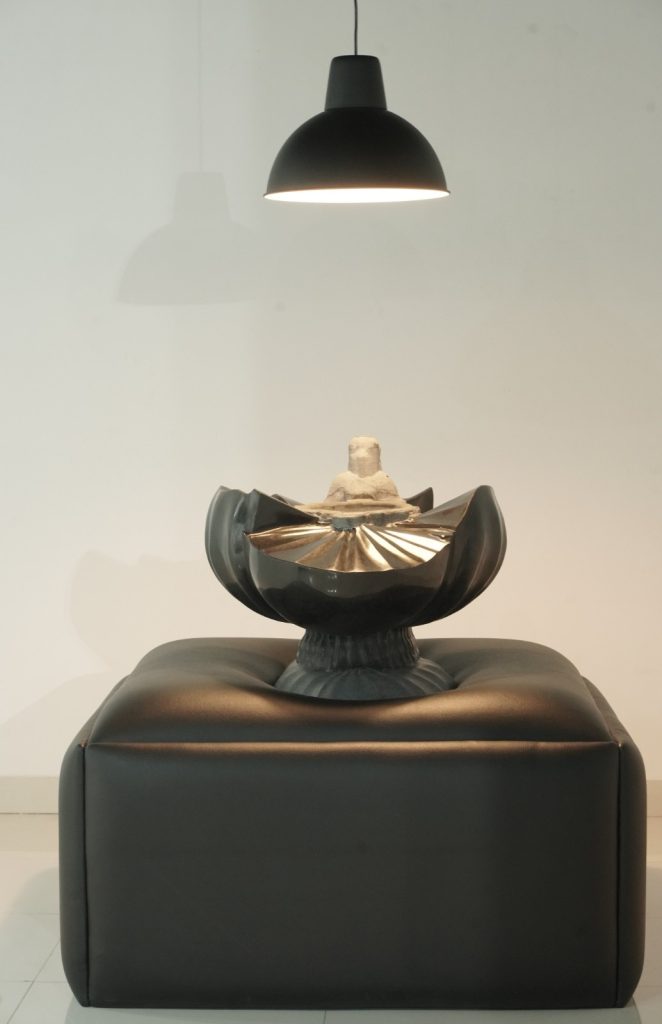
I.P: Radhakrishnan speaks of the ‘kuppi’ lamp from his childhood that inspired a work, which captured flame inside the lantern, but finally, the flame spilled over, to illumine the darkness. Sumakshi Singh describes her work: “Once part of Jain temples, these columns were later absorbed into an Islamic complex – silent witnesses to shifting histories. The monument collapses into two dimensions. Its fading forms speaking the language of fragmented memory.” About ‘Half Horsepower’, Tallur says: “I bring together mythology, engineering and irony. The term horsepower was coined by James Watt in the 18th century to sell his steam engines… in mythology, Vali’s boon allowed him to absorb half the power of anyone he fought – a divine version of power transfer.” Each artist’s imagination is fuelled by personal histories, concepts and even at times cross-cultural experiences to preserve impressions that may have been fleeting or otherwise.
Sculpting with Light & Darkness has been two years in the making. Can you take us through how this idea first took shape and what inspired the concept?
Rekha Lahoti: The idea for Sculpting with Light & Darkness has been a long-held vision of mine. I had always dreamt of bringing L.N. Tallur and Sumakshi Singh to Kalakriti Hyderabad, having followed their practices closely over the years. When I finally approached them and they agreed to participate, I discussed the concept with Ina
Puri, who immediately connected with it. We then invited Radhakrishnan Sir to join, completing what we felt would be a remarkable trio – three of India’s finest sculptors, each working with distinct materials and artistic languages. That’s how the idea gradually took shape and evolved into this exhibition.
The title itself has poetic weight — what does “sculpting with light and darkness” mean to you personally as a gallerist and patron of the arts?
RL: Yes, the title Sculpting with Light and Darkness is indeed very lyrical. When Ina Puri first suggested it, she shared a few other options as well, but this one immediately resonated with me. It beautifully captures the essence of sculpture – the way form interacts with light to create depth, shadow, and contrast. Every sculpture holds a dialogue between illumination and obscurity, and that interplay of light and darkness is what brings the work to life.
What was the moment you knew these three artists — LN Tallur, KS Radhakrishnan, and Sumakshi Singh — needed to come together under one curatorial umbrella?
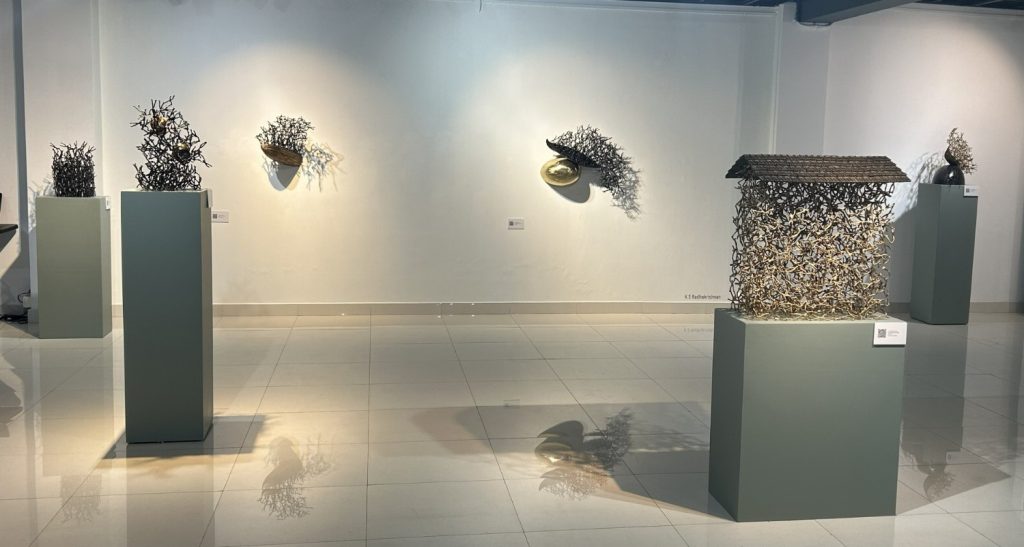
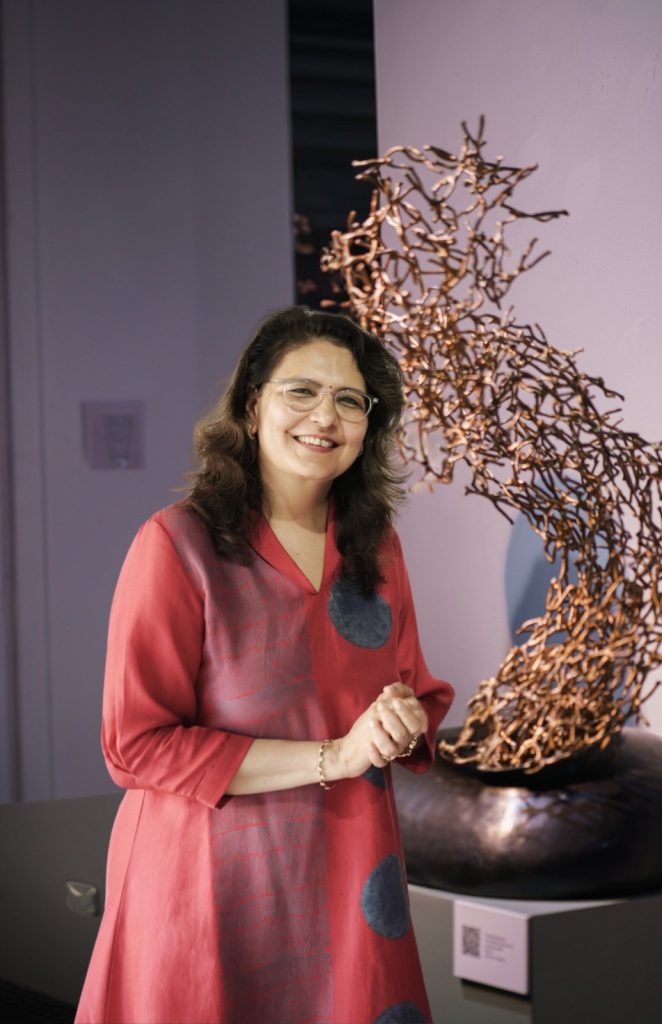
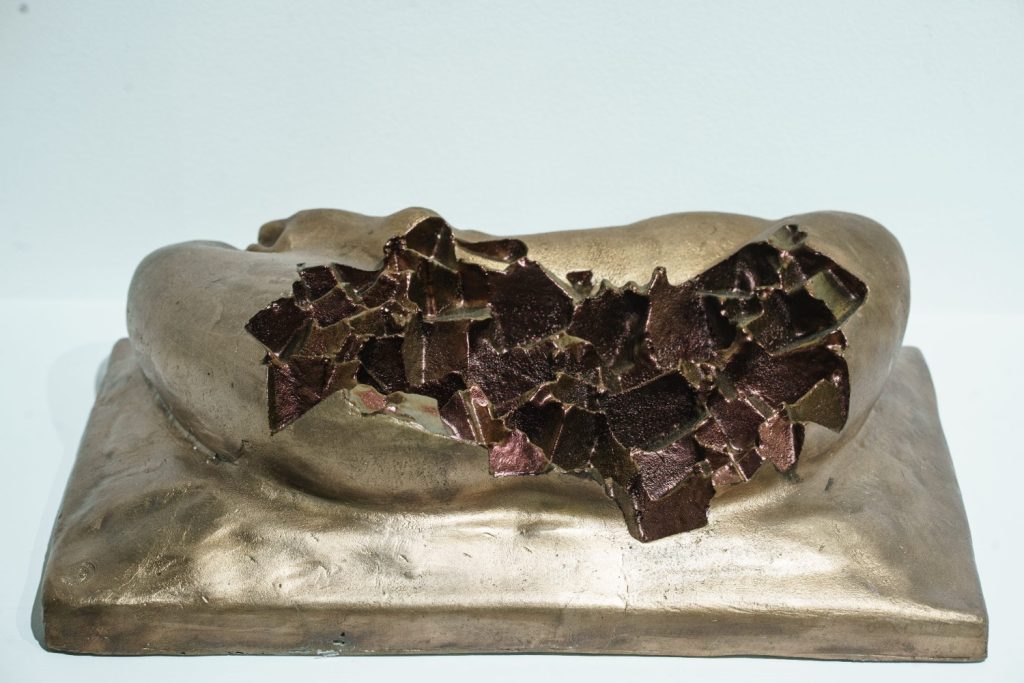
RL: I knew these three artists needed to come together because each of them engages with materiality in such distinct yet compelling ways. Sumakshi works with textiles, threads, and copper, weaving them with incredible precision and delicacy. Radhakrishnan Sir, on the other hand, works primarily in bronze, and in this exhibition, he has achieved a stunning interplay of gold and black tones within the medium. Tallur brings yet another dimension with his remarkable use of diverse materials, each layered with meaning and experimentation. What truly intrigued me was this diversity – how their individual approaches to form and material could converse within a shared space, creating a unified yet multifaceted dialogue.
Coordinating three of India’s most celebrated sculptors must have been a formidable task. What were some of the challenges and surprises during this journey?
RL: Bringing together three of India’s most celebrated sculptors was indeed a formidable yet deeply fulfilling experience. The coordination itself – from aligning schedules to managing logistics – was a challenge, but one I thoroughly enjoyed. The most demanding part was transporting and installing the larger works, especially Tallur’s pieces. Since none of the sculptures could be handled manually, we relied entirely on cranes and pulley systems to move them with precision and care. Watching that process unfold was fascinating – a blend of technical mastery and artistic sensitivity. Overall, while the journey had its complexities, it was an immensely rewarding experience to see everything come together so beautifully in Hyderabad.
How did your conversations with curator Ina Puri shape the exhibition’s final form?
RL: I fondly call Ina Puri “Ina di,” as we both share roots in Calcutta – we often speak in Bengali, which makes our communication effortless and warm. Working with her was an incredibly smooth and enriching experience. She immediately understood my vision for bringing these three artists together and helped shape it with her deep knowledge and curatorial insight. Her sensitivity to both the conceptual and practical aspects of the exhibition made the entire process seamless and truly rewarding.
Each artist works with distinct materials — from bronze to thread to industrial components. How did you envision their works conversing within the same space?
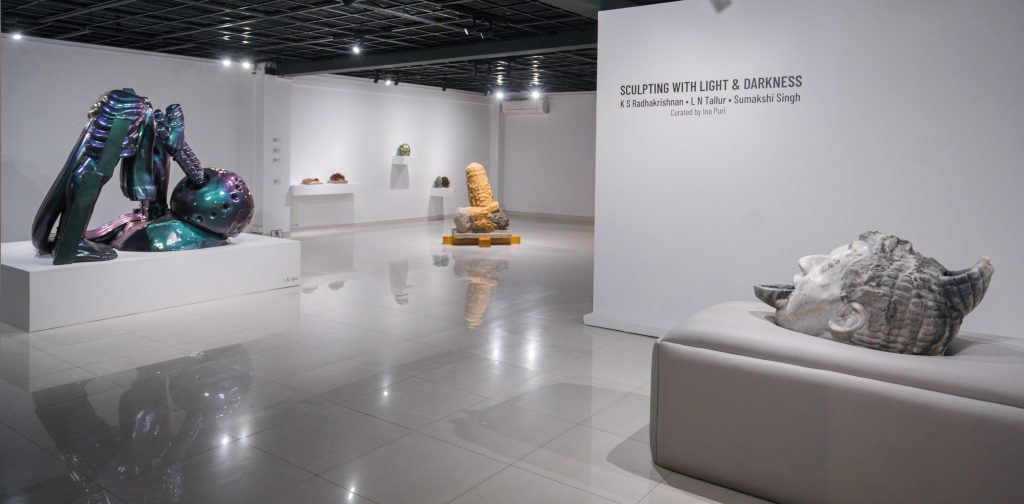
RL: One of the great advantages of exhibiting at Kalakriti Art Gallery is the generous space it offers, which allowed us to plan the layout thoughtfully. We knew that Tallur’s larger works, along with some smaller pieces specially created for the show, would occupy one section. Each artist was given a distinct area to allow their work to breathe and express its individuality, yet the overall flow remained seamless. The transitions between the spaces were designed to encourage dialogue among the works – distinct, yet harmoniously connected within the gallery.
What role did the architecture and light of your Banjara Hills gallery?
RL: Lighting played a crucial role in shaping the experience of this exhibition within our Banjara Hills gallery. For Radhakrishnan Sir’s works, which feature beautifully treated bronze surfaces in gold and black tones, we installed a careful balance of warm and white lights to enhance their texture and reflective quality. Sumakshi had a very clear vision for how her delicate works should be illuminated, and we followed her direction closely to preserve their subtlety. Tallur, ever meticulous, personally oversaw the installation – he visited the gallery a month in advance to plan every detail and returned three days before the preview to fine-tune the lighting and placement. Each artist’s sensitivity to space and light helped us create a cohesive yet nuanced atmosphere throughout the exhibition.
This is Kalakriti’s longest-running show to date — what made you decide on the 55 days exhibition window?
RL: Yes, this is indeed the longest-running exhibition we’ve ever hosted at Kalakriti. The presentation itself is quite unique – from custom-designed pedestals to special installations like the table tennis table used in one of Tallur’s works. It’s been a long and thoughtfully executed process, bringing together the three finest sculptors in the country.
We decided to extend the duration so that more people could experience it – to allow for greater viewership, deeper engagement, and wider discussion. My intention was to ensure that Hyderabad audiences had ample opportunity to encounter these remarkable works and to highlight the city’s growing presence in India’s contemporary art landscape. Each of these artists has an active international presence – in fact, Sumakshi couldn’t attend the preview as she was in Paris receiving an award – so it felt important to create a platform here that reflects that same global energy and excellence.
How does Sculpting with Light & Darkness align with Kalakriti’s evolving direction as one of India’s leading art spaces?
RL: “Sculpting with Light & Darkness” marks a significant milestone in Kalakriti’s journey and reflects our evolving vision as one of India’s leading art spaces. Organizing a large-scale sculpture exhibition of this magnitude is never easy, but it has been an incredibly rewarding experience. I am extremely proud of our entire team – from the art support and administrative staff to the logistics crew – who worked tirelessly to make this show possible. Coordinating the transport of monumental works, including multiple consignments arriving from different locations, was a complex process, but one we approached with enthusiasm and commitment. Through this exhibition, we not only pushed our own boundaries as a gallery but also reaffirmed our dedication to presenting ambitious, museum-quality shows that celebrate the best of contemporary Indian art.
You’ve often bridged art with education and philanthropy through the Krishnakriti Foundation and Franco-Indian Education Trust. How do these initiatives inform your approach to gallery programming?
RL: The Krishnakriti Foundation and the Krishnakriti Art and Culture Festival, along with the Franco-Indian Education Trust, represent the philanthropic dimension of our work. The Foundation began in 2004 and continued until 2020, before pausing due to the pandemic. We plan to revive the festival in 2027 – our silver jubilee year – as a celebration of two decades of art, culture, and dialogue.
The festival has always been more than just an art event – it brings together conversations, art camps, performances, seminars, and workshops under one platform. These experiences have deeply influenced how we approach gallery programming at Kalakriti. We now consciously include post-exhibition walkthroughs and conversations with artists and curators, encouraging audiences to engage more meaningfully with the works. The Foundation has also inspired us to extend our outreach to schools and art institutions across Hyderabad, fostering awareness and appreciation of the arts among younger audiences.