Top 5 Luxury Tourbillon Watches That Define Haute Horology For Collectors
Explore the top 5 luxury tourbillon watches that define haute horology. Discover the history of the tourbillon and why this gravity defying complication represents the pinnacle of fine watchmaking for collectors
When Abraham-Louis Breguet patented the tourbillon in 1801, he could scarcely have imagined that his ingenious solution to the vagaries of gravity would one day become the ultimate talisman of horological supremacy. Conceived in an era when pocket watches languished vertically in waistcoat pockets, the tourbillon was designed to counter positional errors by mounting the escapement and balance wheel within a rotating cage, thereby averaging out the effects of gravity on timekeeping precision. In its original incarnation it was an exercise in scientific rationality. In its modern avatar, it is an ode to mechanical theatre. To behold a tourbillon today is to witness gravity being challenged in slow deliberate rotation. The cage must be featherlight yet resilient, the tolerances microscopic, the finishing immaculate. Collectors revere it not solely for its chronometric ambition but for what it represents. It is the Everest of traditional watchmaking, scaled only by maisons with the confidence to expose their craftsmanship at 6 o’clock in a whirling aperture of pride. In this spirit, Outlook Luxe takes a considered look at five tourbillon watches that every serious collector should know. From classical interpretations that pay homage to Breguet’s original vision to audacious contemporary constructions that suspend, tilt, or multiply the rotating cage, these timepieces exemplify the breadth and brilliance of haute horology.
Breguet Expérimentale 1

Encased in an 18K Breguet gold, this 43.5mm has a double stepped fluted caseband, while hollowed out close set lugs feature striking blue ALD treated gold inlays that lend a contemporary edge. The crown echoes this treatment with sandblasted gold and blue detailing. The sapphire dial, also glare proofed on both sides, presents a regulator style display with hours at 6 o’clock, offset minutes and seconds mounted directly on the tourbillon cage. Gold applied chapter and seconds rings glow with Super LumiNova, as does the minutes track and the Expérimentale 1 blue applique. The Breguet signature rests at 9 o’ clock, balanced by an individual number at 3 o’clock, with secret signatures discreetly placed along the minutes track. Open tipped hands and a blue ALD treated titanium seconds hand with Marine anchor counterweight complete the display. Powering the watch is the manually wound Caliber 7250, built on 18K gold blanks with twin series coupled barrels delivering 72 hours of reserve. Resistant to magnetic fields up to 600 gauss, it features a constant force magnetic escapement, titanium and NiP12 components, a 10 hertz frequency and a titanium tourbillon regulated by a silicon hairspring.
Jacob&Co Bugatti Tourbillon

This timepiece has a black PVD titanium case that echoes the car’s assertive grille, side radiator inlets, and expansive sapphire windows. Measuring 52mm by 44mm, the watch features a three subdial layout beneath a single sapphire crystal, designed to replicate the instrument cluster of the newest Bugatti model. On the left, a 30 second flying tourbillon commands attention, while the central retrograde display shows jumping hours with a red hand and minutes with a blue hand, styled like a rev counter and speedometer. Notably, the hour scale begins at zero rather than twelve, reinforcing the automotive inspiration. Two large sapphire side openings, shaped and tinted like the car’s windows, reveal the mechanical theatre within. A Bugatti logo anchors the inner section at 6 o’clock, while the outer ring tracks 60 minutes. A third subdial displays the power reserve, with a red hand for the calibre and a smaller hand indicating the automaton’s remaining autonomy. The crown at 12 o’clock doubles as the automaton trigger, while time is set via a crown on the caseback with a signature lift out bow. The sapphire V16 engine automaton with titanium pistons animates for 20 seconds. Power comes from the manual winding Calibre JCAM55 with a 42-hour reserve.
Jaeger-LeCoultre Master Ultra Thin Tourbillon Enamel

Crafted in 18K pink gold, this refined timepiece measures 40mm gets an anthracite grey dial sets a dramatic stage for the tourbillon at 6 o’clock and date display at 12 o’clock. Finished with sunray pattern guilloché and coated in Grand Feu enamel, it shimmers subtly as light moves across its surface. Applied indexes and Dauphine hands enhance legibility while preserving classical harmony. The hand guilloché work is a feat of patience and mastery. Each of the 180 sun rays requires six precise passes on a hand operated rose engine lathe, resulting in 1080 perfectly aligned lines radiating from the centre outward. Guided solely by sight and touch, the artisan ensures flawless symmetry. The date sub dial features circular azurage guilloché, offering a refined textural contrast to the radiant sunray motif. At its heart beats the automatic Jaeger-LeCoultre Calibre 978 offering a 45-hour power reserve.
Also Read: The Tourbillon Explained: From Accuracy Myth To Modern Mastery
Audemars Piguet 150 Heritage Pocket Watch
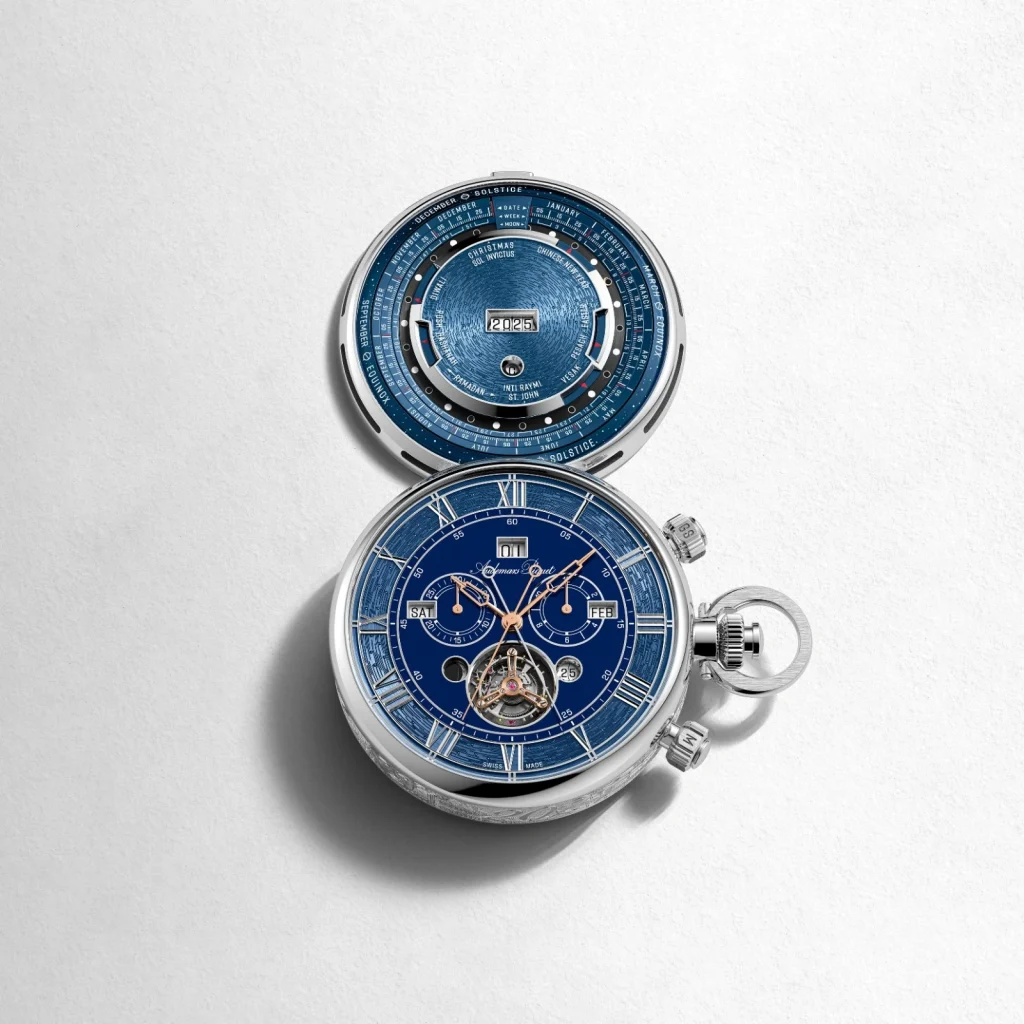
A monument to mechanical excess, this grand complication unites 47 functions, including 30 complications, with totals that may reach 60 under FH standards. Among its most formidable feats are the Grande and Petite Sonnerie, Supersonnerie with soundboard caseback, minute repeater, flying tourbillon, semi Gregorian perpetual calendar with large date and astronomical moon, universal calendar indications, flyback chronograph and split seconds. The hand engraved platinum case measures 23.4mm thick and frames glareproofed sapphire crystals, while a hand made platinum chain of approximately 40cm underscores its haute horology gravitas. The blue translucid enamel dial is adorned with 18k white gold Roman numerals against a hand engraved backdrop, tone on tone subdials, pink gold hands and a white gold split seconds hand, signed in vintage style by Audemars Piguet. A separate universal calendar dial in white gold features engraved star trails filled with blue enamel and titanium toned discs. Inside, the hand wound Calibre 1150 spans 34.3mm in diameter and 8.9mm in thickness, comprising 1,099 components and 81 jewels. Beating at 3 hertz with a minimum 60-hour reserve, it integrates advanced ergonomics from silent regulators to controlled force chronograph reset, uniting acoustic mastery, astronomical precision and mechanical resilience in one extraordinary creation.
Also Read: The Art of Spin: How Tourbillon Balances Gravity And Time
Girard-Perregaux Tourbillon With Three Flying Bridges
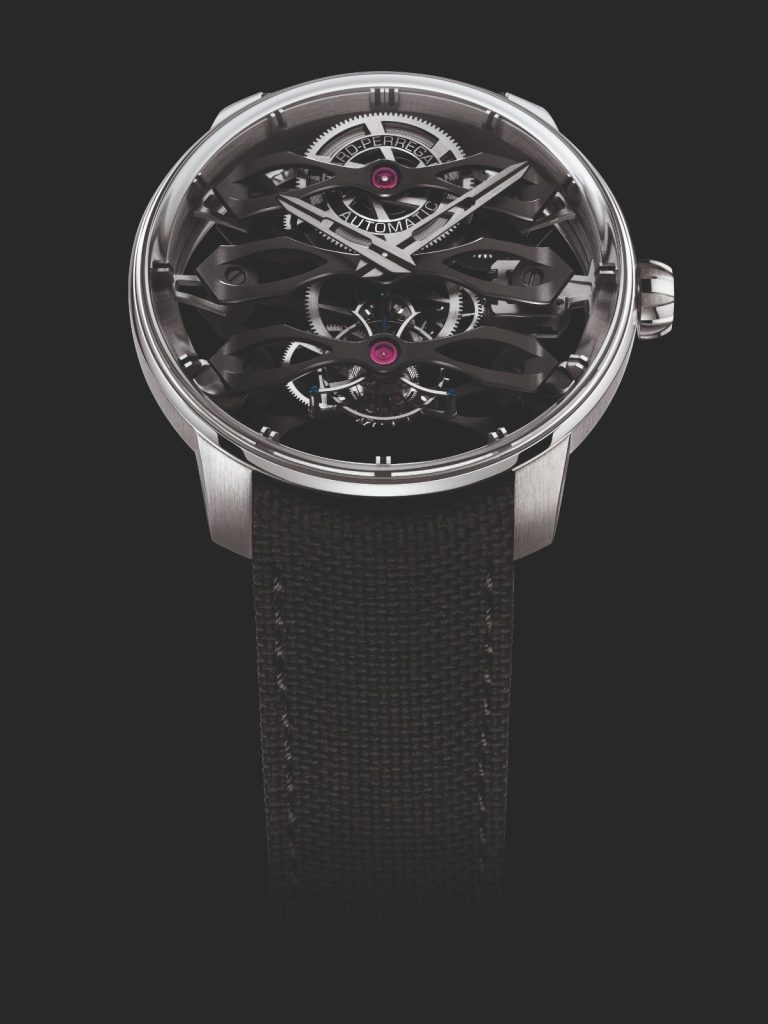
The Tourbillon with Three Flying Bridges is a study in lightness and architectural daring, housed within a 44mm case crafted from 18k white gold. Designed to celebrate transparency and space, the watch allows light to pass freely through its structure, creating a striking sense of depth and three dimensionality. Dispensing with a conventional mainplate, the three signature bridges assume both aesthetic and structural responsibility, supporting the geartrain, barrel and tourbillon while ensuring the integrity of the movement. These titanium bridges appear to float mid air, anchored by open worked gold plinths that extend from the inner case wall. With no traditional dial in place, luminescent hour markers are affixed directly to the case, preserving the airy interior while maintaining legibility. Skeletonised white gold hands, lined with luminescent material, indicate hours and minutes clearly even in low light. Unlike earlier interpretations in gold, the sinuous bridges here are rendered in lightweight titanium with a contemporary black tint, yet finished with hand executed anglage that honours classical haute horlogerie. Box sapphire crystals front and back, both gently arched, maximise illumination and symmetry. Short lugs secure a black rubber strap with a white gold triple folding clasp, while an additional grey nubuck strap offers a refined alternative.