

There are watches that impress because they are expensive. There are watches that impress because they are complicated. And then there are watches that make you stare at them for so long that you completely forget what time it is. The new Reverso Hybris Artistica Calibre 179 Pegasus belongs firmly in that final category.
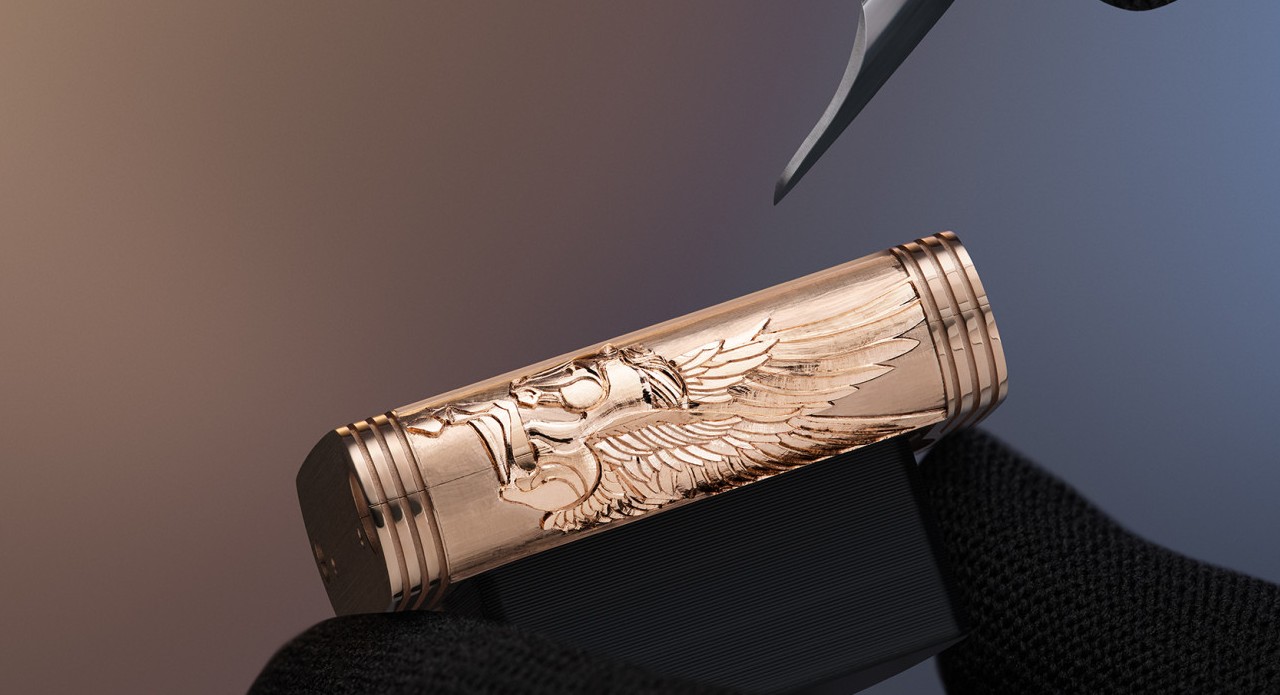
At first glance, it appears to be a beautifully executed Reverso in pink gold. Then you notice a hand-engraved Pegasus soaring through clouds across the case. Then you discover that the dial is partially open-worked and decorated with layers of hand-applied blue lacquer. Then the entire centre erupts into motion as a Gyrotourbillon spins and pirouettes through space like a miniature mechanical satellite. By this point you are no longer looking at a watch. You are looking at a declaration of intent from Jaeger-LeCoultre. One that says the rules of physics, practicality and perhaps sanity are merely suggestions.

180 Hours Of Engraving For A Mythological Masterpiece
The Reverso was originally created in 1931 for polo players who wanted to protect their watch crystals during matches. Practical. Sensible. Purposeful. This watch has taken that sensible sporting heritage and driven it directly into the clouds behind a winged horse.
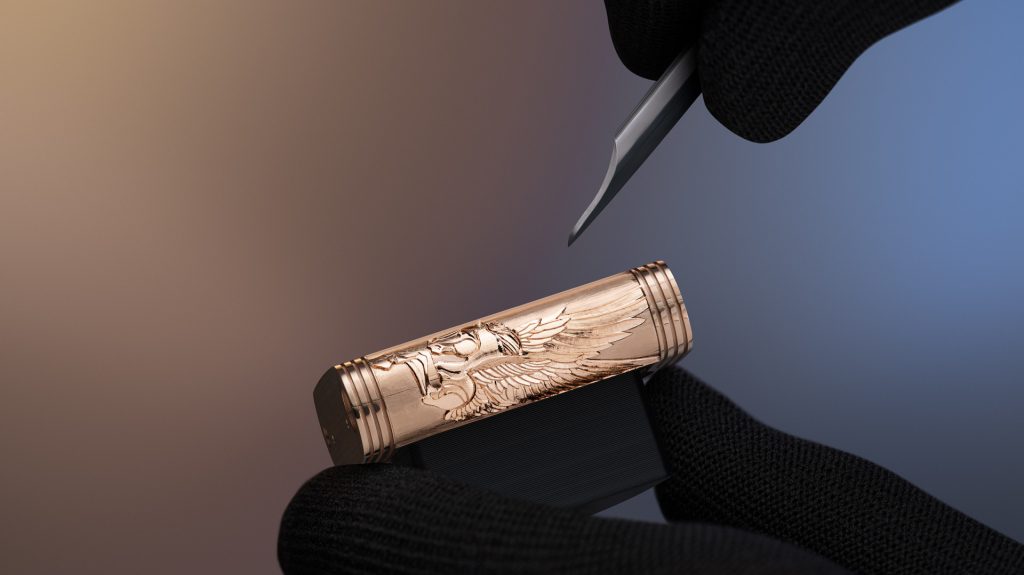
The 51.1 mm by 31 mm reversible case is crafted entirely from 18K pink gold and becomes the canvas for one of the most ambitious decorative projects ever attempted on a Reverso. Master engravers spend approximately 180 hours carving the image of Pegasus across the case, surrounding the mythical horse with sculpted clouds rendered in extraordinary relief.
The result is astonishing. Light dances across peaks and valleys of polished gold, creating shadows and depth that make Pegasus appear almost alive. Even the convex case flanks are seamlessly engraved, disguising the boundaries between different case sections and transforming the entire watch into a continuous work of art.
Also Read: Why Exhibition Casebacks Are The Pinnacle Of Luxury Watchmaking
A Dial Painted Like A Renaissance Canvas
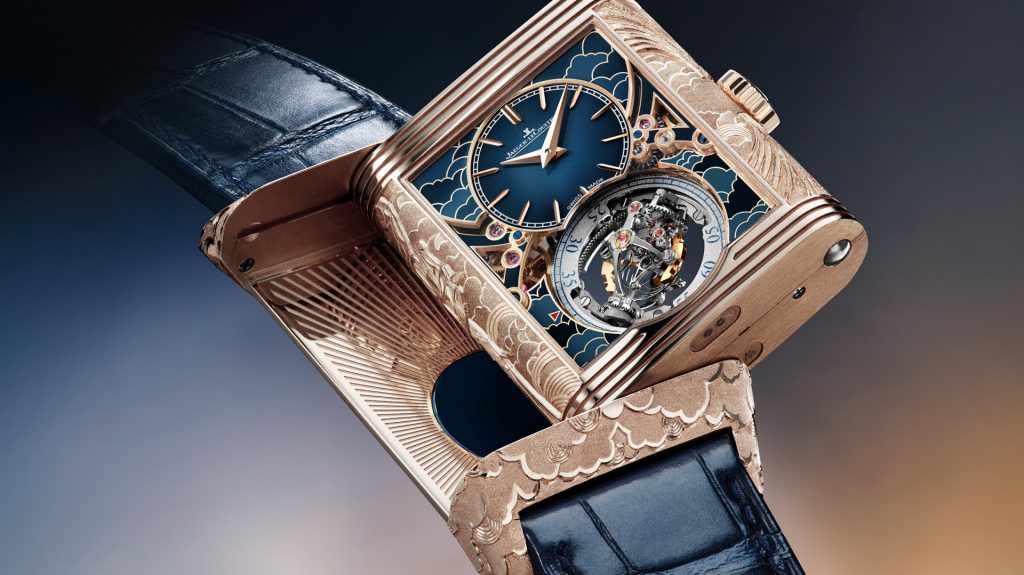
The front dial continues the celestial theme with remarkable complexity. Two separate pink gold dial plates sit at different levels, creating visual depth while framing the flying tourbillon aperture. More than fifty individual recesses are meticulously carved into the dial surface before being filled by hand with multiple layers of blue lacquer.
The process is painstaking. Each cavity receives successive applications of lacquer until perfectly flush with the surrounding gold surface. The resulting cloud motif mirrors the engraving on the case while creating a dramatic backdrop for the movement beneath.
Between these lacquered sections sit skeletonised bridges finished in dark blue lacquer, revealing glimpses of the calibre below while maintaining visual symmetry. It is decorative artistry of the highest order, yet every element remains perfectly functional.
The Reverse Side Is Even Better
Most watches hide their mechanics beneath a solid caseback. The Reverso, naturally, flips the entire concept upside down. Turn the case over and the second dial reveals itself. Here the second time zone is displayed within a fully skeletonised landscape of bridges, gears and architectural complexity. Blue lacquer accents highlight the intricate framework, contrasting beautifully against warm pink gold movement components and softly textured micro-blasted surfaces.
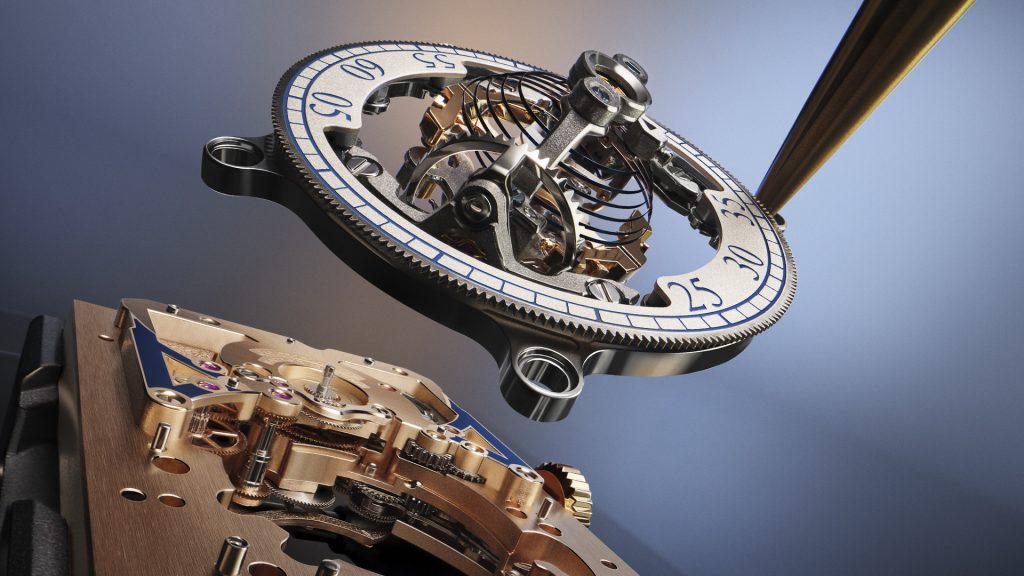
Every bridge edge has been painstakingly bevelled by hand. The Gyrotourbillon cage alone requires approximately fourteen hours of manual finishing, while individual bridge components receive further hours of attention before assembly. The result is not merely skeletonisation. It is mechanical sculpture.
Also Read: Watches and Wonders 2026: Jaeger-LeCoultre Introduces High-Complication Masterpieces for Collectors
The Flying Heart Of The Watch
At the centre of everything sits Calibre 179, one of the most technically ambitious movements Jaeger-LeCoultre has ever created. This manually wound movement powers dual time-zone displays and houses the fourth-generation Gyrotourbillon, the manufacture’s signature multi-axis regulating system. Containing 123 individual components, the mechanism rotates simultaneously on two separate axes. The inner titanium cage completes a full revolution every 16 seconds, while the outer carriage rotates once per minute. Together they create a constantly changing ballet of motion designed to improve positional accuracy while providing endless visual fascination.
A closer inspection reveals a hemispherical balance spring and Jaeger-LeCoultre’s distinctive Gyrolab balance wheel. Both components were developed to reduce air resistance and improve efficiency, proving that even at this level of artistic extravagance, serious chronometric engineering remains central to the watch. Most remarkably, the Gyrotourbillon appears suspended in mid-air. Instead of a traditional upper bridge, the mechanism is supported by hidden ball bearings, creating the illusion that it floats freely between the front and reverse dials.
Five Watches, Countless Hours
For all its complexity, the Reverso Hybris Artistica Calibre 179 Pegasus remains surprisingly wearable. The case measures just 12.41 mm thick and is paired with a dark blue alligator strap secured by an ingenious 18K pink gold folding clasp comprising 46 individual components. Its micro-adjustment system allows sizing changes in increments as small as 0.5 mm.
Only five examples will ever be produced. Which means that somewhere in the world, five collectors will own one of the most extraordinary Reversos ever created. Everyone else will simply admire it from afar and wonder how a watch originally designed for a polo field ended up carrying a flying horse, a rotating mechanical galaxy and 180 hours of engraving on its back. Quite frankly, the world is a better place because it did.