What Is a Limited Slip Differential And How Does It Work In Performance Cars?
A limited slip differential is one of the most important performance tools in a car, improving traction, stability, and cornering by controlling how power reaches the wheels
It is one of the least glamorous parts of a performance car, hidden deep underneath where nobody takes photographs of it. Yet the limited slip differential is often the reason a powerful machine can actually use its power properly. Without it, speed is simply noise and wheelspin.
There are certain parts of a car people love to talk about. Horsepower, naturally. Turbochargers, obviously. Carbon fibre, because it sounds expensive. And then there is the differential, a mechanical component so gloriously unglamorous that most people would rather discuss windscreen wipers. But here is the thing: if horsepower is the headline, the differential is the editor making sure the story makes sense. Without it, all that power becomes little more than smoke, noise, and a very embarrassed driver wondering why his expensive performance car is behaving like a shopping trolley on ice.
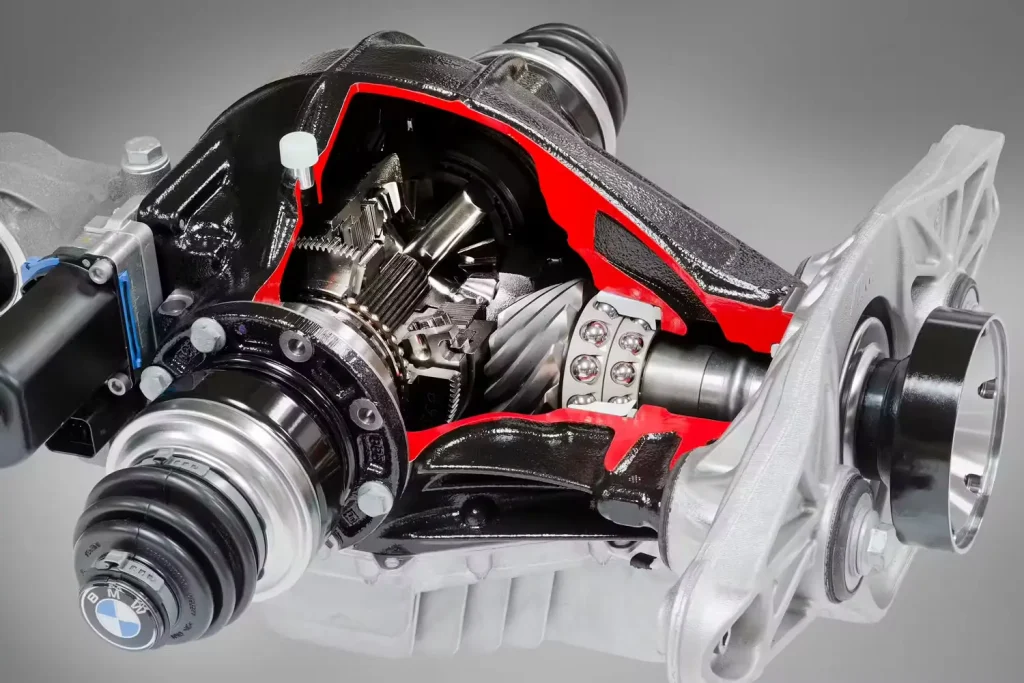
A differential, in its simplest form, allows the wheels on the same axle to rotate at different speeds. That matters because when a car turns, the outside wheel travels a longer distance than the inside wheel. If both wheels were forced to spin at exactly the same speed, the car would fight itself through every corner like a stubborn mule. So the differential exists to let the car turn smoothly, elegantly, and without shredding its tyres in protest.
Also Read: How Certain Engines Cross 300,000 Kms Without Major Repairs
Now, a standard open differential is perfectly fine if you are driving to the supermarket. But the moment power enters the conversation, things become rather silly. An open differential sends power to the wheel with the least resistance. Which means if one wheel loses grip, perhaps on gravel, rain, or during an enthusiastic corner exit, all the power rushes to that slipping wheel. The result is dramatic wheelspin and absolutely no useful forward motion. Brilliant for Instagram reels, terrible for actually going anywhere.
This is where the limited slip differential, or LSD, arrives like the competent adult in the room. Its job is simple but vital: it limits the amount of speed difference between the driven wheels and ensures power is sent to the wheel that actually has grip. Instead of allowing one tyre to perform a pointless burnout while the other politely watches, it distributes torque intelligently, giving the car traction, balance, and the ability to put power down properly.
The way it does this depends on the type of LSD involved. Some use clutch packs that engage when wheel speed differences become too large. Others use gears, helical systems, or electronically controlled mechanisms that react with almost irritating efficiency. Regardless of the method, the principle remains the same: stop wasting power and start using it.
This transforms the way a performance car behaves. Out of a corner, instead of one wheel spinning helplessly, both tyres work together to launch the car forward. Under hard acceleration, traction improves dramatically. In slippery conditions, stability becomes far more predictable. And during spirited driving, the rear of the car feels less like a nervous argument and more like a well-rehearsed orchestra.
It also changes confidence. Drivers may talk endlessly about bravery, but confidence is often mechanical. Knowing the car will hook up properly when you apply throttle means you drive better.

Faster, yes, but also cleaner. The limited slip differential does not just improve performance, it improves trust. And then we arrive at something delightfully excessive: the Mercedes-AMG G63 6×6. This is not so much a car as a declaration of war against subtlety. Six wheels, portal axles, absurd ground clearance, and enough road presence to make small buildings nervous. But beneath the theatre lies serious engineering, and the limited slip differential plays a starring role.
Also Read: Why EV Hypercars Accelerate So Fast Compared To Petrol Supercars
Because with six driven wheels, traction management becomes a very serious business. The G63 6×6 uses multiple locking differentials and advanced differential control systems to ensure torque reaches the wheels with grip, whether it is crossing sand dunes, climbing rocks, or simply terrifying valet parking attendants. In terrain where one or two wheels may be hanging in the air doing absolutely nothing useful, the differential system keeps power moving to the wheels that matter. Without it, the 6×6 would be a six-wheeled monument to disappointment.
This is why serious off-roaders and serious performance cars both rely on the same principle.
Grip is everything. Power without traction is just expensive theatre. A limited slip differential turns brute force into usable performance.
It is also why racing engineers obsess over it. They will spend hours adjusting preload, lock-up percentages, and torque bias because they understand something most casual drivers do not: the way power reaches the ground matters more than the number printed in the brochure. A perfectly tuned differential can make a car feel alive.

So yes, a limited slip differential sounds about as exciting as tax paperwork. It does not sparkle, it does not roar, and nobody buys posters of one for their bedroom wall. But it is one of the cleverest, most important components in performance engineering.
Because speed is not about how much power you have. It is about how much of it you can actually use. And that, hidden quietly beneath the car, is where the real magic lives.